







- Spain's labor framework includes more than 5,000 collective bargaining agreements and regional tax variations across 17 autonomous communities, so selecting an EOR with documented Spain-specific compliance expertise reduces legal exposure significantly.
- Setting up a Spanish legal entity typically takes 6 to 12 months and costs between roughly $17,000 and $46,000, while an EOR can onboard employees within days using its existing registered entity.
- EOR providers that own a wholly-owned Spanish legal entity carry direct control over contracts, payroll filings, and compliance decisions, whereas partner-model providers introduce a third party into that chain, which can affect accountability and response times.
- Spain's 2022 labor reform tightened restrictions on temporary contracts, making correct contract classification at the point of hire a higher-stakes compliance decision than it was before the reform.
- Terminating employment in Spain carries different severance obligations depending on dismissal type, with an unfair dismissal requiring compensation of 33 days of salary per year of service capped at 24 monthly payments, making offboarding support a material part of EOR value.
Spain offers companies access to a highly educated, multilingual workforce and direct entry into the EU market. Demand for skilled professionals in technology, finance, and professional services continues to grow, making Spain a practical hiring destination for international teams in 2026.
This page compares eight best employer of record providers operating in Spain. For each provider, it covers key services, pricing where publicly available, and the factors that distinguish one from another.
Providers were evaluated on three criteria: depth of compliance coverage under Spanish labor law, pricing transparency, and demonstrated expertise in Spain-specific employment requirements including collective bargaining agreements and regional labor variations.
Our Top 8 Picks: Spain for EOR Comparison 2026
The eight providers below cover a range of use cases, from early-stage startups entering Spain for the first time to enterprises managing large, distributed Spanish teams. Each was assessed on pricing, coverage, speed, platform quality, support, and scalability.
| Provider | Pricing per month | Country coverage | Onboarding speed | Platform experience | Customer support | Scalability |
|---|---|---|---|---|---|---|
| Gloroots | From $199/employee/month | 150+ countries | 3–5 working days | User-friendly centralized dashboard with payroll, compliance, onboarding, and workforce visibility | 24/7 human support with dedicated specialists | SMB to enterprise; supports companies scaling across 150+ countries |
| RemoFirst | From $199/employee/month | 185+ countries | 1–5 business days | Centralized EOR platform covering payroll, compliance, benefits, contracts, onboarding, and workforce management | 24/7 support with dedicated account managers | Startups to enterprise; designed for cost-efficient global workforce expansion |
| Deel | $599/employee/month for EOR | 130+ EOR countries; 150+ countries for broader global hiring | Automated onboarding; no fixed universal timeline publicly listed | Modern, self-serve global workforce platform covering EOR, contractors, payroll, HR, benefits, compliance, visas, and integrations | 24/7 customer support with HR, legal, and tax expertise | SMB to enterprise; supports geographically distributed teams at scale |
| Oyster HR | $699/employee/month | 120+ EOR countries; 180+ countries for broader global talent engagement | As fast as 48 hours in supported workflows; country-dependent | Remote-first platform covering hiring, onboarding, payroll, benefits, expenses, time off, and compliance | Local HR specialists and dedicated support resources | Startups to enterprise; suited to remote and distributed international teams |
| Payoneer Workforce Management | From $199/employee/month | 160+ countries | 1–2 weeks | Unified platform covering onboarding, employment contracts, payroll, compliance, benefits, payments, and workforce management | 24×5 dedicated account managers and localized support | SMB to enterprise; designed to scale global hiring across 160+ countries |
| Mercans | Custom pricing / quote-based | 160+ countries | Not publicly listed as a fixed universal timeframe | Integrated EOR, payroll, HR, immigration, and compliance platform with global workforce administration | Dedicated account management and local HR/payroll specialists | SMB to enterprise; supports multinational workforce and payroll operations |
| Remote | $699/employee/month monthly; $599/month with annual billing | 90+ EOR countries | Onboarding with a dedicated specialist; no fixed universal timeline publicly listed | Digital-first EOR platform covering payroll, benefits, compliance, contractors, and workforce management | 24/7 specialist support with local HR, legal, and finance expertise | SMB to enterprise; suited to distributed teams scaling internationally |
| Globalization Partners (G-P) | Custom pricing / contact sales | 180+ countries | Not publicly listed as a fixed universal timeframe | G-P Global Employment Platform (Meridian) covering hiring, onboarding, payroll, compliance, and workforce management | 24/7 support with in-country experts and customer-success resources | Mid-market to enterprise; designed for complex multinational workforce operations |

Top 8 Best EOR Platforms in Spain for
These eight providers were selected based on their ability to support compliant employment in Spain without requiring a local entity. Key selection factors included entity ownership model, depth of Spain-specific compliance coverage, payroll accuracy, and pricing transparency.
Providers with wholly-owned Spanish entities received stronger consideration, as did those with documented expertise in Workers' Statute requirements, collective bargaining agreement mapping, and regional labor law variations across Spain's autonomous communities. Pricing structure and cost visibility before onboarding were also weighted in the evaluation.
Gloroots
Gloroots runs compliant full-time employment across 150+ countries, including Spain, through its Global Employer of Record service. The platform combines Global Payroll, Compliance and Employment Governance, and Benefits and Statutory Coverage into a single employment operating layer.
Gloroots uses predictable, country-specific pricing with full cost visibility before onboarding. Pricing does not use a percentage-of-salary model. Centralized workforce visibility and human-led account support with retained business context are included across all engagements.
Strengths:
-
Predictable, country-specific pricing with full cost transparency before onboarding and no percentage-of-salary fees, reducing budget uncertainty for finance teams.
-
Centralized workforce visibility paired with human-led account support that retains business context across the employment lifecycle.
-
Global EOR coverage across 150+ countries supported by Compliance and Employment Governance and Benefits and Statutory Coverage as integrated service components.
Limitations:
Gloroots operates through a wholly-owned Spanish legal entity.
Best for:
Companies scaling international headcount that require predictable pricing, centralized governance, and human-led employment support across multiple countries including Spain.


RemoFirst
RemoFirst provides EOR services in Spain starting at $199 per employee per month, covering payroll, employment contracts, and statutory benefits. The platform targets startups and mid-market companies that need fast onboarding across a broad global footprint.
RemoFirst operates across 180+ countries, giving companies a single vendor for multi-country hiring. In Spain, the service covers social security contributions, income tax withholding, and employment contract management in line with the Workers' Statute.
Strengths:
-
Published starting price of $199 per employee per month gives buyers a clear cost baseline before committing.
-
Global coverage across 180+ countries supports companies hiring in Spain alongside other markets simultaneously.
-
Fast onboarding timeline of one to three days suits startups moving quickly into the Spanish market.
Limitations:
-
RemoFirst employs in Spain via trusted local partner entities, not a wholly-owned subsidiary.
-
RemoFirst applies GDPR-compliant data handling and EU data-protection requirements to its services in Spain, though LOPDGDD-specific compliance is not independently confirmed.
Best for: Startups and early-stage companies that want a low entry price and broad country coverage without requiring deep Spain-specific compliance specialization.
Deel
Deel employs workers in Spain through a wholly-owned Spanish subsidiary, which means employment contracts and payroll run under a locally registered legal entity rather than a third-party partner. This structure reduces compliance risk for companies hiring in a jurisdiction with strict labor protections.
Deel covers 150+ countries and publishes an eight-step hiring checklist for Spain, giving buyers a structured process before they commit. The platform carries a G2 rating of 4.8 out of 5, based on user reviews collected on that platform.
Strengths:
-
Wholly-owned Spanish subsidiary provides direct legal employment rather than a partner-entity arrangement, which reduces intermediary compliance risk.
-
G2 rating of 4.8 out of 5 reflects consistent user satisfaction across a large review base on that platform.
-
Published eight-step hiring checklist for Spain gives procurement teams a concrete framework for evaluating the onboarding process.
Limitations:
-
Deel's Spain EOR service covers data protection under Spanish law, including the LOPDGDD, which complements GDPR. Deel's data-protection materials commit to applicable national data-protection laws.
-
Deel lists optional supplementary benefits for Spain such as private healthcare (Unisure, Alan, Allianz), flexible remuneration including meal allowance and flexible spending, global life insurance (Allianz), and pension insurance via Cobee.
Best for: Mid-market and enterprise companies that want a wholly-owned entity structure in Spain and a high-rated platform with broad multi-country coverage.
Payoneer
Payoneer offers global payment and workforce solutions across multiple markets. Its EOR offering in Spain covers employment contracts, payroll processing, and statutory compliance for companies hiring without a local entity.
Strengths:
-
Payoneer’s group includes Boundless Payroll Spain, S.L., indicating a Spanish subsidiary presence supporting its workforce management services.
-
Payoneer Workforce Management’s Contractor Management System starts at $19 per contractor per month.
Limitations:
-
Public sources reviewed did not document a provider-specific limitation.
Best for: Best for companies that need to hire in Spain without setting up a local entity, with onboarding typically completed in 3–5 business days.
Mercans
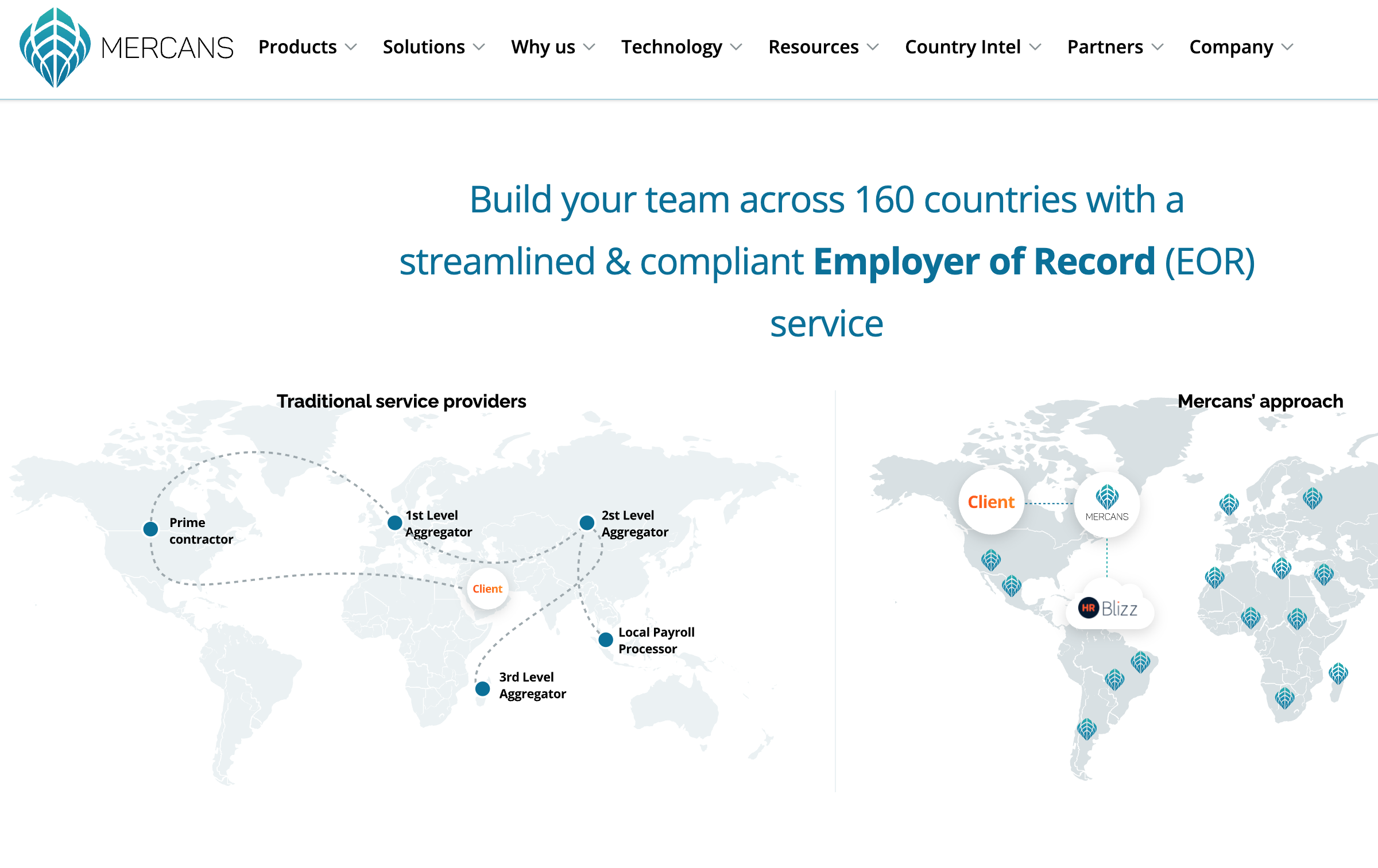
Mercans provides global payroll and EOR services across multiple countries, including Spain. The platform targets mid-market and enterprise clients that require dedicated account support and structured compliance management.
Strengths:
-
Mercans operates in Spain through its own established local entity, providing the framework to manage employment, payroll, and administration.
-
Mercans lists supplementary employee benefits in Spain, including a Total and Permanent Disability benefit often linked to annual salary.
Limitations:
-
Public sources reviewed did not document a provider-specific limitation.
Best for: Best for employers that prefer a Spain EOR operating through its own local entity to manage hiring, payroll, and compliance.
Oyster
Oyster HR is a global employment platform that supports hiring in Spain and other countries through an employer of record model. The platform targets distributed teams and remote-first companies seeking entity-free employment across multiple regions.
Strengths:
-
Oyster provides expert guidance on Spanish regulations and compliant onboarding, and handles Spain payroll with timely payments, accurate tax withholding, and benefits management for Spanish employees.
Limitations:
-
Oyster’s EOR pricing uses an annual, seat-based billing model, with semi-annual or quarterly terms offered at a higher per-seat price.
Best for: Best for teams that want automated, guided hiring in Spain, since Oyster’s automated Global Hiring features are available for Spain.
Remote
Remote operates a wholly-owned legal entity in Spain, which means employment contracts and payroll run through Remote's own registered structure rather than a third-party partner. This entity ownership model reduces the intermediary risk that aggregator-model providers carry.
Remote publicly lists pricing for both employer of record and contractor management services, giving finance teams a clear cost baseline before committing to a hire. The platform covers Spain's income tax withholding requirements and social security contributions, and it supports compliance with Spain's data protection obligations under the Ley Orgánica de Protección de Datos y Garantía de los Derechos Digitales (Spain's data protection and digital rights law, which aligns with GDPR).
Strengths:
-
Wholly-owned Spanish legal entity supports direct employment without a third-party intermediary, reducing structural compliance risk.
-
Publicly listed contractor management pricing gives teams cost visibility before onboarding contractors alongside full-time employees.
Limitations:
-
Customer support operates during business hours rather than around the clock, which may create response delays for teams in significantly different time zones compared to providers offering 24/7 coverage.
Best for: Mid-market to enterprise companies hiring in Spain that prioritize entity ownership transparency and want publicly listed pricing for both employees and contractors.
Globalization Partners
Globalization Partners is an enterprise-focused EOR provider with global coverage and a dedicated account management model. Its platform targets larger organizations that require structured onboarding and compliance support across multiple countries.
Strengths:
-
G-P enabled Trent Limited to hire employees in Spain in 10 days without setting up a local entity, acting as legal employer to manage compliant contracts, payroll, benefits, and labor-law obligations.
Limitations:
-
Public sources reviewed did not document a provider-specific limitation.
Best for: Best for companies that need to hire in Spain in under two weeks without setting up a local entity, as shown in G‑P’s Trent Limited case (Spain hire completed in 10 days).
What Are the Key Services of an EOR in Spain for?
An EOR in Spain manages the full employment relationship on behalf of a foreign company, covering payroll, tax filings, statutory benefits, and contract administration. This matters because Spain's regulatory environment is unusually layered.
The Workers' Statute sets baseline employment rules, but more than 5,000 collective bargaining agreements apply across industries and regions, and each of Spain's 17 autonomous communities adds its own labor variations. An EOR tracks and applies the correct rules for each employee's location and sector.
Data compliance is also part of the EOR's scope in Spain. The country enforces both the EU General Data Protection Regulation and Spain's own Organic Law on Data Protection and Digital Rights, which means employee data must be handled under specific local standards. A qualified EOR manages these obligations alongside payroll and employment governance.
Employment Contracts and Local Compliance
Spain's 2022 labor reform significantly restricted the use of temporary contracts. Employers can now only use fixed-term contracts for specific, justified circumstances, and repeated or unjustified temporary arrangements are treated as indefinite employment by default.
Every employment contract must reference the applicable collective bargaining agreement (CBA) governing the role. Spain has over 5,000 industry and regional CBAs, each setting minimum wages, working conditions, and entitlements that override the statutory floor where more favorable to the employee.
Contracts must be written in Spanish. Where employees work in bilingual autonomous communities such as Catalonia or the Basque Country, bilingual documentation is standard practice. An EOR manages contract drafting, CBA mapping, and ongoing compliance as agreements are updated.
Payroll and Tax Administration
All payroll in Spain is processed in euros. Employers withhold income tax (IRPF) at progressive rates ranging from 19% to 47%, calculated based on each employee's personal circumstances and annual earnings.
Spain's tax system includes notable regional variations. The Basque Country operates under the Concierto Economico (Economic Agreement), and Navarre operates under the Convenio Economico (Economic Covenant). Both regions administer their own tax collection independently from the central Spanish Tax Agency (AEAT), which affects how payroll tax obligations are calculated and remitted for employees based there.
An EOR tracks each employee's region of residence, applies the correct tax regime, and submits monthly and quarterly filings to the relevant authority. This removes the administrative burden of managing multiple tax jurisdictions across Spain's autonomous communities.
Benefits Administration
Spanish collective bargaining agreements frequently mandate benefits above statutory minimums. An EOR tracks these CBA obligations and applies them correctly for each employee's sector and region.
Statutory entitlements include 30 calendar days of paid vacation, 14 public holidays, sick leave, and 16 weeks of maternity and paternity leave. Many CBAs add supplementary entitlements on top of these floors.
EOR providers may also administer optional benefits, including:
-
Private health insurance, which is common in technology and financial services sectors
Meal vouchers and transport allowances
-
Flexible remuneration plans under Spain's personal income tax law (Ley 35/2006), which allow employees to receive part of their salary in tax-efficient non-cash benefits
Gloroots covers statutory benefits and CBA-mandated entitlements as part of its Benefits and Statutory Coverage service, with full cost visibility before onboarding begins.
Employee Onboarding
Onboarding a new employee in Spain involves several regulated steps. The EOR executes the employment contract, registers the employee with the General Treasury of Social Security (TGSS), and verifies the employee's tax identification number (NIE for foreign nationals, NIF for Spanish residents).
For foreign employees, NIE verification is a prerequisite before payroll can run. Delays in NIE processing can extend the onboarding timeline, so EOR providers typically confirm document status before scheduling the first payroll cycle.
The full onboarding sequence generally covers:
-
Employment contract execution, drafted to comply with the Workers' Statute and the applicable collective bargaining agreement
-
Social security registration with TGSS, which must be completed before the employee's first working day
NIE or NIF verification for tax withholding and payroll setup
-
First payroll cycle configuration, including IRPF withholding rate calculation
Depending on the provider and document readiness, onboarding takes between one and five days. Gloroots targets a two-to-five-day timeline, with human-led account support managing each step and retaining context across the employment lifecycle.
Ongoing HR Support
An EOR in Spain does not stop at onboarding. Ongoing HR support covers the full employment lifecycle, including data protection compliance under Spain's Organic Law on Data Protection (LOPDGDD) and the EU General Data Protection Regulation (GDPR).
This includes maintaining data processing agreements, ensuring employee data residency requirements are met, and managing breach notification obligations. These are standing legal duties, not one-time setup tasks.
Collective bargaining agreements are renegotiated periodically across Spain's 5,000-plus industry and regional agreements. A qualified EOR tracks those updates and adjusts employment terms accordingly. When labor disputes arise, EOR providers also offer advisory support for proceedings before Spain's labor courts (social jurisdiction courts), helping employers understand their exposure before a case escalates.
Employee Offboarding
Terminating employment in Spain requires careful classification of the dismissal type, because each carries different legal and financial consequences.
A fair dismissal (procedente dismissal) occurs when the employer has documented, legally valid grounds. Severance in this case is 20 days of salary per year of service, capped at 12 monthly payments. An objective dismissal applies to economic, technical, organizational, or production reasons and carries a severance rate of 20 days per year of service, up to a maximum of 12 months.
An unfair dismissal (improcedente dismissal) is the most costly outcome. The employer must either reinstate the employee or pay enhanced compensation of 33 days per year of service, capped at 24 monthly payments. A qualified EOR manages the procedural requirements for each dismissal type and tracks documentation to reduce exposure to adverse rulings from Spain's labor courts.
How to Hire Through an EOR in Spain for
Hiring through an EOR in Spain follows a structured process covered in the steps below. The process applies to both EU and non-EU employee scenarios, so companies can build Spanish teams regardless of where their workers hold citizenship.
Setting up a Spanish legal entity typically takes 6 to 12 months. An EOR removes that requirement entirely, allowing companies to employ workers in Spain within days rather than waiting through entity registration, tax enrollment, and social security setup.
The sections below cover provider selection, contract setup, onboarding, and ongoing payroll management. Each step is designed to give hiring teams a clear sequence to follow from first contact with an EOR through to a fully employed Spanish worker on payroll.
Selection and Setup
Choosing the right EOR for Spain requires verifying several compliance and operational factors before signing a contract. Work through the following checklist in order.
-
Confirm the EOR holds or partners with a registered Spanish legal entity. Without a local entity, the provider cannot legally employ workers in Spain.
-
Verify the EOR can map employment contracts to the correct collective bargaining agreement for your industry and region. Spain has more than 5,000 industry and regional agreements, and misclassification creates legal exposure.
-
Request an itemized cost quote covering payroll processing, social security contributions, tax filings, and any advisory fees. Gloroots uses predictable, country-specific pricing with full cost visibility before onboarding and no percentage-of-salary pricing.
-
Review the data processing agreement for compliance with Spain's data protection law. Confirm the EOR's data handling practices meet the requirements of that framework.
-
Check independent review platforms such as G2 or Trustpilot for verified client feedback on Spanish payroll accuracy and support responsiveness.
On entity ownership, distinguish between EORs that own their Spanish entity outright and those that operate through a local partner. A wholly-owned entity gives the provider direct control over employment contracts, payroll filings, and compliance decisions. A partner model introduces a third party into that chain, which can affect response times and accountability. Ask the provider directly which model applies to Spain before proceeding.
Onboarding and Compliance
Onboarding an employee in Spain through an EOR follows a defined sequence. The process begins with contract execution that references the applicable collective bargaining agreement for the employee's industry and region.
Before the employee's first day, the EOR registers the worker with the General Treasury of Social Security (TGSS). For foreign employees, the EOR verifies the NIE or NIF identification number as a prerequisite to payroll setup.
Income tax withholding (IRPF) is configured based on the employee's personal circumstances and applicable tax bracket. A data processing agreement under Spain's data protection law (LOPDGDD) is also signed as part of the onboarding documentation.
-
Contract execution referencing the applicable collective bargaining agreement
-
Social Security registration with TGSS before the first working day
NIE or NIF verification for foreign nationals
IRPF withholding configuration
LOPDGDD data processing agreement signature
For straightforward cases, the total timeline from signed agreement to first payroll run is typically one to five business days.
What Are the Benefits of Using an EOR in Spain for?
Using an EOR in Spain produces measurable advantages across four areas: speed to hire, labor law compliance, cost control, and workforce flexibility.
On speed, an EOR removes the need to register a legal entity before hiring. Setting up a Spanish limited company (Sociedad Limitada) or public company (Sociedad Anonima) typically takes six to twelve months and costs between $17,423 (15,000 and 40,000 euros). An EOR reduces that timeline to days.
On compliance, Spain's Workers' Statute, 5,000-plus collective bargaining agreements, and regional labor variations across 17 autonomous communities create significant legal exposure for employers without local expertise. An EOR carries that compliance responsibility directly.
Cost savings extend beyond entity setup. Employers avoid maintaining in-house Spanish payroll, tax filing, and labor relations functions. The sub-sections below compare EOR costs against entity setup in detail, including how employer of record cost structures differ by provider and model.
Workforce flexibility is the fourth benefit. An EOR supports both short-term project hires and long-term employment without requiring separate legal infrastructure for each arrangement.
Faster Market Entry
Setting up a legal entity in Spain takes time and money. Registering a Sociedad Limitada requires notary fees, Registro Mercantil registration, AEAT registration, and a minimum share capital of $3,485 (€3,000). Total setup costs typically range from $17,423 (€15,000) to $46,460 (€40,000), with a timeline of six to twelve months before you can legally employ anyone.
An EOR removes that requirement entirely. You hire through the EOR's existing Spanish legal entity and can onboard employees within two to five days.
For companies testing the Spanish market or moving quickly on a hiring opportunity, this difference is material. The capital and time saved can be redirected toward the actual work of building a local team.
Reduced Compliance Risk
Spain's labor framework creates real liability for companies that get classification wrong. Misclassifying an employee as an independent contractor can trigger back-payment of all unpaid social security contributions, plus fines from the labor inspectorate.
The 2022 labor reform tightened rules on temporary contracts, making it harder to justify short-term arrangements and increasing scrutiny on contract type at the point of hire. Companies that relied on successive temporary contracts before the reform faced significant exposure after it passed.
Data handling adds another layer of risk. Spain's Organic Law on Data Protection and Digital Rights (LOPDGDD) governs how employee personal data must be stored, processed, and transferred. Violations carry penalties under both Spanish law and the EU General Data Protection Regulation.
An EOR carries the employment relationship and the associated compliance obligations. That includes correct contract classification, social security filings, and data governance aligned with LOPDGDD requirements, reducing the direct exposure for the hiring company.
Simplified Payroll Administration
Spain's payroll obligations extend beyond standard salary processing. Two autonomous communities, the Basque Country and Navarre, operate under separate foral tax regimes with their own income tax rules, rates, and filing authorities, distinct from the national Agencia Tributaria framework.
An EOR manages these regional differences directly. It handles monthly income tax withholding submissions to the relevant authority, files Model 111 returns each quarter, and submits the annual Model 190 declaration covering all employee withholdings for the year.
Companies avoid building in-house expertise across multiple tax jurisdictions. Payroll runs on time, filings go to the correct authority, and records stay audit-ready without additional overhead on the employer's side.
Access to Local Benefits
Spanish law sets a clear statutory floor for employee benefits. Workers receive a minimum of 30 calendar days of paid vacation per year, 14 public holidays, and 16 weeks of maternity or paternity leave each. Sick leave is covered through the social security system, with the Spanish Social Security Treasury funding payments after the initial waiting period.
Collective bargaining agreements frequently set entitlements above this floor. An EOR identifies the applicable agreement for each role and applies the correct terms from day one.
Beyond statutory requirements, EOR providers can administer supplementary benefits including private health insurance, meal vouchers, and flexible remuneration arrangements permitted under Spanish income tax law. These additions support competitive compensation packages without requiring the employer to manage local benefit contracts directly.
Lower Entity Setup Costs
Setting up a legal entity in Spain carries significant upfront costs. Notary fees typically run $581 (€500) to $1,742 (€1,500). Registration with the Mercantile Registry adds $348 (€300) to $697 (€600). Tax agency registration with the Spanish Tax Authority (AEAT) requires additional filings. Legal and administrative advisory fees commonly reach $2,323 (€2,000) to $5,808 (€5,000). A private limited company (Sociedad Limitada) also requires a minimum share capital of $3,485 (€3,000).
Ongoing compliance costs, including annual filings, local accounting, and labor law advisory, add further expense each year. An EOR monthly fee of $755 (€650) to $1,510 (€1,300) per employee covers payroll, social security, tax filings, and compliance without those setup costs. For companies hiring one to three employees, the annualized EOR cost is typically lower than entity setup and maintenance combined. Learn more about employer of record cost before committing to a structure.
More Flexible Workforce Scaling
Spanish labor law imposes collective redundancy procedures, known as Expediente de Regulación de Empleo (ERE), on companies with five or more employees. These procedures require regulatory approval, consultation periods, and can delay workforce reductions by weeks or months. An EOR absorbs the legal employer role, which means companies can scale headcount up or down without triggering ERE obligations directly.
Spain's Digital Nomad Visa creates an additional use case. International remote workers relocating to Spain under this visa can be employed through an EOR from day one, without the hiring company needing a local entity. This makes EOR a practical option for companies that want to support internationally mobile talent entering the Spanish market. For companies building distributed teams, EOR services provide a structured path to compliant employment at any headcount level.

How to Find the Right EOR for Spain for
Choosing an EOR for Spain requires more than comparing monthly fees. The right provider must hold a wholly-owned Spanish legal entity rather than routing employment through a local partner. That distinction determines who carries legal liability and how quickly compliance issues get resolved.
Beyond entity structure, five criteria separate reliable providers from risky ones: local compliance expertise, service scope, support quality, platform capability, and the ability to scale across Spain's 17 autonomous communities. Each criterion is covered below.
Local Compliance Expertise
Confirm whether the provider operates through a wholly-owned Spanish legal entity or relies on a third-party partner. A wholly-owned entity means the provider directly employs your workers under Spanish law and carries full employer liability. A partner model adds a layer of risk and can slow resolution of compliance disputes.
Spain's employment rules vary significantly across its 17 autonomous communities. The Basque Country and Navarre operate under distinct foral tax and labor regimes that require specific payroll and contract handling. A provider without documented coverage of these regions cannot reliably employ workers there.
Data compliance is a separate requirement. Spain enforces the Organic Law on Data Protection and Digital Rights alongside the EU General Data Protection Regulation. Verify that the provider has documented processes for both before signing any agreement.
Clear Service Scope
A clear service scope prevents billing surprises and compliance gaps. Before signing with any EOR in Spain, confirm exactly which services are included in the base fee and which cost extra.
Contractor management is a common gap. Some providers include it in their standard EOR contract; others price it separately or require a distinct contractor management module. Confirm this in writing before onboarding.
Supplementary benefits such as private health insurance and meal vouchers are not statutory requirements in Spain, but they are common in competitive hiring markets. Check whether the provider arranges these directly or whether you must source a third-party benefits broker.
-
Digital Nomad Visa advisory: Spain's Digital Nomad Visa creates a distinct employment pathway. Confirm whether the provider includes advisory support for this visa category or treats it as an out-of-scope service.
-
Data processing agreement: Spain's data protection framework requires a formal data processing agreement aligned with local rules. Confirm this document is included in the service contract, not offered as an optional add-on.
Gloroots uses predictable, country-specific pricing with full cost visibility before onboarding. Its single-invoice billing covers payroll, social security filings, and compliance, with no hidden charges for advisory services.
Support Model
Support quality matters most when something goes wrong. A payroll error, a disputed termination, or a labor court filing in Spain requires fast, knowledgeable help, not a generic ticket queue.
Check whether the provider offers 24/7 support or operates on standard business hours. For companies hiring across time zones, business-hours-only support can create real delays during payroll runs or employee disputes.
Spanish-speaking support is a practical requirement, not a preference. Employment contracts, collective bargaining agreement queries, and regional labor authority correspondence are conducted in Spanish. Confirm the provider has native-language capability on its support team.
-
Dedicated account manager: Verify whether a named account manager with Spain-specific knowledge is assigned to your account, or whether support is handled by a rotating team without country context.
-
Labor court escalation path: Spain's labor court system (jurisdiccion social) handles unfair dismissal claims and employment disputes. Confirm the provider has a defined escalation path for these situations, including access to local legal counsel.
Gloroots provides centralized workforce visibility and human-led account support with retained business context. Its support model includes 24/7 availability and account managers who carry ongoing knowledge of each client's workforce and compliance position.
Technology and Reporting
A reliable EOR platform for Spain must provide real-time confirmation of Social Security Treasury (TGSS) contribution submissions and current filing status with the Spanish Tax Agency (AEAT).
Audit-ready payroll documentation in both Spanish and English is a practical requirement for multinational teams managing cross-border compliance reviews.
Collective bargaining agreement compliance alerts matter when sector or regional agreements are renegotiated. Platforms that track CBA changes and flag affected employees reduce manual monitoring work for HR teams.
Data storage and access controls must comply with Spain's Organic Law on Data Protection and Digital Rights Guarantees (LOPDGDD). Confirm that the provider documents its data residency, access logging, and retention policies before signing.
Scalability for Your Hiring Plans
Spain has 17 autonomous communities, each with distinct regional labor regulations, public holidays, and collective agreements. A capable EOR covers all of them without requiring you to establish additional legal entities per region.
If your workforce includes both full-time employees and independent contractors, confirm whether the provider supports both engagement types on a single platform. Managing a hybrid workforce through separate tools adds administrative overhead and increases compliance risk.
Check whether the provider publishes minimum and maximum employee count thresholds for Spain. Some platforms are structured for startup-scale teams, while others are built to support enterprise headcount. Matching provider capacity to your hiring plan avoids operational friction as your Spanish team grows.

Why Gloroots Is a Strong EOR Partner in Spain for
Gloroots supports compliant full-time employment across 150+ countries, including Spain. Companies use Gloroots to employ workers in Spain without setting up a local entity, while keeping full visibility over payroll, filings, and workforce data.
Gloroots combines four service pillars: Global Employer of Record (EOR), Global Payroll, Compliance & Employment Governance, and Benefits & Statutory Coverage. Each pillar applies directly to Spain's employment requirements, including social security contributions to the Treasury General of Social Security, income tax withholding reported to the Spanish Tax Agency, and statutory benefits under the Workers' Statute.
Spain's labor environment adds specific complexity. Employers must map each worker to one of 5,000+ collective bargaining agreements, manage regional labor law variations across 17 autonomous communities, and maintain bilingual documentation for workforces in Catalonia, the Basque Country, and Galicia. Gloroots handles these requirements through centralized workforce visibility and human-led account support with retained business context, so your team does not need to rebuild that knowledge with each engagement.
Pricing is predictable and country-specific. Gloroots does not use percentage-of-salary pricing. Full cost visibility is available before onboarding begins. See Gloroots pricing for details, or review the full scope of Gloroots EOR services to assess fit for your Spain hiring requirements.
To discuss your specific hiring situation in Spain, contact Gloroots to book a demo.
FAQs About the Best EOR in Spain for
The questions below cover both general EOR mechanics and Spain-specific compliance topics. General questions address how an employer of record works, what services are included, and how pricing is structured.
Spain-specific questions cover areas that carry meaningful compliance risk for foreign employers. These include worker misclassification risk under Spanish labor law, how collective bargaining agreement applicability is determined for a given role or industry, and data protection obligations under both the EU General Data Protection Regulation and Spain's Organic Law on Data Protection and Digital Rights Guarantee.
If you have a question not addressed here, contact Gloroots directly for guidance on your specific situation.
How does an EOR work in Spain for?
An Employer of Record in Spain holds the legal employment contract with your Spanish hire. The EOR registers the employee with the Social Security Treasury (TGSS), withholds income tax (IRPF) at the correct progressive rate, and manages compliance with the applicable collective bargaining agreement on your behalf.
Your company retains full day-to-day management direction over the employee's work. The EOR handles the legal employment layer: filings, contributions, contracts, and statutory obligations. This structure lets you run compliant employment in Spain without establishing a local entity. To understand the broader mechanics, see how does EOR work.
What does an EOR cost in Spain for?
EOR pricing in Spain typically ranges from approximately 500 to 1,600 euros per employee per month, depending on the provider. Gloroots, for example, prices between 650 and 1,300 euros per month. RemoFirst starts at the lower end of the market, while providers such as Mercans and Globalization Partners sit toward the higher end.
A well-structured EOR fee should cover payroll processing, Social Security Treasury (TGSS) filings, tax authority (AEAT) submissions, and collective bargaining agreement compliance. Contractor management is typically priced separately, often at 25 to 49 US dollars per contractor per month for providers that offer it. Confirm exactly what is included before signing. For a full breakdown of what drives these costs, see employer of record cost.
When should a company use an EOR in Spain for?
An EOR in Spain is the right choice when a company wants to hire one or a few employees without committing to the 6 to 12 months required to register a local entity.
It also applies when a company wants to test the Spanish market before making a permanent investment, or when managing compliance across Spain's 17 autonomous communities is beyond current internal capacity.
Companies facing exposure to collective redundancy procedures (Expediente de Regulacion de Empleo) benefit from transferring employment liability to an EOR. International remote workers relocating to Spain under the Digital Nomad Visa can also be employed through an EOR, keeping the arrangement fully compliant from day one.
Can an EOR hire both local and foreign employees in Spain for?
Yes. An EOR in Spain can employ Spanish nationals, EU and EEA citizens (who require no work permit), and non-EU nationals who hold a valid work and residence permit along with a NIE or NIF tax identification number.
Non-EU workers relocating to Spain under the Digital Nomad Visa can also be employed through an EOR, provided the visa conditions are met.
In all cases, both local and foreign workers must be placed on payroll. An EOR is not a contractor management arrangement. Every worker the EOR employs receives a compliant employment contract, payroll processing, and statutory benefits under Spanish labor law.
How do I choose the right EOR in Spain for?
Start by confirming the provider owns a legal entity in Spain rather than relying on a third-party partner. Then verify the provider can map your employees to the correct collective bargaining agreement across Spain's 5,000-plus industry and regional agreements.
Check that the provider meets Spain's data protection requirements under the Personal Data Protection and Digital Rights Act. Review independent ratings on platforms such as G2 or Trustpilot, and compare contractor management pricing if you plan to engage both employees and contractors. See the selection criteria section above for detailed guidance on each of these points.