







- South Africa's statutory framework, covering PAYE, UIF, SDL, COIDA, and CCMA dispute procedures, makes EOR services especially valuable for foreign companies that want to hire without registering a local entity.
- Pricing across the eight providers ranges from $175 to $599 per employee per month, with flat-rate options such as RemoFirst at $199 and Gloroots at $199 offering more predictable costs than percentage-of-salary models.
- Owned-entity EOR providers including Deel, Remote, and Borderless AI manage South African payroll and statutory filings directly without relying on third-party partner networks, which reduces compliance risk for employers.
- Contractor misclassification carries direct legal exposure in South Africa, as workers earning below the BCEA earnings threshold may be reclassified as employees under the Labour Relations Act regardless of contract wording.
- Onboarding speed varies from one day to three weeks depending on the provider, and companies should confirm whether CCMA case representation, medical aid administration, and COIDA registration are included in the base fee before signing.
South Africa gives global employers access to a skilled, English-speaking workforce of more than 16 million people in the formal economy, operating in the GMT+2 time zone that overlaps with European business hours. The country ranks among the top English-proficient nations in sub-Saharan Africa, making it a practical base for BPO, tech, and financial services teams.
The IMF projects continued GDP growth for South Africa, reinforcing its position as the continent's most developed hiring market. Statutory obligations, including PAYE, UIF, SDL, BCEA compliance, and CCMA dispute procedures, make local employment law complex for foreign companies without a registered entity.
This page evaluates eight best employer of record providers on pricing, compliance depth, platform features, country coverage, and support quality to help HR, Finance, and Legal teams build a shortlist for South Africa hiring in 2026.
Our Top 8 Picks: South Africa EOR Comparison 2026
The eight providers below were evaluated across six axes: monthly pricing, country coverage, onboarding speed, platform experience, customer support model, and scalability. G2 ratings are sourced from the verified G2 platform where confirmed. Pricing is stated in USD as reported by researched sources;
| Provider | Pricing per month | Country coverage | Onboarding speed | Platform experience | Customer support | Scalability |
|---|---|---|---|---|---|---|
| Gloroots | From $199 per employee/month | 150+ countries | 3–5 business days; country-dependent | Centralized platform for hiring, onboarding, payroll, compliance and workforce management | 24/7 human support | SMB to Enterprise |
| Deel | $599 per employee/month for EOR | 130+ countries for EOR; 150+ countries overall | As fast as 2 days; country-dependent | All-in-one platform covering EOR, payroll, HR, compliance and contractor management | 24/7 support with HR, legal and tax expertise | SMB to Enterprise |
| Borderless AI | From $579 per employee/month; $49 per contractor/month | 170+ countries and territories | 24–48 hours | AI-native platform with automated contracts, payroll, benefits and HR workflows | 24/7 support with dedicated customer success management | SMB to Enterprise |
| RemoFirst | From $199 per employee/month; $25 per contractor/month | 185+ countries | Country-dependent | Global EOR platform covering onboarding, payroll, compliance, benefits and workforce management | 24/7 support with dedicated account manager | Startups to Enterprise |
| Remote | $699 per employee/month; $599 on annual commitment | 90+ EOR countries | Country-dependent; dedicated onboarding specialist | Platform-driven workflows for employment, payroll, benefits and compliance | Dedicated specialist and in-house local experts | Mid-market to Enterprise |
| Horizons | From $299 per employee/month | 180+ countries | Country-dependent | Global employment platform covering EOR, payroll, compliance and talent sourcing | Dedicated support | SMB to Mid-market |
| Workforce Africa | Custom pricing | 40+ African countries | Country-dependent | Africa-focused EOR and workforce management platform | Dedicated account management and local HR support | SMB to Mid-market |
| Pebl | $399 per employee/month | 185+ countries | As fast as 48 hours | AI-powered EOR platform covering hiring, onboarding, payroll, benefits, compliance and immigration | 24/7 concierge-level support with 240+ in-country experts | SMB to Enterprise |

Top 8 Best EOR Platforms in South Africa
The eight platforms below were selected based on pricing transparency, depth of compliance with the BCEA and LRA, CCMA dispute support, platform usability, G2 ratings where available, and onboarding speed for South African hires.
Gloroots
Gloroots supports compliant full-time employment across 150+ countries, including South Africa, without requiring companies to open a local legal entity. Its service set covers Global Employer of Record, Global Payroll, Compliance and Employment Governance, and Benefits and Statutory Coverage.
Pricing is flat and country-specific, with full cost visibility provided before onboarding begins. Gloroots does not use percentage-of-salary pricing, so monthly costs remain predictable regardless of employee compensation levels. EMP201 filing management is included as part of the payroll service for South African hires.
Gloroots provides centralized workforce visibility across all active headcount, paired with human-led account support where the same team retains context about your business over time. This structure supports companies managing employees across multiple countries from a single operational layer.
Strengths:
-
Flat, predictable pricing with no percentage-of-salary component and full cost disclosure before onboarding, reducing budget uncertainty for finance and operations teams.
-
Centralized workforce visibility combined with human-led account support that retains business context, giving HR and legal teams a consistent point of contact across the employment lifecycle.
-
Coverage across 150+ countries supports multi-country scaling from a single platform, with EMP201 filing and South African payroll compliance managed as part of the standard service.
Limitations:
-
Gloroots requires foreign nationals to hold a valid South African work visa before employment begins.
Best for:
Companies scaling employment across multiple countries that require predictable flat-rate pricing, centralized workforce governance, and South African payroll compliance including EMP201 filing management.


Deel
Deel is a full-service EOR and HRIS platform covering 150+ countries. It operates using its own legal entities where possible, which means it acts as the direct legal employer for South African hires rather than relying on third-party partners. Deel handles PAYE withholding, UIF contributions, SDL deductions, and statutory benefits for employees based in South Africa.
Pricing starts at $599 per employee per month for EOR services, with contractor management available at $49 per contractor per month. A demo is available, but Deel does not offer a free trial. Onboarding takes approximately two days, and the platform carries a G2 rating of 4.8 out of 5. Deel also provides immigration support, which is useful for companies relocating workers into or out of South Africa.
Strengths:
-
Operates through its own legal entities where possible, giving direct control over South African payroll, PAYE, UIF, and SDL compliance without relying on third-party intermediaries.
-
Full HRIS platform with web and mobile access covers employee management, payroll, and self-service tools, with support available via chat, ticketing, and a dedicated customer success manager for enterprise clients.
-
Immigration support capability and two-day onboarding speed make Deel practical for companies that need to move quickly when hiring in South Africa.
Limitations:
-
No free trial is available; companies must request a demo to evaluate the platform before committing.
-
At $599 per employee per month, Deel sits at the higher end of the pricing range compared with budget-focused EOR providers covering South Africa.
Best for:
Companies that need a full HRIS and EOR platform with own-entity South African employment, fast onboarding, and immigration support across a global workforce.
Borderless AI
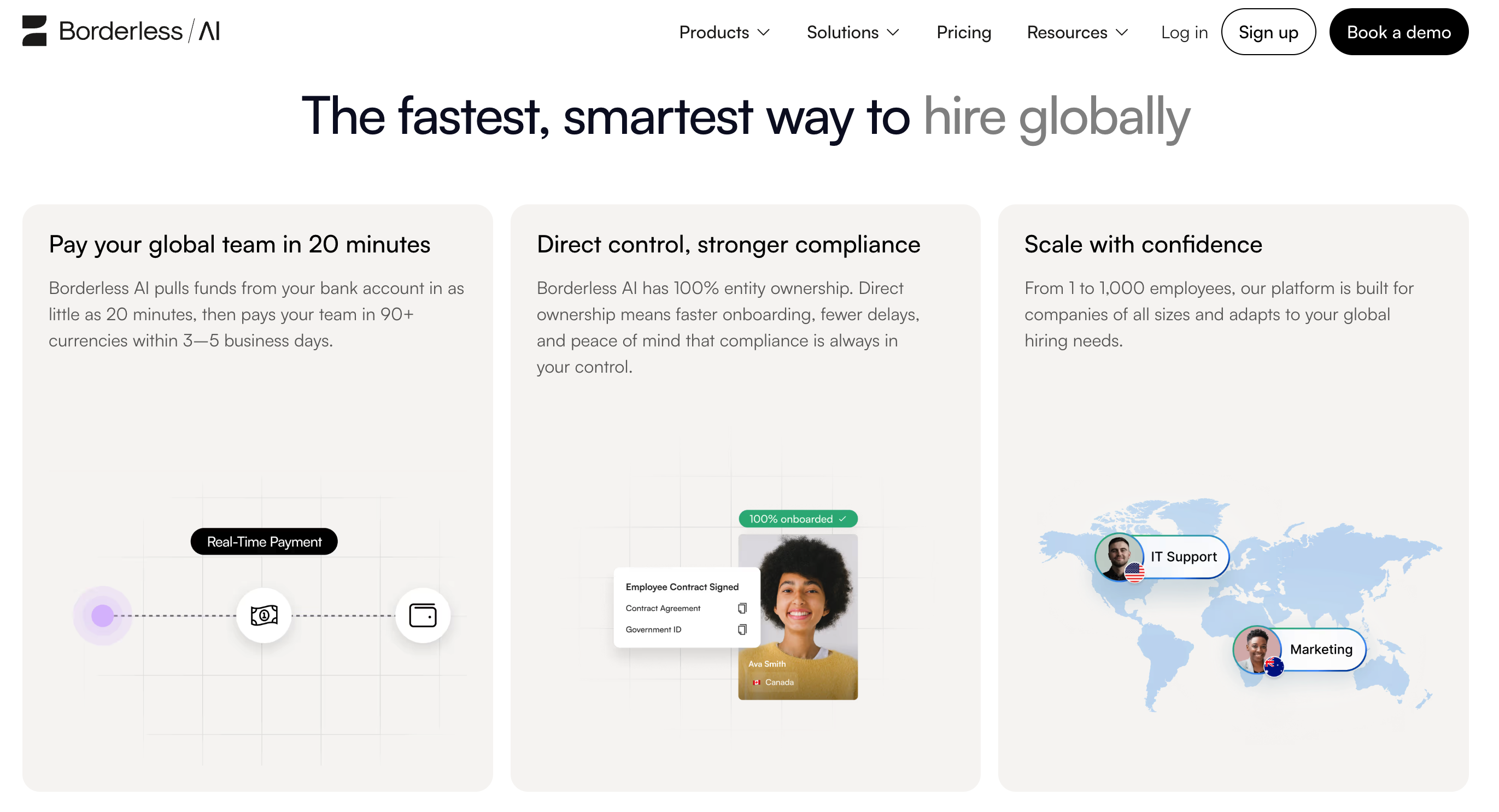
Borderless AI is a global EOR platform covering 170+ countries, operating on an owned-entity model. It handles South African statutory requirements including PAYE, UIF, SDL, EMP201 declarations, and COIDA assessments. Pricing starts at $579 per employee per month, with contractor management at $49 per contractor per month.
The platform includes automation tools for contract generation, payroll calculations, and benefits administration. Employees can use a mobile app for self-service onboarding and expense management. Borderless AI carries a G2 rating of 4.9 out of 5 and offers 24/7 customer support with onboarding completed in one to two days. A demo is available; free trial availability is not documented in reviewed sources.
Strengths:
-
Covers the full South African statutory compliance stack, including UIF, PAYE, SDL, EMP201 declarations, and COIDA assessments, through an owned-entity model.
-
Rated 4.9 out of 5 on G2 with 24/7 customer support and one-to-two-day onboarding, alongside a mobile self-service app for employee onboarding and expense management.
Limitations:
-
Some users report that pricing flexibility is limited for smaller companies, and currency conversion rates applied by the platform may be higher than prevailing market averages.
-
Multi-currency billing options are noted as a constraint for smaller organizations, which may find the pricing structure less adaptable to tighter budgets.
Best for:
Companies that prioritize employee self-service via a mobile app and want full South African statutory coverage, including COIDA and EMP201, through an owned-entity EOR model.
RemoFirst
RemoFirst is a global EOR covering 180+ countries, starting at $199 per employee per month with no setup fees or hidden charges. Contractor pricing is $25 per contractor per month. The flat-rate model means companies pay the same fee regardless of compliance updates, benefits administration changes, or equipment shipping requests in South Africa.
RemoFirst handles locally compliant contracts, PAYE withholding, tax certificates, and payroll for South African employees. It also offers equipment shipping within South Africa and private health insurance through RemoHealth. Most employees can be onboarded within a matter of days. A demo is available; free trial availability is not confirmed in reviewed sources.
The pricing model is a clear differentiator. There are no surprise invoices for compliance updates or benefits administration, which gives finance teams predictable monthly costs from the start.
Strengths:
-
Flat-rate pricing at $199 per employee per month with no add-ons, no surprise invoices for compliance updates, benefits administration, or equipment shipping in South Africa.
-
Covers South African PAYE, tax certificates, payroll, and locally compliant contracts, with equipment shipping capability and private health insurance via RemoHealth included in the service scope.
-
24/5 support with a dedicated account manager provides consistent account context across the employment lifecycle.
Limitations:
-
RemoFirst has fewer HRIS platform integrations than several competitors, which may limit workflow connectivity for teams relying on existing HR systems. The service uses a partner network rather than owned legal entities in South Africa.
Best for:
Startups and small to mid-size businesses seeking affordable, flat-rate EOR coverage in South Africa without inflated pricing or unexpected compliance fees.
Remote
Remote is a global EOR operating across 170+ countries. It owns 100% of its legal entities with no third-party partners, which means South African employment contracts, payroll, and statutory filings are managed directly rather than through an intermediary network. Pricing starts at $599 per employee per month.
For South Africa, Remote covers the full statutory compliance stack: PAYE withholding, UIF contributions, SDL levies, COIDA assessments, and EMP201 declarations. Onboarding speed is 1 to 2 days. A free trial is available, and global customer service support is provided. Remote holds a G2 rating of 4.6 out of 5.
The owned-entity model reduces the compliance risk that can arise when an EOR relies on in-country partners. For companies that treat legal-entity ownership as a selection criterion, Remote's structure is a concrete differentiator.
Strengths:
-
Owned-entity model across 170+ countries means South African employment is managed directly, covering PAYE, UIF, SDL, COIDA, and EMP201 filings without reliance on third-party partners.
-
Free trial availability and 1 to 2 day onboarding speed reduce the time and commitment required to evaluate the platform before committing to a hire.
Limitations:
-
At $599 per employee per month, Remote sits at the higher end of the pricing range compared to flat-rate providers such as RemoFirst, which may be a constraint for cost-sensitive startups or small teams.
Best for:
Mid-market and enterprise companies that require a fully owned-entity EOR for South Africa with direct statutory compliance coverage across PAYE, UIF, SDL, COIDA, and EMP201.
Horizons
Horizons is a global employer of record covering 180+ countries through a local-entity model. Pricing starts at $299 per employee per month, making it one of the more accessible options among full-service EOR providers. The platform is rated 4.6/5 on G2.
Horizons handles labor contract drafting, payroll processing, benefits administration, statutory contributions, and employer liability management. For South Africa specifically, it covers the full range of statutory obligations: PAYE withholding, UIF contributions, SDL levies, COIDA assessments, and EMP201 declarations. Onboarding typically completes within one to two days.
Strengths:
-
Local-entity EOR and PEO model with one to two day onboarding speed and a platform designed for fast, straightforward hiring.
-
Full South African statutory compliance covering PAYE, UIF, SDL, COIDA, and EMP201 filings, with employer liability managed directly by Horizons.
G2 rating of 4.6/5 across verified user reviews.
Limitations:
-
No free trial is available; companies must commit to a paid engagement to evaluate the platform in practice.
Best for:
Companies seeking an affordable local-entity EOR with fast onboarding and full South African statutory compliance across a broad global footprint.
Pebl
Pebl (formerly Velocity Global) provides Employer of Record with global payroll, benefits administration, immigration support, and an AI-powered platform across 185+ countries, with EOR pricing starting at $399 per employee per month.
Pebl is a global Employer of Record platform operating across 185+ countries, with EOR pricing starting at $399 per employee per month. It covers hiring, onboarding, payroll, taxes, immigration, and benefits without requiring clients to set up local entities.
One gap worth confirming before signing: Pebl does not publicly disclose whether its South African employment runs through a Pebl-owned entity or a local partner. Prospective clients should ask for that entity structure directly.
For South Africa, Pebl supports EOR services with employees paid in ZAR. The platform combines automated workflows with local compliance support.
Strengths:
Wide country coverage at 185+ countries
Transparent base pricing at $399 per employee per month
-
AI-powered platform with automated onboarding and payroll workflows
Covers immigration and benefits alongside standard payroll
Limitations:
-
Pebl does not publicly disclose whether South African employment runs through a Pebl-owned entity or a local partner
-
Final pricing varies by country and service requirements, so quotes may differ from the base rate
Best for:
Companies hiring across multiple countries who want a single
platform with predictable base pricing and built-in compliance support, and
who are prepared to confirm local entity structure before signing.
Workforce Africa
Workforce Africa is a pan-African EOR with 20 years of experience operating across 40 African nations. Its operations are based in Cape Town, giving it direct local presence in the South African market. Pricing is available upon request for both EOR and contractor services.
The platform offers highly tailored HR advisory services alongside standard EOR functions. It covers South African statutory requirements including labour law compliance, employment equity rules, and B-BBEE requirements. A dedicated account manager supports complex situations such as visa processing, relocations, and benefits structuring. Workforce Africa also maintains a strong commitment to impact sourcing and social responsibility across its African operations.
Strengths:
-
Deep understanding of South African labor laws, employment equity rules, and local business norms, with a dedicated account manager for complex situations including visas, relocations, and B-BBEE requirements.
-
Strong benefits administration covering medical aid and provident funds, supported by detailed reporting on employment costs, compliance status, and local market benchmarks.
Limitations:
-
Public sources reviewed did not document a provider-specific limitation.
Best for:
Businesses that want an EOR with deep experience across Africa, including NGOs and organizations that need broad African footprint coverage alongside South Africa-specific labour law expertise.
What Are the Key Services of an EOR in South Africa?
An EOR in South Africa takes on the legal employer role and manages the full employment relationship on your behalf. That includes payroll processing, statutory filings, contract management, and benefits administration.
South Africa's statutory framework makes professional EOR service management especially valuable. Employers must comply with the Basic Conditions of Employment Act (BCEA), the Labour Relations Act (LRA), the Unemployment Insurance Fund (UIF), the Skills Development Levy (SDL), the Compensation for Occupational Injuries and Diseases Act (COIDA), and the Employment Equity Act (EEA). Each carries its own filing obligations, contribution rates, and enforcement mechanisms.
The sections below break down each service category an EOR covers in South Africa, from payroll and tax withholding through to dispute resolution and B-BBEE advisory support.
Employment Contracts and Local Compliance
South African employment contracts must comply with the Basic Conditions of Employment Act (BCEA). Every employee must receive a written contract before starting work.
Notice periods under the BCEA are tied to length of service: one week for employees with less than six months of service, two weeks for six months to one year, and four weeks for employees with more than one year of service. Probation periods typically run three to six months.
In certain sectors, bargaining council agreements override standard BCEA minimums. Industries including metal and engineering, building and construction, clothing and textiles, and motor retail operate under council-specific wage and conditions determinations that employers must follow.
An EOR provides pre-vetted contract templates updated for current BCEA amendments, reducing the risk of non-compliant documentation when hiring across multiple South African provinces.
Payroll and Tax Administration
South African payroll involves several statutory contributions that employers must calculate and remit accurately each month.
Unemployment Insurance Fund (UIF) contributions total 2% of remuneration: 1% from the employer and 1% from the employee. UIF applies only up to a remuneration cap of $1,098 (R17,712) per month. The Skills Development Levy (SDL) is 1% of payroll, paid by the employer only, and applies when the annual payroll exceeds $30,993 (R500,000).
Compensation for Occupational Injuries and Diseases Act (COIDA) contributions range from 0.11% to 8.26% of payroll, depending on the industry classification assigned to the employer.
Employers must file the EMP201 return with SARS by the 7th of each month, covering PAYE, UIF, and SDL. A bi-annual EMP501 reconciliation is also required. An EOR manages these filings, tracks deadlines, and ensures accurate PAYE withholding under South Africa's progressive tax rates, which reach up to 45%.
Benefits Administration
South African EORs manage two distinct categories of benefits: statutory and voluntary. Statutory benefits include UIF contributions and COIDA registration, both mandatory under South African law.
Voluntary benefits are where competitive differentiation happens. Medical aid schemes such as Discovery Health, Momentum, and Bonitas are commonly administered by EORs, with typical costs ranging from $124 (R2,000) to $310 (R5,000) per employee per month. Retirement and pension fund contributions typically run 5 to 15 percent of salary. Group life insurance is also standard in many EOR benefit packages.
Whether medical aid and retirement fund administration is included in the base fee or priced as an add-on varies by provider. Buyers should confirm this before signing. Although statutory employer costs in South Africa are relatively low at 2 to 4 percent of salary, competitive voluntary benefits remain important for attracting skilled talent in the local market.
Employee Onboarding
Onboarding timelines across EOR providers in South Africa range from as fast as one day to as long as three weeks, depending on the provider and the complexity of the hire.
In the South African context, onboarding covers contract signing, UIF registration, SARS tax number verification, bank account setup for ZAR payroll, and COIDA registration. The EOR handles all statutory registrations directly, so the employee can begin work without delays caused by administrative backlogs.
Several providers offer digital or mobile onboarding options, allowing employees to complete documentation and self-service steps from any location. This reduces the time between offer acceptance and the first working day, which matters in competitive hiring markets.
Ongoing HR Support
An EOR in South Africa handles recurring compliance tasks that fall due every month and every year. The most time-sensitive is the EMP201 declaration, filed monthly with SARS to report PAYE, UIF, and SDL contributions.
Leave tracking is equally ongoing. The Basic Conditions of Employment Act entitles employees to 21 days of annual leave, 30 days of sick leave across each three-year cycle, and three days of family responsibility leave per year. The EOR records and monitors each entitlement.
For employers with 50 or more employees, the Employment Equity Act requires an annual submission to the Department of Employment and Labour, typically due by 15 January. The EOR prepares and files this report. When the BCEA or LRA is amended, the EOR updates employment practices to reflect the change, keeping clients continuously compliant without manual monitoring.
Employee Offboarding
Offboarding in South Africa differs significantly depending on whether the separation is a resignation, a retrenchment, or a dismissal. Each path carries distinct legal obligations under the BCEA and the Labour Relations Act.
For retrenchments, the LRA (Section 41) requires severance pay of one week's remuneration for each completed year of service. Notice periods under the BCEA must also be observed: one week for employees with fewer than six months of service, scaling to four weeks for those employed for more than one year.
Dismissals require both substantive and procedural fairness under the LRA. The EOR manages the disciplinary process to meet CCMA standards, reducing the risk of unfair dismissal referrals. When a termination occurs for any reason, the EOR notifies the Department of Employment and Labour so the employee can access UIF benefits. Some providers bill CCMA case representation separately, so confirm this scope before signing a contract.
How to Hire Through an EOR in South Africa
Hiring through an EOR in South Africa removes the need to register a Proprietary Limited (Pty Ltd) company with the Companies and Intellectual Property Commission (CIPC). That registration process involves director requirements, capital structuring, and ongoing statutory filings that take months to complete.
The EOR becomes the legal employer under South African law. Your company retains full day-to-day management control over the employee's work, tasks, and performance. The EOR carries the legal and compliance obligations.
The following sections cover two stages: selecting and setting up your EOR relationship, then managing onboarding and ongoing compliance once your first hire is in place.
Selection and Setup
When evaluating EOR providers for South Africa, focus on five compliance areas: depth of coverage under the Basic Conditions of Employment Act (BCEA) and Labour Relations Act (LRA), scope of support for Commission for Conciliation, Mediation and Arbitration (CCMA) disputes, B-BBEE advisory capability, guaranteed EMP201 monthly filing with SARS, and handling of COIDA registration and annual assessments.
Once you select a provider, you sign a service agreement that defines the scope of employment, liability allocation, and billing terms. At this stage, you define the employee's role, seniority, and compensation benchmarked in ZAR against local market rates.
From provider selection to your first hire being active, expect one to three weeks depending on the provider's onboarding process and the complexity of the role.
Onboarding and Compliance
When an EOR takes on a South African hire, the first steps are fixed by law. The EOR executes a BCEA-compliant employment contract, registers the employee with the Department of Employment and Labour for UIF, and completes SARS PAYE registration. COIDA registration follows, and the employee's ZAR salary account is set up for payroll disbursement.
The first EMP201 return is due by the 7th of the month following the first payroll run. From that point, the EOR manages all recurring obligations: monthly EMP201 submissions, the annual EMP501 reconciliation, leave tracking under BCEA rules, and CCMA procedural support when disputes arise.
Each pay cycle, the employee receives a ZAR payslip with every statutory deduction itemized, including PAYE, UIF, and SDL contributions.
What Are the Benefits of Using an EOR in South Africa?
South Africa's employment framework is one of the more demanding in sub-Saharan Africa. Employers must comply with the Basic Conditions of Employment Act (BCEA), the Labour Relations Act (LRA), the Employment Equity Act (EEA), UIF and SDL contribution rules, COIDA registration, and CCMA dispute procedures. Sector-specific bargaining councils add another layer on top of that.
That complexity raises the cost of a compliance error. An EOR absorbs those obligations as the legal employer, so your company manages the work without managing the filings, registrations, and dispute procedures directly.
The sections below cover each benefit in detail, from faster market entry to statutory contribution management and CCMA support.
Faster Market Entry
Setting up a Proprietary Limited (Pty Ltd) company in South Africa involves CIPC registration, legal fees, accounting setup, and tax registration. Total costs typically run $310 (ZAR 5,000) to $9,298 (ZAR 150,000), and the process takes a minimum of one to three weeks before a single hire can be made.
An EOR removes that requirement entirely. Companies can employ workers in days to weeks rather than waiting months for entity setup to complete.
South Africa's primary talent pools in Cape Town, Johannesburg, and Durban become accessible immediately. There is no need to establish a local legal presence before engaging skilled workers in tech, finance, or BPO roles.
Reduced Compliance Risk
South Africa's employment framework creates specific liability exposure for foreign companies hiring without local expertise. Late EMP201 filings trigger SARS PAYE penalties. Failure to register for UIF or COIDA carries direct financial liability. Underpaying the Skills Development Levy (SDL) creates further exposure.
Contractor misclassification is a particular risk. Under Labour Relations Act Sections 198A to 198D, contractors earning below the BCEA earnings threshold of $16,225 (R261,748) per year may be deemed employees by law, regardless of how the contract is written.
An EOR absorbs these risks as the legal employer of record. It manages CCMA unfair dismissal procedures, PAYE filings, UIF registration, SDL contributions, and COIDA compliance, keeping the client company insulated from direct liability.
Simplified Payroll Administration
South African payroll involves multiple statutory obligations that must be calculated and filed accurately each month. PAYE rates are progressive, reaching up to 45% for higher earners. UIF contributions are set at 1% from the employer and 1% from the employee, capped at a monthly remuneration of $1,098 (R17,712). SDL applies at 1% of total payroll for businesses with an annual payroll above $30,993 (R500,000). COIDA assessments range from 0.11% to 8.26% depending on industry classification.
An EOR handles all calculations, deductions, and SARS submissions automatically. The monthly EMP201 return must be filed by the 7th of each month, and a qualified EOR manages this deadline without manual intervention from the client.
Employees receive ZAR payslips with itemized deductions covering PAYE, UIF, and any other applicable statutory contributions, giving workers full visibility into their compensation.
Access to Local Benefits
South Africa's statutory employer costs are relatively contained. UIF sits at 1% of remuneration, SDL at 1% of payroll, and COIDA varies by industry. These contributions alone are unlikely to attract or retain skilled professionals in competitive sectors such as technology, finance, and business process outsourcing.
Voluntary benefits make a material difference. Medical aid schemes from providers such as Discovery Health, Momentum, and Bonitas are widely expected by professional employees. Retirement and pension fund contributions, along with group life insurance, are standard components of competitive employment packages in South Africa.
An EOR can administer these voluntary benefits on behalf of the client company. Whether benefits administration is included in the base fee or priced separately depends on the provider, so confirming scope before signing is advisable.
Lower Entity Setup Costs
Registering a Proprietary Limited (Pty Ltd) company in South Africa costs between $310 (ZAR 5,000) and $9,298 (ZAR 150,000) in setup fees alone. An EOR carries no entity setup cost.
Ongoing entity costs add up quickly. Direct employers pay annual CIPC returns, SARS tax compliance filings, accounting fees, and carry full CCMA liability as the legal employer of record.
The break-even point matters. For fewer than three to five employees in South Africa, an EOR is typically the more cost-effective path. Beyond that threshold, establishing a local entity may become more economical. For companies testing the market or managing a small headcount, EOR removes fixed overhead before revenue justifies a permanent structure. Learn more about employer of record cost factors to model your own break-even.
More Flexible Workforce Scaling
Direct employers in South Africa must follow the Section 189 Labour Relations Act consultation process before any retrenchment. An EOR manages that process on your behalf, reducing procedural risk when headcount needs to decrease.
Scaling up is equally straightforward. Companies can hire across Cape Town, Johannesburg, Durban, and Pretoria without city-specific entity requirements. The EOR is already the legal employer in each location.
The same structure extends beyond South Africa. A single EOR relationship can support employment across other African markets, giving companies a consistent employment operating layer as their footprint grows. EOR for startups covers how early-stage companies use this flexibility to scale without committing to fixed entity costs.

How to Find the Right EOR for South Africa
South Africa's employment framework is one of the most layered in Africa. The Basic Conditions of Employment Act (BCEA), Labour Relations Act (LRA), CCMA dispute procedures, UIF, SDL, COIDA, Employment Equity Act (EEA), and B-BBEE requirements each carry distinct obligations. A generic global EOR platform may cover payroll basics but lack the in-country depth to manage dismissal procedures, bargaining council determinations, or equity reporting correctly.
Local compliance expertise matters here more than in most markets. The sub-sections below cover the criteria that separate capable South Africa EOR providers from those that simply list the country in their coverage map.
Local Compliance Expertise
Ask any EOR provider whether they hold in-house South African HR and legal staff or rely on third-party partners. The answer shapes how quickly they can respond to a CCMA referral, an EEA reporting deadline, or a COIDA registration query.
Specific areas to probe include: BCEA-compliant contract templates, LRA-aligned dismissal procedures, EMP201 filing guarantees, COIDA registration support, B-BBEE advisory for procurement scoring, and EEA reporting for clients with 50 or more employees.
Ask directly whether the provider has handled CCMA cases and what their track record looks like. Providers that outsource South African compliance to local partners may add response delays at exactly the moments when speed matters most.
Clear Service Scope
Not every EOR covers the same obligations in South Africa. Before signing, ask whether COIDA registration is included in the base fee or billed separately. Confirm whether CCMA case representation is part of the service or an add-on. Ask whether medical aid administration is included and whether Employment Equity Act reporting is covered for clients with 50 or more employees.
Request a written service schedule that maps directly to South African statutory obligations. Some providers include only payroll and basic contract management, leaving CCMA representation and B-BBEE advisory as separately priced extras. A clear service schedule removes that ambiguity before onboarding begins.
Support Model
South Africa operates at GMT+2. US-based or Asia-based EOR providers may offer limited overlap with local business hours, which matters when a compliance issue needs a same-day response.
Ask whether support runs 24/7 or only during the provider's business hours, and whether a dedicated account manager is assigned to your account. Confirm whether CCMA dispute support is handled by in-house South African labor law specialists or outsourced to a third party.
Response time is a practical concern, not just a service preference. CCMA referrals carry a 30-day window from the date of dismissal. A provider that cannot respond quickly to a referral notice puts that deadline at risk.
Technology and Reporting
A capable EOR platform should give you real-time visibility into UIF and SDL contribution tracking, PAYE payslip generation in ZAR, and EMP201 filing status. These are not optional features for South African payroll; they are the baseline for SARS compliance.
Ask whether the platform produces audit-ready payroll reports that hold up under a SARS inspection. Detailed records of each statutory deduction, filed on time and accessible on demand, reduce your exposure significantly.
Integration with your existing HRIS tools matters too. A platform that connects with your HR stack reduces manual reconciliation and keeps workforce data consistent. For distributed South African teams spread across multiple provinces, mobile self-service access lets employees view payslips, track leave balances under the BCEA, and manage personal details without routing every request through HR.
Scalability for Your Hiring Plans
Hiring across all nine South African provinces requires an EOR that can manage bargaining council compliance in multiple sectors simultaneously. As headcount grows past 50 employees, Employment Equity Act reporting obligations also apply, and your EOR should be equipped to support that transition without additional setup on your side.
If your plans extend beyond South Africa into other African markets, confirm that the EOR can operate across those countries under a single contract. Multi-country coverage from one provider reduces administrative overhead and keeps compliance governance centralized.
Finally, ask whether the EOR supports entity setup if your headcount eventually justifies a local Proprietary Limited company. Providers that offer EOR for enterprises often include entity transition support, which protects your investment as the business scales.

Why Gloroots Is a Strong EOR Partner in South Africa
Companies hiring in South Africa need an EOR that manages statutory obligations precisely and maintains visibility across the full employment lifecycle. Gloroots supports compliant full-time employment across 150+ countries, including South Africa, without requiring a local entity.
Gloroots combines four core services: Global Employer of Record (EOR), Global Payroll, Compliance & Employment Governance, and Benefits & Statutory Coverage. In South Africa, this means payroll runs in ZAR with UIF contributions managed at 1% employer and 1% employee (2% total), SDL at 1%, and PAYE filed accurately with SARS.
Compliance is handled by in-house HR and payroll experts, not third-party partners. These specialists manage BCEA contract requirements, CCMA dispute procedures, and EMP201 filing obligations directly. Clients retain a named account manager who carries business context across every interaction, so support does not reset with each query.
-
Predictable, country-specific pricing with full cost visibility before onboarding and no percentage-of-salary fees. See Gloroots pricing for current rates.
-
Centralized workforce visibility across all active employees, payroll runs, and compliance filings in one dashboard.
-
Multi-country scalability: companies that start in South Africa can extend employment to 150+ countries without switching platforms.
For mid-market companies building distributed teams across Africa or globally, EOR for mid-market companies outlines how Gloroots structures employment governance at scale. Full service details are available on the Gloroots EOR services page.
FAQs About the Best EOR in South Africa
The questions below address the most common decisions buyers face when evaluating EOR providers for South Africa. They cover statutory obligations, cost structures, compliance scope, and how to choose a provider that fits your hiring volume and growth plans.
Each answer draws on the provider evidence and South African employment law context covered in this guide, including PAYE, UIF, SDL, BCEA, CCMA procedures, and B-BBEE requirements. Use these answers as a starting point before speaking with a provider directly.
How does an EOR work in South Africa?
An EOR in South Africa registers as the legal employer with SARS and the Department of Employment and Labour. This covers UIF and COIDA registration, monthly EMP201 filings, PAYE withholding, and SDL contributions.
Your company retains full operational control over the employee's day-to-day work. The EOR holds all legal employment liability under the Basic Conditions of Employment Act (BCEA) and the Labour Relations Act (LRA).
This structure removes the need to register a Proprietary Limited company (Pty Ltd) with CIPC. You can employ workers in South Africa from day one without establishing a local entity. For a fuller explanation of the model, see how does EOR work.
What does an EOR cost in South Africa?
EOR fees across the providers reviewed in this guide range from $199 per employee per month (RemoFirst) to $599 per employee per month (Deel and Remote). For a broader view of how fees are structured globally, see employer of record cost.
The final figure depends on the employee's salary level, the benefits package included, and whether services such as CCMA representation or B-BBEE advisory are in scope. Some providers charge a one-time setup fee, and COIDA registration or CCMA case support may be billed separately.
Request a full written cost breakdown before signing any agreement. Confirm which statutory filings, compliance updates, and advisory services are included in the quoted monthly fee and which are charged as extras.
When should a company use an EOR in South Africa?
An EOR makes sense when a company wants to test the South African market before committing to registering a Proprietary Limited (Pty Ltd) entity. It also applies when hiring one to four employees, since entity setup costs rarely break even at that headcount.
Companies without in-house South African HR should consider an EOR for CCMA expertise. Even at five to ten employees, the complexity of CCMA compliance can justify continued EOR use over direct entity management.
Contractor misclassification is another trigger. Under Labour Relations Act Sections 198A to 198D, workers who meet certain criteria are deemed employees by law, creating direct liability for the engaging company.
Can an EOR hire both local and foreign employees in South Africa?
South African citizens and permanent residents can be employed through an EOR without any visa requirements. The EOR acts as the legal employer and manages payroll, contracts, and statutory contributions from day one.
Foreign nationals require a valid work permit before an EOR can employ them. Relevant permit types include the Critical Skills Work Visa, the General Work Visa, and the Intra-Company Transfer Visa. In most cases, an EOR cannot sponsor visas directly.
Some EOR providers offer immigration advisory support as an add-on service. This covers guidance on permit selection and application processes, but does not constitute visa sponsorship.
How do I choose the right EOR in South Africa?
Start by confirming the provider handles BCEA and LRA compliance in depth, guarantees EMP201 filings, and includes COIDA registration. Ask whether B-BBEE advisory is in scope and whether medical aid administration is available.
Check the provider's G2 rating and customer reviews. Request itemized pricing with no hidden fees. Ask whether the provider uses in-house South African staff or relies on third-party partners, as local expertise is a key differentiator.
Request a demo or pilot before committing to a contract.