






- Collective agreements cover 83.1% of Slovenian workers, meaning most pay floors, leave entitlements, and working conditions are set at the sector or national level, so any EOR partner must identify and apply the correct branch agreement for each role before the contract is signed.
- New employees must be registered with the Health Insurance Institute and tax authorities within 8 days of their employment start date, making onboarding speed and registration compliance a baseline requirement when evaluating EOR providers for Slovenia.
- Statutory employment costs in Slovenia include a total tax wedge of 45.3%, mandatory meal and commuting allowances, and an annual holiday bonus equal to the minimum wage due by 30 June each year, all of which should be confirmed as included in an EOR provider's base pricing before signing.
- For non-EU nationals, Slovenia requires a single combined work and residence permit with approximately two months of processing time, so buyers should confirm upfront whether their chosen EOR actively supports this permit process.
- Security certifications such as ISO 27001 and SOC 2 Type II vary across providers, with Gloroots, Deel, Remote, and Rippling confirmed as certified, while certification status for Asanify and Skuad requires direct confirmation from those providers.
Slovenia's unemployment rate sits at 3.4% in 2025, its ICT sector grew 6.6% in 2023, and 48% of adults aged 25 to 34 hold a tertiary qualification. Hiring here means competing for a skilled, educated workforce in a tight labor market.
Employment in Slovenia is governed by the ZDR-1 (Employment Relationships Act) and a set of EU directives covering working time, data protection, and equal treatment. Foreign companies must align contracts and payroll with both national law and EU-level obligations before the first hire.
Collective agreements cover 83.1% of Slovenian workers. That coverage rate means most employment terms, including pay floors, leave entitlements, and working conditions, are set at the sector or national level rather than by individual negotiation. Selecting an best employer of record partner with verified ZDR-1 compliance depth is not optional; it is the baseline requirement for operating legally in Slovenia.
Our Top 8 Picks: Slovenia EOR Comparison 2026
Selecting an EOR services partner for Slovenia requires more than a country coverage check. The eight providers below were evaluated across six axes: pricing transparency, Slovenia compliance depth, platform self-serve capability, security certifications (ISO 27001 and SOC 2 Type II), service model (human-led versus automated), and entity ownership structure. Each axis reflects a real operational risk for companies hiring under ZDR-1 and EU employment law.
The table below summarises how each provider performs across the standard comparison dimensions. Detailed profiles follow the table.
| Provider | Pricing per month | Country coverage | Onboarding speed | Platform experience | Customer support | Scalability |
|---|---|---|---|---|---|---|
| Gloroots | From $199/employee/month | 150+ countries | 3–5 working days | Centralized workforce dashboard with hiring, payroll, compliance, benefits, expenses, and multi-country workforce visibility | 24/7 human support with dedicated specialists | SMB to enterprise; built for companies scaling across multiple countries |
| Teamed | Custom pricing / quote-based | 150+ countries | Not publicly listed as a fixed timeframe | Global EOR platform covering employment contracts, payroll, benefits, compliance, and workforce management | Expert-led support with dedicated account management | SMB to enterprise; supports international workforce expansion |
| Deel | $599/employee/month for EOR | 130+ EOR countries; 150+ countries for broader global hiring | Automated onboarding; no fixed universal timeline publicly listed | Self-serve global workforce platform covering EOR, contractors, payroll, HR, benefits, compliance, visas, and integrations | 24/7 customer support with HR, legal, and tax expertise | SMB to enterprise; suited to fast-scaling distributed companies |
| Remote | $699/employee/month monthly; $599/month with annual billing | 90+ EOR countries | Onboarding with a dedicated specialist; no fixed universal timeline publicly listed | Owned-entity EOR platform with global payroll, benefits, compliance, IP protection, and workforce management | 24/7 specialist support with local HR, legal, and finance expertise | SMB to enterprise; strong fit for distributed teams prioritizing owned-entity infrastructure and IP protection |
| Rippling | Custom EOR pricing | 80 EOR countries | Not publicly listed as a fixed universal timeframe | Unified HR, IT, payroll, finance, and workforce platform with EOR capabilities | In-app support and customer assistance; support depth varies by plan | SMB to enterprise; particularly strong for automation-driven teams combining HR, IT, payroll, and finance |
| Oyster HR | $699/employee/month | 120+ EOR countries; 180+ countries for broader global talent engagement | As fast as 48 hours in supported workflows; country-dependent | Remote-first global employment platform covering hiring, onboarding, payroll, benefits, expenses, time off, and compliance | Local HR specialists and dedicated support resources | Startups to enterprise; suited to remote and distributed international teams |
| Globalization Partners (G-P) | Custom pricing / quote-based | 180+ countries | Not publicly listed as a fixed universal timeframe | G-P Global Employment Platform / Meridian covering hiring, onboarding, payroll, compliance, and workforce management | 24/7 support with in-country experts and customer-success resources | Mid-market to enterprise; designed for complex multinational workforce operations |
| Payoneer Workforce Management | From $199/employee/month | 160+ countries | 1–2 weeks | Unified platform covering onboarding, employment contracts, payroll, compliance, benefits, payments, and workforce management | 24×5 dedicated account managers and localized support | SMB to enterprise; designed to scale global hiring across 160+ countries |

Top 8 Best EOR Platforms in Slovenia
Eight EOR platforms are evaluated in this guide, covering both global providers with broad country networks and European-focused platforms with deeper regional compliance infrastructure.
The evaluation covers compliance with Slovenian labor law, payroll execution, statutory benefits administration, pricing transparency, and support quality. Each provider is assessed on the same criteria with no paid placements influencing the order.
Locally rooted Slovenian providers, including staffing firms and labour-leasing agencies, exist but fall outside this list's scope. Buyers with blue-collar workforce needs or labour-leasing arrangements should assess those providers separately alongside the platforms reviewed here.
Gloroots
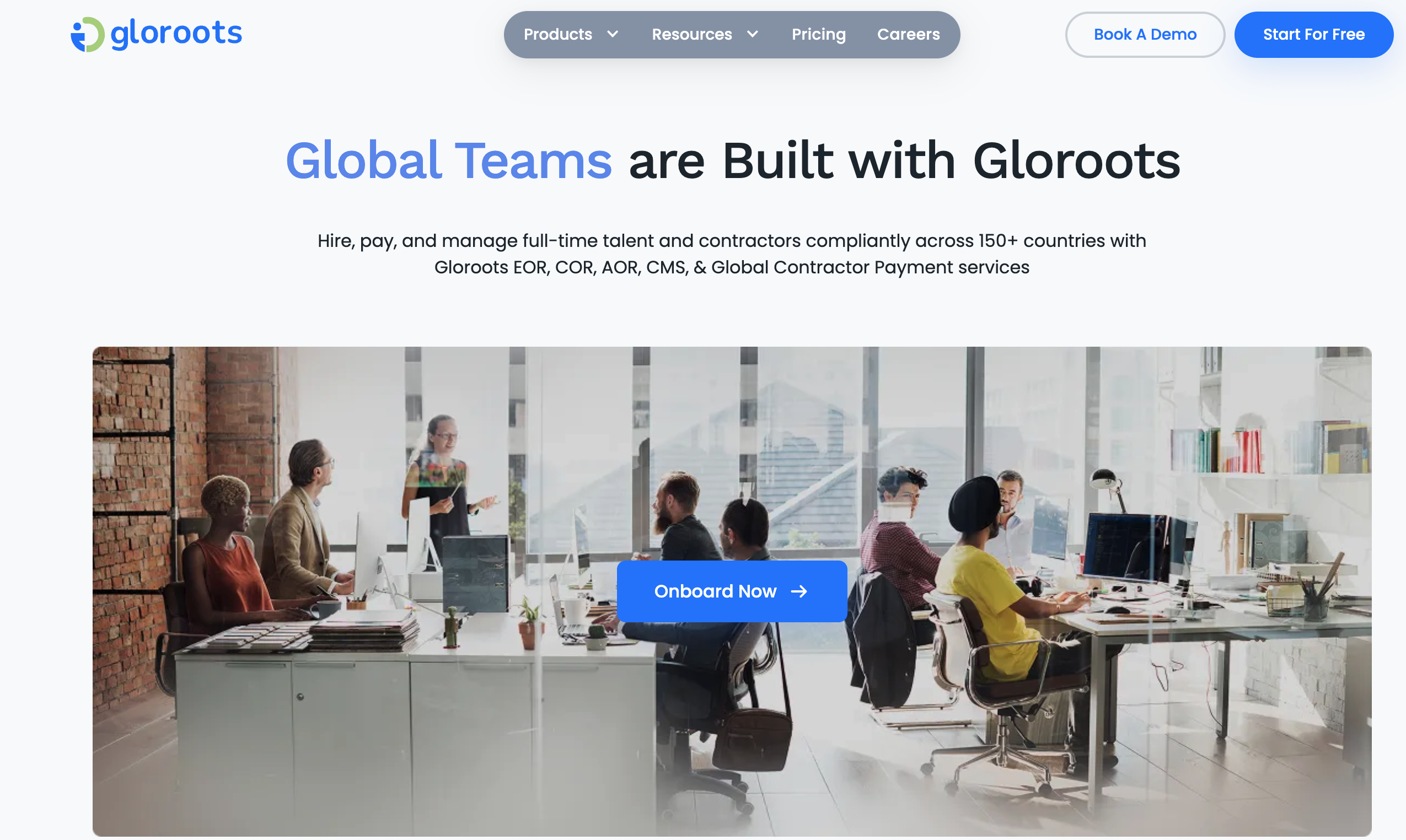
Gloroots is a global hiring and employment platform that supports compliant full-time employment across 150+ countries, including Slovenia. It combines Global Employer of Record (EOR), Global Payroll, Compliance and Employment Governance, and Benefits and Statutory Coverage into a single employment operating layer.
Employment contracts in Slovenia are structured in compliance with the Employment Relationship Act (ZDR-1) and applicable collective agreements. Gloroots manages statutory allowance administration, including meal and commuting allowances, and handles Regres, the mandatory annual holiday bonus required under Slovenian law. As Slovenia is an EU member state, Gloroots operates with a GDPR-compliant posture across data handling, employment records, and cross-border data transfers.
Gloroots uses predictable, country-specific pricing with full cost visibility before onboarding. There is no percentage-of-salary pricing. Employers receive a clear cost picture for each Slovenian hire before the employment relationship begins.
Strengths:
-
ZDR-1 compliant employment contracts with collective agreement handling, covering mandatory statutory allowances including meal, commuting, and Regres administration.
-
Predictable, country-specific pricing with no percentage-of-salary fees, supporting accurate financial forecasting for finance and operations teams.
-
Centralized workforce visibility and human-led account support with retained business context, reducing operational friction across multi-country employment.
Limitations:
-
Slovenia-specific feature depth, such as the benefits portal and leave management capabilities, is not fully detailed in public documentation.
Best for: Growth-stage and enterprise companies that need compliant employment in Slovenia without entity setup, and that require centralized governance across multiple countries.


Teamed
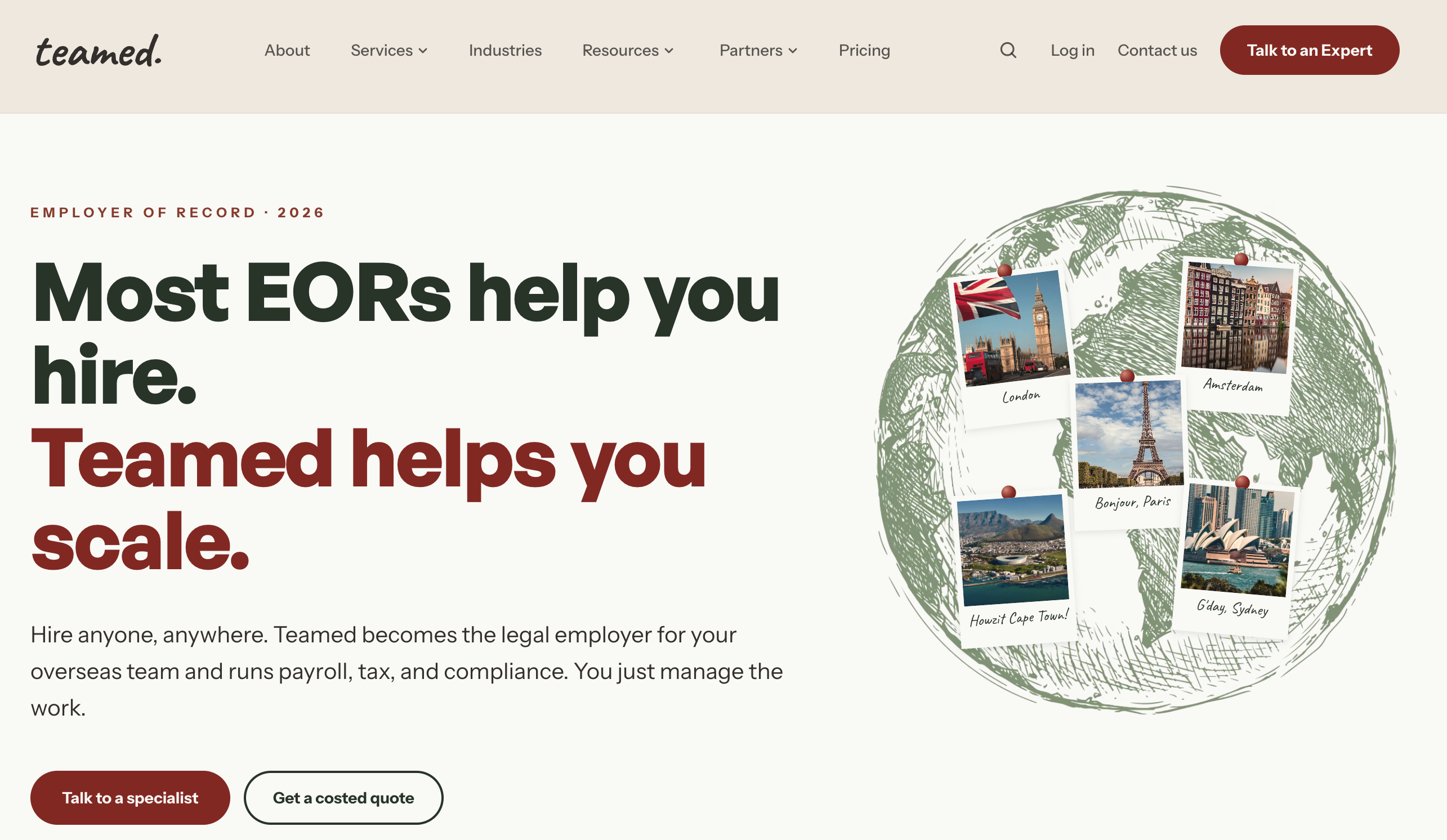
Teamed is a Berlin and London-based employer of record with a stated focus on Slovenia compliance and a flat monthly fee pricing model. It is positioned for companies that want pricing transparency and Slovenia-specific compliance depth from the start.
Teamed covers compliance with the Employment Relationship Act (ZDR-1), which governs individual employment contracts, working time, and termination in Slovenia. The platform also identifies applicable branch collective agreements for each role, which is a requirement many generalist EOR providers handle inconsistently.
A notable feature is Teamed's entity transition planning. Companies that grow headcount in Slovenia can use Teamed's graduation model to plan a structured move to their own local entity (d.o.o.) rather than remaining on EOR indefinitely.
-
ZDR-1 compliance and collective agreement identification for each Slovenian role
-
Flat monthly fee structure with itemised invoices for cost visibility
-
Entity graduation planning to support transition to a Slovenian d.o.o.
-
Teamed states it does not hold Remote’s or Multiplier’s current security certifications (ISO 27001 and SOC 2) today.
Teamed absorbs FX at zero markup in any currency pairing.
Teamed's global footprint is smaller than Deel or Remote, which may limit its suitability for companies hiring across many countries simultaneously. Platform self-serve depth relative to larger competitors is Teamed acknowledges it is lighter on self-serve platform depth than Remote or Multiplier..
Pricing follows a flat fee model. A published rate was not identified in researched sources; buyers should request a direct quote. Teamed suits companies that want transparent pricing and Slovenia compliance depth with a clear path to entity ownership.
Deel
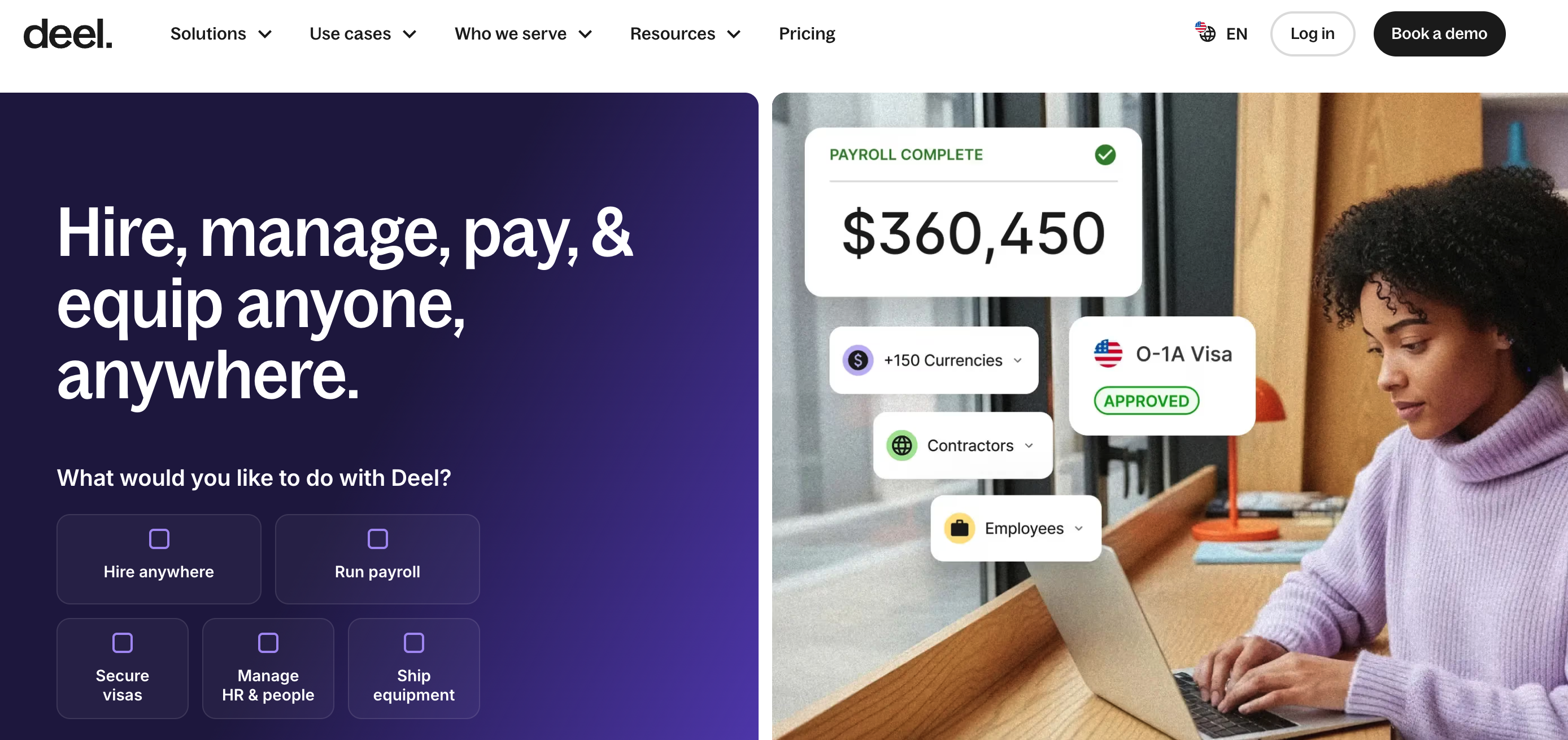
Deel is a global payroll and HR platform operating in 150+ countries. It is best suited for fast-scaling companies that prioritize onboarding speed and a self-serve platform experience for Slovenia employment.
Deel states that its EOR model uses Deel-owned entities in 120+ countries and that EOR hiring is available where Deel has a legal entity. However, Deel's public documentation does not explicitly confirm whether Slovenia operates through a Deel-owned entity or a partner arrangement. Verify the employing entity structure for Slovenia before signing.
Deel holds ISO 27001 certification and SOC 2 compliance, covering data security across its platform. Payroll for Slovenian employees runs in EUR, and billing currency terms should be confirmed directly with Deel for non-EUR buyers to understand any FX implications.
-
Fast contract generation and digital onboarding for Slovenian employees
-
Automated payroll with statutory deductions, employer contributions, and tax filing
-
Contractor of Record (Agent of Record) availability in Slovenia for buyers considering contractor vs. employee engagement
-
Broad integrations with accounting and HR tools for multi-country operations
Deel's official Slovenia documentation confirms that its EOR service handles local employment-law and compliance requirements, but does not publicly describe a specific process for identifying or applying applicable collective agreements. Verification of how Deel addresses branch collective-agreement identification for Slovenian roles should be requested directly from the company.
Deel's EOR pricing starts at approximately $599 per employee per month. Slovenia-specific costs may vary by service scope and contract terms.
Remote
Remote is a global EOR and payroll provider operating in 180+ countries. It is best suited for companies that prioritize owned-entity infrastructure and IP protection when hiring in Slovenia.
Remote employs workers in Slovenia through its own legal entities, managing payroll in EUR, statutory contributions, and employment contracts without relying on third-party partners. This direct-entity model gives companies consistent execution and reduces partner-related compliance risk.
Strengths:
-
Owned legal entities in operating countries reduce third-party reliance and support consistent employment execution in Slovenia.
-
IP protection clauses are built into employment agreements, addressing a key concern for technology companies hiring internationally.
-
Transparent, flat-rate pricing supports cost predictability without percentage-of-salary charges.
Limitations:
-
Public documentation does not confirm whether Remote holds a dedicated legal entity specifically in Slovenia, as distinct from broader European operating coverage.
-
Slovenia-specific collective agreement compliance, non-EU work permit support, and FX policy for EUR payroll are not detailed in publicly reviewed sources.
Best for: Companies hiring in Slovenia that require owned-entity employment infrastructure and standard IP protection in employment contracts.
Remote's EOR pricing starts at approximately $599 per employee per month. Slovenia-specific costs fall within standard pricing tiers. Security certifications including ISO 27001 and SOC 2 status are Remote holds ISO 27001 certification and maintains a SOC 2 Type 2 report..
Rippling
Rippling is a global HR and payroll platform operating in 150+ countries. It is best suited for companies that want unified HR, IT, and payroll automation across multiple countries, including Slovenia.
Rippling enables companies to hire and pay employees in Slovenia through its integrated platform, handling employment contracts, statutory deductions, and tax filings. Its automation-first design connects workforce management to broader business systems beyond the traditional EOR scope.
Strengths:
-
A unified platform connects HR, IT provisioning, and payroll in a single system, reducing vendor fragmentation for multi-country teams.
-
A workflow automation engine reduces manual HR and payroll tasks, supporting lean operations teams managing employees across jurisdictions.
-
A broad integration ecosystem connects EOR services with accounting, project management, and communication tools.
Limitations:
-
An automation-first model may not suit companies that need high-touch, human-led support for complex Slovenia-specific compliance queries or employment disputes.
-
Slovenia-specific collective agreement identification, non-EU work permit support, and FX or billing currency policy for EUR payroll are not detailed in publicly reviewed sources.
Best for: Companies seeking a unified HR, IT, and payroll platform with strong automation capabilities across multiple countries, including Slovenia.
Rippling's EOR pricing for Slovenia is not publicly listed and requires a custom quote based on headcount and service scope. Security certifications including ISO 27001 and SOC 2 status are Rippling is ISO 27001 certified and audited for SOC 2 Type 2..
Globalization Partners
Globalization Partners (G-P) is one of the earliest employer of record providers globally. The company manages employment contracts, payroll processing, statutory compliance, and benefits administration for Slovenian employees. Companies can hire without establishing a local legal entity, with G-P acting as the legal employer of record.
G-P was recognized as the highest Leader in Everest Group's 2024 EOR Solutions PEAK Matrix and named an EOR Leader in NelsonHall's 2025 Global EOR Services NEAT evaluation.
-
Employment contracts, payroll, compliance, and benefits managed under a single service for Slovenian employees.
-
Fast employee onboarding backed by legal expertise across covered markets, including Slovenia.
-
No local entity required; G-P acts as the legal employer of record.
Strengths: One of the longest-established EOR providers globally, with documented legal and compliance expertise. Covers the full employment lifecycle for Slovenian hires under one contract.
Limitations: Pricing is custom and not publicly listed, which makes upfront cost comparison difficult for smaller companies evaluating budget.
Best for: Companies that prioritize compliance track record and established legal infrastructure when hiring in Slovenia.
Payoneer
Payoneer is a global EOR platform that supports compliant hiring and payroll in Slovenia. It is built for companies that want a self-serve platform to manage international employment without establishing a local entity.
Payoneer handles employment contracts aligned to Slovenian labor law, runs payroll in EUR, manages statutory compliance, and provides a unified dashboard for workforce visibility across countries.
payoneer's [Skuad's] platform follows SOC security controls covering security, processing integrity, confidentiality, and privacy, though a publicly issued SOC 2 report or ISO 27001 certification could not be verified from the company or authoritative certification registries.
-
Employment contracts drafted in compliance with Slovenian statutory requirements and EU employment directives.
-
Payroll processing in EUR covering employer contributions, tax filings, and statutory deductions.
-
Unified dashboard providing centralized visibility into headcount, payroll status, and compliance across countries.
Payoneer offers Employer of Record services in Slovenia at $349/month, with pricing adjusted based on hiring volume. The platform provides localized employment agreements, payroll processing, and statutory deductions in compliance with local law, though Slovenia-specific platform features and support tiers are not detailed in public documentation.
Handling of Slovenian collective agreements through Skuad is Skuad’s Slovenia guide requires employment contracts to include a collective agreement reference and outlines collective bargaining rules..
Strengths:
-
Self-serve platform model gives HR teams direct control over employment lifecycle tasks in Slovenia without heavy vendor dependency.
-
Unified dashboard supports multi-country workforce visibility, useful for companies hiring across several markets simultaneously.
Limitations:
-
Slovenia-specific compliance depth and local support team availability are not detailed in public documentation reviewed for this guide.
Best for: Companies that want a self-serve global EOR platform with Slovenia coverage and centralized workforce management across multiple countries.
Oyster HR
Oyster HR is a global employment platform operating in 180+ countries. It is suited for companies that prioritize a user-friendly interface and structured benefits management for international employees.
Oyster HR enables companies to hire employees in Slovenia through its platform, handling employment contracts, payroll processing, and statutory benefits administration.
Strengths:
-
User-friendly platform interface that reduces the learning curve for HR teams managing international employment for the first time.
-
Benefits management tools that support statutory coverage and supplemental benefits for employees across multiple countries, including Slovenia.
Limitations:
-
Public sources reviewed did not document a provider-specific limitation for Oyster HR in the context of Slovenia operations.
Best for:
Companies seeking a structured, platform-led approach to employment in Slovenia with a focus on benefits administration and ease of use.
What Are the Key Services of an EOR in Slovenia?
An EOR in Slovenia manages the full employment lifecycle on behalf of a foreign company. Core services include payroll execution in EUR, employment contract drafting, statutory benefits administration, tax filings, and ongoing compliance reporting.
In Slovenia, EOR services must account for requirements under the Employment Relationship Act (ZDR-1), applicable branch collective agreements, and mandatory statutory benefits including Regres (annual holiday allowance), meal allowance, and commuting allowance. Providers that do not address these obligations create direct legal exposure for their clients.
A critical compliance obligation EOR providers must manage is the 8-day registration deadline with the Health Insurance Institute of Slovenia (ZZZS) and the relevant tax authorities. Missing this window triggers penalties and can delay an employee's access to statutory health coverage.
Platforms such as Gloroots combine EOR services with centralized compliance governance, covering payroll, benefits, and statutory filings under a single employment operating layer.
Employment Contracts and Local Compliance
Employment contracts in Slovenia must comply with the Employment Relationships Act, known locally as ZDR-1. Contracts must be written in Slovenian for all local employees.
Before drafting a contract, the applicable branch collective agreement must be identified. Slovenia has sector-specific agreements covering trade, metalworking, and the private sector, among others. Each agreement sets minimum pay grades, seniority bonus entitlements, and notice periods that exceed statutory minimums.
Probation clauses must align with the terms set in the relevant collective agreement. Clauses that deviate from collective agreement terms may be unenforceable under Slovenian law. An EOR with in-country compliance expertise will identify the correct agreement and apply its terms before the contract is signed.
Payroll and Tax Administration
Slovenia carries a total tax wedge of 45.3% on employment costs. Employers contribute 16.6% in social security contributions, and employees contribute 24.07%. Both rates apply to gross salary and must be calculated correctly each payroll cycle.
The minimum wage in Slovenia is $1,721 (EUR 1,482) per month as of January 2026. Payroll must also include two mandatory allowances: a meal allowance and a commuting allowance. These are statutory line items, not discretionary benefits.
Employers must also pay Regres, an annual holiday allowance equal to the minimum wage. Regres is due by 30 June each year. Missing this deadline creates a compliance liability. An EOR running payroll in Slovenia will account for all of these obligations within each monthly cycle.
Benefits Administration
Slovenia mandates several statutory benefits that every employer must provide. A qualified EOR provider administers these correctly and includes them in base pricing.
Mandatory statutory benefits include:
-
Holiday allowance (Regres): equal to the minimum wage, due to employees by 30 June each year
Meal allowance: required for each working day
-
Commuting allowance: covering the cost of travel between home and workplace
Statutory leave entitlements in Slovenia are among the more generous in the EU. Maternity leave runs 15 weeks, paternity leave 25 weeks, and parental leave 37.1 weeks. Employees are also entitled to 15 public holidays per year.
In some sectors, a 13th-month salary applies under collective agreements. Buyers should confirm with their EOR provider whether this applies to their specific industry before signing a contract.
Confirm that all statutory benefits are covered within the base EOR fee. Providers that invoice benefits separately can significantly increase total employment costs beyond the quoted rate.
Employee Onboarding
Onboarding in Slovenia carries a firm legal deadline. New employees must be registered with the Health Insurance Institute and the relevant tax authorities within 8 days of their employment start date.
This registration requirement is not optional. Missing the deadline creates compliance exposure for the legal employer, which in an EOR arrangement is the provider. Buyers should confirm that this 8-day registration is explicitly covered in the provider's onboarding service-level agreement before signing.
Digital onboarding workflows must produce employment contracts written in Slovenian. Contracts issued only in English do not satisfy local legal requirements. Providers operating in Slovenia should generate Slovenian-language contracts as a standard output of their onboarding process, not as a custom add-on.
When evaluating providers, ask specifically how they handle the registration deadline, what documentation they collect from the employee, and how quickly contracts are generated after the employment start date is confirmed.
Ongoing HR Support
Ongoing HR support in Slovenia extends well beyond payroll processing. A qualified EOR provider must monitor collective agreement updates, which can revise minimum pay grades and allowances across sectors throughout the year.
Collective agreements in Slovenia are legally binding and can set pay floors above the statutory minimum. When a relevant agreement is updated, the EOR must adjust payroll and employment terms accordingly, without delay.
One task buyers frequently overlook is ZZZS sick-leave reimbursement claim handling. When a Slovenian employee takes sick leave, the employer initially covers the cost, then submits a reimbursement claim to the Health Insurance Institute of Slovenia (ZZZS). The EOR manages this process on the employer's behalf.
-
Monitoring collective agreement changes that affect pay grades and allowances
Adjusting payroll when updated agreements take effect
Filing and tracking ZZZS sick-leave reimbursement claims
Maintaining accurate employment records for compliance audits
Buyers should ask any EOR provider directly how they handle ZZZS reimbursement claims, including turnaround times and error resolution procedures.
Employee Offboarding
Offboarding in Slovenia is governed by the Employment Relationship Act, known as ZDR-1. Procedural compliance is mandatory; errors in the termination process can expose the employer to unfair dismissal claims.
The statutory notice period under ZDR-1 is approximately 5.3 weeks for standard terminations, though this figure should be verified against the employee's specific contract and tenure. Collective agreements may set longer notice periods above the ZDR-1 minimum, and the EOR must apply whichever standard is higher.
For redundancy terminations, ZDR-1 requires severance pay. The amount depends on the employee's length of service and salary. The EOR calculates, processes, and documents severance obligations as part of the offboarding workflow.
-
Issuing written termination notices that meet ZDR-1 procedural requirements
-
Applying the correct notice period, including any collective agreement extension
-
Calculating and paying statutory severance for redundancy cases
-
Completing final payroll, tax filings, and social contribution settlements
A compliant offboarding process protects the employer from post-termination disputes. Buyers should confirm that their EOR provider follows ZDR-1 procedural steps in full, not just the financial obligations.
How to Hire Through an EOR in Slovenia
Hiring through an EOR in Slovenia involves two distinct phases: selection and setup, followed by onboarding and ongoing compliance management. Getting both phases right reduces legal exposure and avoids costly corrections later.
Slovenia's Health Insurance Institute (ZZZS) requires employee registration within 8 days of the employment start date. This deadline makes onboarding speed a critical capability to evaluate when comparing EOR providers.
For non-EU nationals, Slovenia requires a single combined work and residence permit. Processing typically takes approximately two months. Confirm upfront whether your EOR provider actively supports this permit process, including document preparation and authority liaison.
Selection and Setup
Before signing with an EOR provider for Slovenia, work through the following checks to avoid compliance gaps and unexpected costs.
-
Identify which branch collective agreement applies to the role. Slovenia operates multiple sector-level agreements that affect minimum pay grades, seniority bonus entitlements, and notice period lengths. Confirm the EOR applies the correct agreement for your industry.
-
Confirm whether the EOR includes Regres (the mandatory annual holiday bonus), meal allowance, and commuting allowance in its base pricing. These are statutory obligations in Slovenia and should not appear as billing surprises after onboarding.
-
If hiring third-country nationals, confirm whether the EOR supports non-EU work permit applications, including the single combined work and residence permit required under Slovenian immigration rules.
-
If your organisation operates in a regulated industry, confirm the EOR holds ISO 27001 or SOC 2 certification before sharing employee data or integrating with internal systems.
-
If the arrangement involves labour leasing rather than direct employment, confirm the EOR holds a valid Ministry of Labour licence for that activity in Slovenia.
Onboarding and Compliance
A compliant onboarding in Slovenia follows a defined sequence. The EOR registers the employee with the Health Insurance Institute of Slovenia (ZZZS) and the tax authority within the statutory 8-day deadline from the employment start date.
A Slovenian-language employment contract is signed before work begins. Digital signatures are accepted in Slovenia under EU eIDAS regulations, though the EOR should confirm validity for the specific contract type.
The applicable collective agreement is applied to the contract from day one. This covers the minimum pay grade for the role, any seniority bonus entitlement, and the correct notice period under that agreement.
-
Meal and commuting allowances are set up in payroll from the first pay cycle, as required by Slovenian law.
-
For non-EU nationals, a work permit must be obtained before the employment start date. Allow approximately two months of lead time for permit processing.
What Are the Benefits of Using an EOR in Slovenia?
Using an EOR in Slovenia reduces legal exposure and operational cost for foreign companies. The EOR becomes the legal employer, managing payroll, tax filings, and statutory benefits without requiring a local entity.
Slovenia's total tax wedge sits at 45.3%, one of the higher rates in the EU. An EOR handles employer contribution calculations and filings accurately, reducing the risk of underpayment penalties or misclassification under the Employment Relationships Act.
The collective agreement system in Slovenia adds further complexity. An EOR applies the correct sectoral agreement to each employment contract, covering pay grades, seniority bonuses, and notice periods that vary by industry.
An EOR also removes the need to incorporate a Slovenian private limited company. That process involves notary fees, legal costs, and ongoing audit and tax obligations that add time and fixed overhead before a single employee is hired. Gloroots supports entity-free employment in Slovenia through its EOR services, with predictable, country-specific pricing and centralized compliance governance.
Faster Market Entry
Setting up a d.o.o. in Slovenia requires notary appointments, court registration, and legal fees that can take several weeks to complete. An EOR cuts that timeline to one to two weeks, giving companies a direct path to employing workers without entity setup.
Slovenia's ZZZS social security registration deadline requires new employees to be registered within eight days of their start date. EOR providers must be operationally ready to meet this deadline from day one, which means the onboarding process is built around speed and compliance from the start.
Slovenia's ICT sector recorded 6.6% employment growth in 2023, creating competitive talent acquisition timelines. Companies that move slowly risk losing candidates to faster-moving employers. An EOR removes the administrative delay between offer acceptance and employment start.
Reduced Compliance Risk
Slovenia's Employment Relationship Act (ZDR-1) sets mandatory rules for contracts, probation periods, notice, and termination. Errors in any of these areas create legal exposure for foreign employers who lack local legal infrastructure.
Collective agreements add another layer of complexity. The applicable branch agreement governs allowances including the annual holiday bonus (Regres), meal allowance, and commuting allowance. Misapplying these rules can result in underpaid entitlements or probation clauses that courts will not enforce.
The eight-day ZZZS registration deadline is a specific compliance risk. A missed registration exposes the employer to penalties and leaves the employee without statutory health and social coverage from their first working day. An EOR manages this registration as a standard part of onboarding, removing the risk entirely.
Simplified Payroll Administration
Slovenian payroll involves multiple mandatory components that must be calculated and filed accurately each cycle. An EOR manages all of them on your behalf.
Employer social security contributions run at 16.6% of gross salary. Employee social security deductions total 24.07%. Income tax is withheld and filed in line with Slovenian tax authority requirements. All payroll is executed in EUR.
-
Regres (annual holiday allowance) is calculated and paid by 30 June each year.
-
Meal allowance and commuting allowance are administered per statutory and contractual terms.
-
Collective agreement updates can raise payroll minimums; the EOR monitors changes and applies them to the next cycle.
Gloroots runs payroll in EUR with predictable, country-specific pricing and full cost visibility before onboarding begins. Each cycle is executed through centralized payroll management with no percentage-of-salary pricing.
Access to Local Benefits
Slovenian law mandates a defined set of employee benefits. An EOR identifies, calculates, and administers each one so your employees receive full statutory entitlements from day one.
Mandatory statutory benefits include:
-
Regres (annual holiday allowance equivalent to at least the minimum wage), due by 30 June each year.
-
Meal allowance and commuting allowance, paid per statutory rates.
15 public holidays per calendar year.
-
Maternity leave of 15 weeks, paternity leave of 25 weeks, and parental leave of 37.1 weeks.
Collective agreements in some sectors provide benefits above these statutory minimums. A 13th salary also applies in certain industries. The EOR identifies whether a collective agreement or sector rule applies to each employee and adjusts benefits administration accordingly.
Gloroots administers Benefits and Statutory Coverage as part of its employment operating layer, covering mandatory entitlements and flagging sector-specific obligations before employment begins.
Lower Entity Setup Costs
Setting up a d.o.o. (private limited company) in Slovenia involves notary fees, legal registration costs, a minimum share capital of $8,711 (EUR 7,500), and ongoing audit and tax compliance obligations that accumulate annually.
For companies hiring one to five employees, these fixed costs make entity setup economically inefficient. EOR monthly fees are predictable and scoped to headcount, while d.o.o. compliance costs vary based on audit scope, tax filings, and local HR administration.
The cost threshold at which a d.o.o. becomes more cost-effective than EOR typically falls between 15 and 25 full-time employees, depending on salary levels and compliance complexity. Below that threshold, employer of record cost through an EOR is lower and more controllable.
More Flexible Workforce Scaling
EOR lets companies scale headcount in Slovenia up or down without carrying the fixed overhead of a d.o.o., including annual audits, local tax filings, and dedicated HR administration costs.
Slovenia's unemployment rate stood at 3.4% in 2025, making the labor market competitive. Retaining skilled employees requires consistent, competitive benefits administration. An EOR manages statutory benefits and supplementary coverage without requiring a local entity to administer them.
EOR also supports both short-term project hiring and long-term employment in Slovenia within the same operational structure. Companies can bring on fixed-term employees for a defined project and transition them to permanent contracts without changing the employment infrastructure.
This flexibility is particularly relevant for EOR for startups and growth-stage companies that need to respond to project demand without committing to permanent local overhead.

How to Find the Right EOR for Slovenia
Choosing the right EOR for Slovenia requires more than a generic vendor checklist. Slovenia-specific criteria go beyond standard EOR evaluation. Collective agreement expertise, ZZZS registration capability, and statutory benefit inclusion are filters that apply specifically to Slovenia and should be non-negotiable in any shortlist.
Start by reviewing the best employer of record options against a transparent scoring rubric. That rubric should cover six areas: pricing transparency, Slovenia compliance depth, platform self-serve capability, security certifications, service model, and entity ownership. Ask each provider to score themselves against these criteria and explain their evidence.
Providers that cannot answer Slovenia-specific questions with specificity are likely relying on generic EU compliance frameworks. That gap creates risk for your employment operations in Slovenia.
Local Compliance Expertise
Slovenia compliance expertise is specific and testable. A qualified EOR must demonstrate working knowledge of the Employment Relationship Act (ZDR-1), the ability to identify and apply the correct branch collective agreement for each role, ZZZS registration completed within the mandatory 8-day deadline, and full administration of statutory benefits including health insurance and pension contributions.
Generic EU compliance experience does not satisfy these requirements. Ask each provider directly: which branch collective agreement applies to my role, and what does it do to the minimum pay obligation? A provider that cannot answer that question with precision has not operated in Slovenia at the employment level.
Request evidence of a Slovenia-specific compliance track record. Case references, client counts in Slovenia, or documented ZZZS registration processes are all acceptable forms of proof. Broad EU coverage claims are not a substitute.
Clear Service Scope
Service scope clarity matters in Slovenia because several statutory payments sit outside a standard base salary and can appear as surprise line items on invoices.
Regres, the mandatory annual leave bonus, is one example. Buyers should ask directly: "Is Regres included in the quoted price?" Some providers bundle it; others invoice it separately when the payment falls due in June.
Meal allowance and commuting allowance are also common additions. Both are standard in Slovenian employment practice and should be disclosed in the pricing breakdown before onboarding begins.
-
Confirm whether Regres, meal allowance, and commuting allowance are included in base pricing or invoiced separately.
-
Ask whether 13th salary applicability by sector is disclosed upfront, as it varies by collective agreement.
-
Verify that non-EU work permit support is explicitly scoped if you plan to hire third-country nationals.
Gloroots uses predictable, country-specific pricing with full cost visibility before onboarding and no percentage-of-salary pricing, which supports accurate scoping for Slovenia-based hires.
Support Model
Slovenia-specific support goes beyond routine payroll queries. Providers should be able to handle Health Insurance Institute of Slovenia sick-leave reimbursement claims, monitor collective agreement updates, and manage Employment Relationships Act termination procedures correctly.
Buyers should ask: "How do you handle Health Insurance Institute of Slovenia sick-leave reimbursement claims?" The answer reveals whether the provider has in-country process knowledge or relies on a generic escalation path.
Human-led support is particularly valuable when a collective agreement dispute arises or when an Employment Relationships Act termination procedure requires careful sequencing. Automated ticket systems are not well suited to those scenarios.
-
Confirm that support operates in Central European Time to align with Slovenia-based employees.
-
Ask whether a named account contact handles collective agreement and termination queries directly.
Gloroots provides centralized workforce visibility and human-led account support with retained business context, which is relevant when managing ongoing compliance obligations across multiple employment cycles in Slovenia.
Technology and Reporting
A provider's technology layer determines how much visibility you have over Slovenian employment at any given time. Evaluate platforms on their ability to track collective agreement compliance, schedule Regres payments, confirm ZZZS registration status, and produce multi-currency reports covering EUR payroll alongside non-EUR billing.
Security certifications matter here. Slovenia is an EU member state with full GDPR obligations, so confirm that any provider holds ISO 27001 or SOC 2 Type II certification before sharing employee data. Providers without documented certifications introduce regulatory risk that falls on your organization.
GDPR compliance posture should be verified directly with each provider. Ask for their data processing agreements and confirm where employee data is stored and processed. A platform that cannot answer these questions clearly is not ready for EU employment operations.
Scalability for Your Hiring Plans
Your EOR provider should support employment from a single hire through to a larger team without pricing cliffs or service degradation. In Slovenia, this means the platform can handle both white-collar and blue-collar roles where applicable, and can scale payroll execution without requiring manual workarounds as headcount grows.
At a certain headcount threshold, establishing a local d.o.o. entity becomes more cost-effective than continuing on an EOR model. The exact threshold depends on salary levels and service fees, but providers that offer entity graduation support add long-term value for companies planning permanent Slovenia operations. Confirm whether your shortlisted provider can support that transition before you need it.
Gloroots supports employment across 150+ countries and is built for companies scaling international workforces. Its EOR for startups offering supports early-stage teams entering Slovenia, while its EOR for enterprises offering supports larger organizations managing multi-country headcount from a centralized platform.

Why Gloroots Is a Strong EOR Partner in Slovenia
Gloroots supports compliant full-time employment across 150+ countries, including Slovenia, through its Global Employer of Record service. For companies entering Slovenia without a local entity, Gloroots manages the full employment lifecycle under the Employment Relationship Act (ZDR-1), including statutory contributions, collective agreement obligations, and Regres holiday allowance administration.
Gloroots combines Global EOR, Global Payroll, Compliance and Employment Governance, and Benefits and Statutory Coverage in a single platform. This gives HR, Finance, and Legal teams centralized visibility across headcount, payroll costs, and compliance status without managing multiple vendors.
Because Slovenia is an EU member state, GDPR compliance is a baseline requirement for any employer processing employee data. Gloroots operates with data governance practices aligned to EU standards, reducing legal exposure for companies running cross-border employment from outside the EU.
Gloroots uses predictable, country-specific pricing with full cost visibility before onboarding. There is no percentage-of-salary pricing. This pricing model supports accurate financial forecasting for growth-stage companies and enterprises that need to control employment costs from day one in Slovenia.
Human-led account support with retained business context means your account team understands your workforce structure across employment cycles, reducing friction when handling Slovenia-specific compliance queries or payroll adjustments.
To see exact costs for employing in Slovenia, request a quote through Gloroots pricing or review the full scope of Gloroots EOR services before onboarding.
FAQs About the Best EOR in Slovenia
The questions below address the most common buyer questions about EOR in Slovenia, covering compliance requirements, cost structures, and use cases for companies hiring without a local entity. For deeper due-diligence questions on how to evaluate and select an EOR provider, see the selection criteria section of this guide.
What does an EOR handle under Slovenian labor law?
An EOR manages employment contracts, payroll in EUR, statutory contributions to health and pension funds, and compliance with the Employment Relationship Act (ZDR-1). It also administers mandatory benefits including Regres and annual leave entitlements.
Do I need a local entity to hire in Slovenia through an EOR?
No. An EOR becomes the legal employer in Slovenia on your behalf. You direct the work; the EOR handles all legal, payroll, and compliance obligations locally.
How is EOR pricing structured for Slovenia?
Most providers charge a flat monthly fee per employee. Some use percentage-of-salary models. Gloroots uses predictable, country-specific pricing with no percentage-of-salary component, giving finance teams full cost visibility before onboarding begins.
How does an EOR work in Slovenia?
In Slovenia, an EOR becomes the legal employer under the Employment Relationship Act (ZDR-1). The EOR registers the employee with the Health Insurance Institute of Slovenia (ZZZS) and the tax authorities within eight days of the employment start date.
The EOR applies the correct branch collective agreement, runs payroll in EUR, and administers statutory entitlements including the annual holiday bonus (Regres) and meal and commuting allowances. Your company retains full day-to-day management of the employee's work and output.
For a broader explanation of the model, see how does EOR work.
What does an EOR cost in Slovenia?
EOR fees in Slovenia typically range from $348 (EUR 300) to $1,162 (EUR 1,000) or more per employee per month, depending on the provider and service scope. Confirm whether Regres, meal allowance, and commuting allowance are included in the quoted fee or invoiced separately, as this affects total cost materially.
Employer social security contributions add 16.6% on top of gross salary, so budget for that figure when modelling total employment cost. If your company pays in a currency other than EUR, confirm the provider's foreign exchange markup policy before signing.
For a detailed breakdown of what drives these figures, see employer of record cost.
When should a company use an EOR in Slovenia?
An EOR in Slovenia is appropriate when a company wants to test the Slovenian market before committing to a d.o.o. entity setup. It is also the right model for hiring one to five employees without the overhead of a local subsidiary.
Companies hiring non-EU nationals benefit from EOR support because those workers require a single work and residence permit, which adds processing complexity. An EOR with local expertise manages that process directly.
Slovenia's collective agreement framework adds compliance risk for employers without in-country knowledge. An EOR absorbs that risk by applying the correct sectoral agreement to each employment contract. For companies running a multi-country EU expansion, an EOR provides a consistent employment operating layer across markets. Learn more about EOR for small business use cases.
Can an EOR hire both local and foreign employees in Slovenia?
Yes. An EOR can employ Slovenian nationals and EU citizens without any work permit requirements. Both groups can be onboarded under standard employment contracts governed by the Employment Relationship Act.
Non-EU nationals require a single work and residence permit processed through the Employment Service of Slovenia. Processing typically takes approximately two months. Not all EOR providers support this permit process in Slovenia, so buyers should confirm this capability before signing a contract.
Blue-collar roles and labour-leasing arrangements may require the EOR to hold a Ministry of Labour licence. Confirm that your provider holds the relevant authorisation if your hiring falls into either category.
How do I choose the right EOR in Slovenia?
Before signing with any EOR provider for Slovenia, ask these six questions to assess whether the provider can execute compliantly and transparently.
-
Which branch collective agreement applies to my role, and does your employment contract reflect it?
-
Are Regres (annual holiday bonus), meal allowance, and commuting allowance included in the quoted price, or billed separately?
-
Can you support non-EU work permit applications for employees relocating to Slovenia?
-
How do you manage Health Insurance Institute (ZZZS) sick-leave reimbursement claims on behalf of the employer?
-
Do you hold a Ministry of Labour licence if the engagement involves labour leasing under Slovenian law?
-
What security certifications do you hold, such as ISO 27001 or SOC 2, to protect employee and payroll data?
A provider that answers all six with specifics, not generalities, is prepared for Slovenian employment compliance.