







- Providers with an owned Saudi legal entity and direct Qiwa platform registration carry lower compliance risk than those relying on local partner networks, making entity status the first filter when evaluating EOR options for Saudi Arabia.
- Wage Protection System payroll disbursement requires active Mudad platform registration; any provider without confirmed Mudad registration cannot legally disburse salaries in the Kingdom, so buyers should verify this before signing a contract.
- A new Nitaqat phase took effect in April 2026 targeting localisation of more than 340,000 private-sector jobs, raising the compliance stakes for companies with expatriate headcount and making Saudization quota management a core EOR capability to confirm.
- Onboarding timelines differ significantly by worker type: Saudi nationals can typically be onboarded in 7 to 14 days, while expatriate hires requiring residence permit processing take 4 to 8 weeks, which affects project planning for Vision 2030 giga-project staffing.
- Using an EOR removes the need to establish a Saudi LLC before hiring, avoiding setup costs of $13,333 to $40,000 and a minimum 2 to 4 week registration process, while the EOR absorbs statutory obligations including General Organization for Social Insurance filings, end-of-service benefit accrual, and mandatory medical insurance from day one.
Saudi Arabia's labor market is shifting fast. The national unemployment rate stood at 7.2% in Q4 2025, while overall unemployment across the workforce held at 3.5%, reflecting a two-speed market where Saudi nationals and expatriate workers operate under different rules and quotas.
Vision 2030 giga-projects including NEOM, the Red Sea Project, and Diriyah Gate continue to pull international talent into the Kingdom. These projects require companies to hire quickly, often across multiple nationalities, without the time or capital to establish a local legal entity.
Compliance stakes rose further in April 2026, when a new Nitaqat phase took effect, targeting the localisation of more than 340,000 private-sector jobs. Companies hiring in Saudi Arabia now need an EOR services partner with current, in-country expertise across Saudization quotas, GOSI filings, and Qiwa labor platform registration. This page reviews eight providers best positioned to support Saudi Arabia hiring in 2026.
Our Top 8 Picks: Saudi Arabia for EOR Comparison 2026
Two factors separate compliant Saudi hiring from costly remediation: whether a provider holds an owned Saudi legal entity, and whether it integrates directly with Qiwa, the government labor platform used to register employment contracts and manage worker records. Providers without an owned entity rely on local partners, which adds a layer of counterparty risk. Providers without Qiwa integration require manual contract registration, slowing onboarding and increasing filing error risk.
The table below ranks eight providers across seven comparable dimensions. Ranking reflects owned-entity status, Qiwa integration, Nitaqat zone classification where verifiable, onboarding speed, GOSI automation, Wage Protection System compliance, pricing transparency, and support model. For a broader global comparison, see the best employer of record guide.
| Provider | Pricing per month | Country coverage | Onboarding speed | Platform experience | Customer support | Scalability |
|---|---|---|---|---|---|---|
| Gloroots | From $199 per employee/month | 150+ countries including Saudi Arabia | 3–5 working days | Unified platform for hiring, onboarding, payroll, benefits, visa and compliance management | 24/7 human-led support with dedicated specialists | SMB to Enterprise |
| Deel | $599 per employee/month | 130+ EOR countries | As fast as 2 days; country-dependent | Global HR platform covering EOR, payroll, contractors, benefits, expenses, onboarding, integrations and compliance | 24/7 support with HR, legal and tax expertise | SMB to Enterprise |
| Multiplier | $499 per employee/month; $459 with annual billing | 150+ countries | As fast as 24 hours; country-dependent | Global employment platform covering payroll, contracts, benefits, expenses, timesheets, leave and compliance | 24/7 support | SMB to Enterprise |
| Mercans | Custom pricing | 160+ countries | Employee can begin within 48 hours | Proprietary HR Blizz platform with centralized employee data, payroll automation, compliance, reporting and employee self-service | Dedicated account manager and in-country specialists | SMB to Enterprise |
| Payroll Middle East | Not publicly listed in researched sources | GCC countries | Not publicly listed in researched sources | Payroll processing, compliance and financial administration across GCC markets | Not publicly listed in researched sources | Not publicly listed in researched sources |
| Globalization Partners (G-P) | $599 per employee/month | 180+ countries | Country-dependent; can be completed in days | Global employment platform covering onboarding, payroll, benefits, time off, expenses, contracts, compliance and workforce management | Dedicated customer success and in-country HR/legal experts | Mid-market to Enterprise |
| Borderless AI | $579 per employee/month | 170+ countries | 24–48 hours | AI-powered global employment platform covering contracts, onboarding, payroll, benefits and compliance through a centralized dashboard | Dedicated local payroll, HR and compliance support | SMB to Enterprise |
| Safeguard Global | $699 per employee/month | 187 countries | Country-dependent | End-to-end workforce platform covering EOR, payroll, benefits, HR administration, workforce analytics and compliance | 400+ in-country experts with human-led support | Mid-market to Enterprise |

Top 8 Best EOR Platforms in Saudi Arabia
Providers were evaluated on six Saudi-specific criteria: owned legal entity in the Kingdom, direct Qiwa platform integration, Nitaqat zone handling, onboarding speed, GOSI contribution automation, Wage Protection System compliance, pricing transparency, and support model.
Global EOR platforms cover Saudi Arabia alongside 150 or more countries and suit companies hiring across multiple regions at once. Regional and local specialists, such as TASC Outsourcing, concentrate on GCC labor law and are better suited to large-scale in-Kingdom staffing with deep Saudization compliance. Both categories are included in this list.
Gloroots
Gloroots is a global hiring and employment platform that supports compliant full-time employment across 150+ countries, including Saudi Arabia. It operates through its own Saudi legal entity, which means employment contracts, filings, and payroll run under Gloroots' commercial registration in the Kingdom rather than through a third-party partner network.
Gloroots holds direct Qiwa registration and Mudad registration for Wage Protection System salary file submission. WPS-compliant payroll disbursement is a named capability, covering the Ministry of Human Resources' requirements for salary transfer records. GOSI contributions are handled for both Saudi nationals and expatriate employees, covering General Organization for Social Insurance filings on the correct schedule. Iqama sponsorship for expatriate hires is supported under Gloroots' commercial registration.
Pricing follows a predictable, country-specific model starting from $199 per employee per month. Gloroots does not use a percentage-of-salary structure, so finance teams know the full monthly cost per Saudi employee before onboarding begins. Human-led account support with retained business context replaces ticket-only models, giving teams working across Saudi Arabia and other GCC markets a consistent point of contact.
Strengths:
-
Gloroots operates through its own Saudi legal entity with direct Qiwa and Mudad registration, covering WPS salary file submission and Qiwa employee enrollment before Day 1.
-
GOSI contribution handling for both Saudi nationals and expatriate employees is included, alongside Iqama sponsorship support under Gloroots' commercial registration.
-
Predictable, country-specific pricing with full cost visibility before onboarding and no percentage-of-salary fees, supported by centralized workforce visibility across Global EOR, Global Payroll, Compliance and Employment Governance, and Benefits and Statutory Coverage.
Limitations:
-
Public sources reviewed did not document a provider-specific limitation for Gloroots' Saudi Arabia EOR service beyond its current 150-country coverage scope.
Best for:
International companies in technology and professional services that need entity-free employment in Saudi Arabia with predictable monthly costs, WPS-compliant payroll disbursement, and centralized governance across multiple countries.


Deel
Deel is a global employment platform covering 150+ countries, including Saudi Arabia. For Saudi Arabia specifically, Deel employs workers through a local partner rather than its own owned legal entity. This distinction matters for compliance risk assessment, particularly for companies that require direct-entity employment in the Kingdom.
Deel manages GOSI contributions for both Saudi nationals and expatriate employees, handles Wage Protection System compliance for salary disbursements, and supports Iqama sponsorship processing for foreign workers. Employment contracts are issued through the Qiwa portal, with Deel managing the digital signature process. Pricing starts from $599 per employee per month. Deel holds a G2 rating of 4.8/5 (G2, 2026).
Strengths:
-
Fast onboarding timeline, with research sources citing 1 to 2 days for employee activation in supported markets, making it one of the faster options for Saudi Arabia entry.
-
GOSI automation and Wage Protection System compliance handling are included for Saudi Arabia payroll runs, reducing manual administration for finance teams.
-
Broad country coverage across 150+ countries supports teams hiring across multiple regions alongside Saudi Arabia.
Limitations:
-
Deel employs workers in Saudi Arabia through a local partner rather than an owned legal entity, which may introduce an additional compliance layer compared with direct-entity providers.
Best for:
Fast-growing startups and technology companies that need rapid employee activation in Saudi Arabia alongside multi-country hiring across global markets.
Multiplier
Multiplier is a global employment platform founded in 2020, initially focused on Asia-Pacific markets and now operating across 150+ countries. It is positioned as a Middle East specialist among EOR providers, with coverage that includes Saudi Arabia. Pricing starts from approximately $400 per employee per month on annual billing or $505 per month on a monthly plan. Multiplier holds a G2 rating of 4.7/5 (G2, 2026).
Multiplier supports employment in Saudi Arabia covering payroll processing, benefits administration, and compliance with local labor law. Its Saudi Arabia-specific capabilities regarding GOSI contribution handling, Wage Protection System compliance, Iqama sponsorship status, and Qiwa platform integration are not confirmed in publicly reviewed sources for this page. Companies with specific requirements in these areas should verify current capabilities directly with Multiplier before onboarding.
Strengths:
-
Positioned as a Middle East and GCC specialist among global EOR providers, with Saudi Arabia included in its active country coverage.
-
Competitive pricing starting from approximately $400 per employee per month on annual billing, making it one of the lower-cost options among providers reviewed on this page.
-
Global platform covering payroll, contracts, benefits, expenses, timesheets, leave, and compliance across 150+ countries, supporting teams with multi-country hiring needs alongside Saudi Arabia.
Limitations:
-
Saudi Arabia-specific capabilities including GOSI handling, Wage Protection System compliance, Iqama sponsorship, and Qiwa integration status are not confirmed in publicly reviewed sources; buyers should verify these directly with Multiplier.
Best for:
Companies entering Saudi Arabia that want a Middle East-aware EOR at a competitive price point and are hiring across multiple countries simultaneously.
Payroll Middle East
Payroll Middle East is a regionally established EOR provider focused on payroll accuracy, tax compliance, and financial administration across Gulf Cooperation Council countries. It holds a 5.0/5 rating on Joinneo for Saudi Arabia, reflecting its on-the-ground expertise in the Kingdom.
The provider handles WPS-compliant payroll disbursement, GOSI administration, Iqama and visa processing, Saudization compliance, and employment contracts issued under Saudi Labor Law. Operations are conducted in Arabic, which supports direct engagement with Saudi government platforms and labor authorities.
Pricing is not publicly listed in researched sources. Companies should contact Payroll Middle East directly for a quote based on headcount and service scope.
Strengths:
-
Specialized focus on payroll accuracy, tax compliance, and financial administration across GCC countries, with locally established operations in Saudi Arabia.
-
On-the-ground expertise in Saudi labor law, Saudization requirements, and GOSI compliance, supported by Arabic-language operations and direct engagement with Saudi regulatory bodies.
Limitations:
-
Coverage is focused on the GCC and Middle East region, making this provider less suited for companies that need multi-country EOR across global markets outside the Gulf.
Best for:
Companies with Saudi Arabia-only or GCC-focused hiring needs that require a locally established provider with deep Saudi compliance knowledge and Arabic-language operations.
Globalization Partners
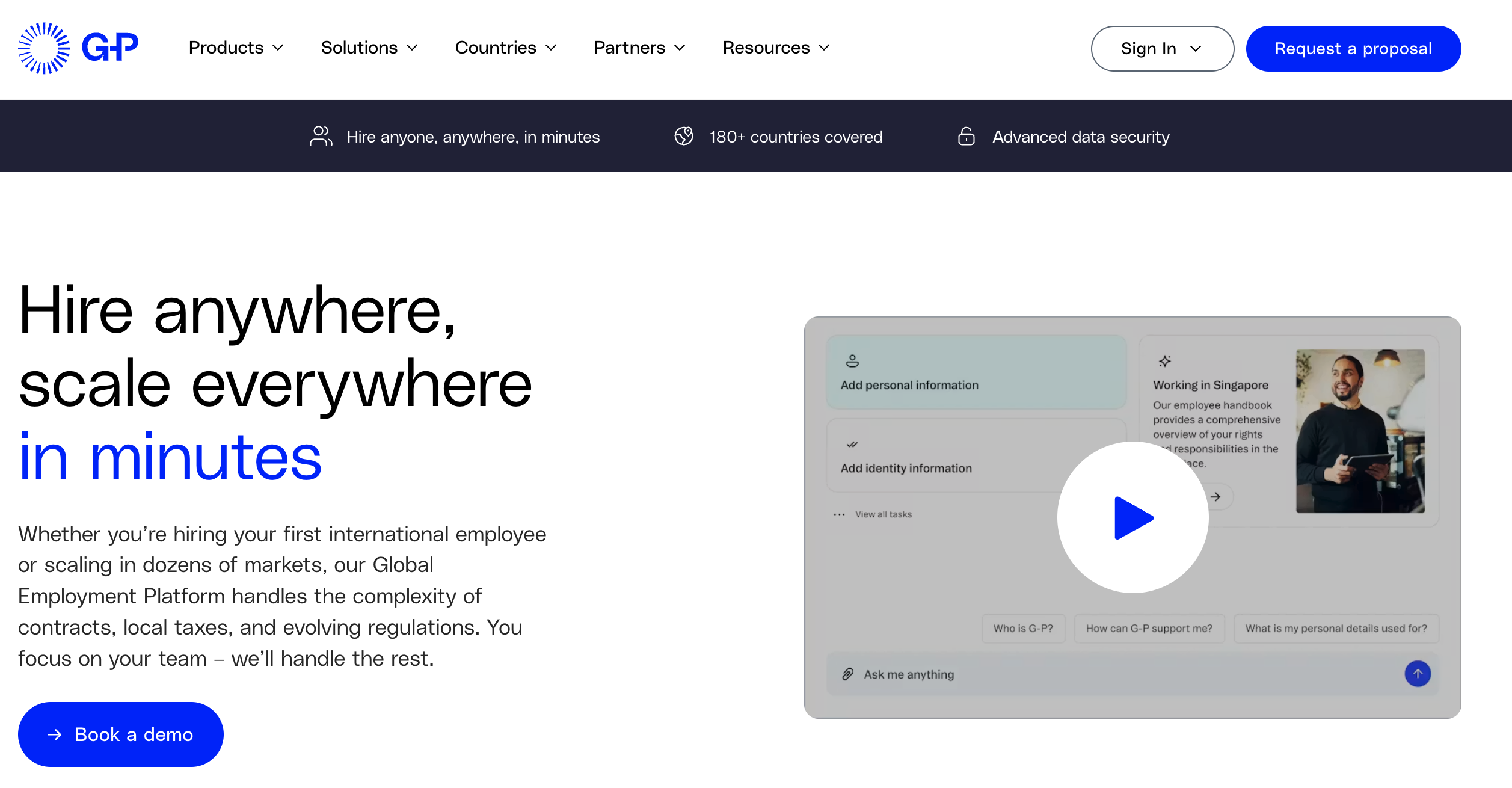
Globalization Partners (G-P) operates across 180+ countries and is positioned for enterprise teams managing complex, multi-country hiring programs. For Saudi Arabia, G-P uses a combination of owned entities and in-country partner networks depending on the market.
The platform covers GOSI contribution management for both Saudi nationals and expatriate employees, Iqama sponsorship and renewal processing, and Nitaqat zone tracking to keep clients within compliant Saudization bands. Employment contracts are issued in Arabic as required under Saudi Labor Law. G-P also offers G-P Gia, an AI-powered compliance intelligence tool providing country hiring insights, salary benchmarks, tax and labor law data, and forecasting tools.
Pricing is custom and not publicly disclosed. Industry sources estimate costs at 10 to 20 percent of salary per employee per month. A contractor plan starts at $39 per month per contractor. Qiwa integration status for Saudi Arabia has not been confirmed in public sources reviewed.
Strengths:
-
Deep legal and compliance coverage through G-P's own compliance engine and in-country experts, covering contracts, payroll, benefits, and taxes across 180+ countries including Saudi Arabia.
-
Enterprise-grade infrastructure supporting GOSI administration, Nitaqat zone management, and Iqama sponsorship within the core EOR service for Saudi Arabia hires.
Limitations:
-
Pricing is not publicly listed and is custom-quoted, making upfront cost comparison difficult for budget-conscious teams evaluating multiple providers.
Best for:
Large enterprises and multinational teams scaling headcount in Saudi Arabia who need a globally recognized EOR with proven compliance infrastructure across multiple jurisdictions.
Safeguard Global

Safeguard Global is a global workforce management and EOR provider with coverage across 187+ countries and territories. The company has operated as an EOR provider for 18+ years and was positioned as a market leader in the 2025 NelsonHall EOR Services NEAT report. Its model combines technology with in-country experts who provide guidance on local labor laws, payroll requirements, and compliance obligations.
For Saudi Arabia, Safeguard Global handles employment contracts issued under Saudi Labor Law, GOSI contributions for both Saudi nationals and expatriate employees, Iqama sponsorship for foreign workers, and WPS-compliant payroll disbursement. Qiwa platform integration status has not been confirmed in publicly available sources. Whether Safeguard Global operates through an owned Saudi legal entity or a partner network in the Kingdom is not confirmed in researched sources. Pricing starts at $699 per employee per month based on published evidence.
Strengths:
-
Technology and human-centered delivery model with in-country experts providing guidance on local labor laws, compliance, payroll requirements, and workforce management across 187+ countries.
-
Recognized as a market leader in the 2025 NelsonHall EOR Services NEAT Report, with 18+ years of EOR operating history supporting enterprise and mid-market clients.
-
Workforce analytics and compliance depth suited to organizations managing headcount across multiple jurisdictions alongside Saudi Arabia.
Limitations:
-
Pricing starts at $699 per employee per month, which positions Safeguard Global toward mid-market and enterprise budgets rather than early-stage or SMB teams.
-
Qiwa integration status and owned-entity confirmation for Saudi Arabia are not publicly documented in researched sources, which limits pre-sales compliance verification.
Best for:
Enterprise and mid-market companies that require human-led compliance guidance, workforce analytics, and broad multi-country coverage alongside Saudi Arabia employment.
Borderless AI
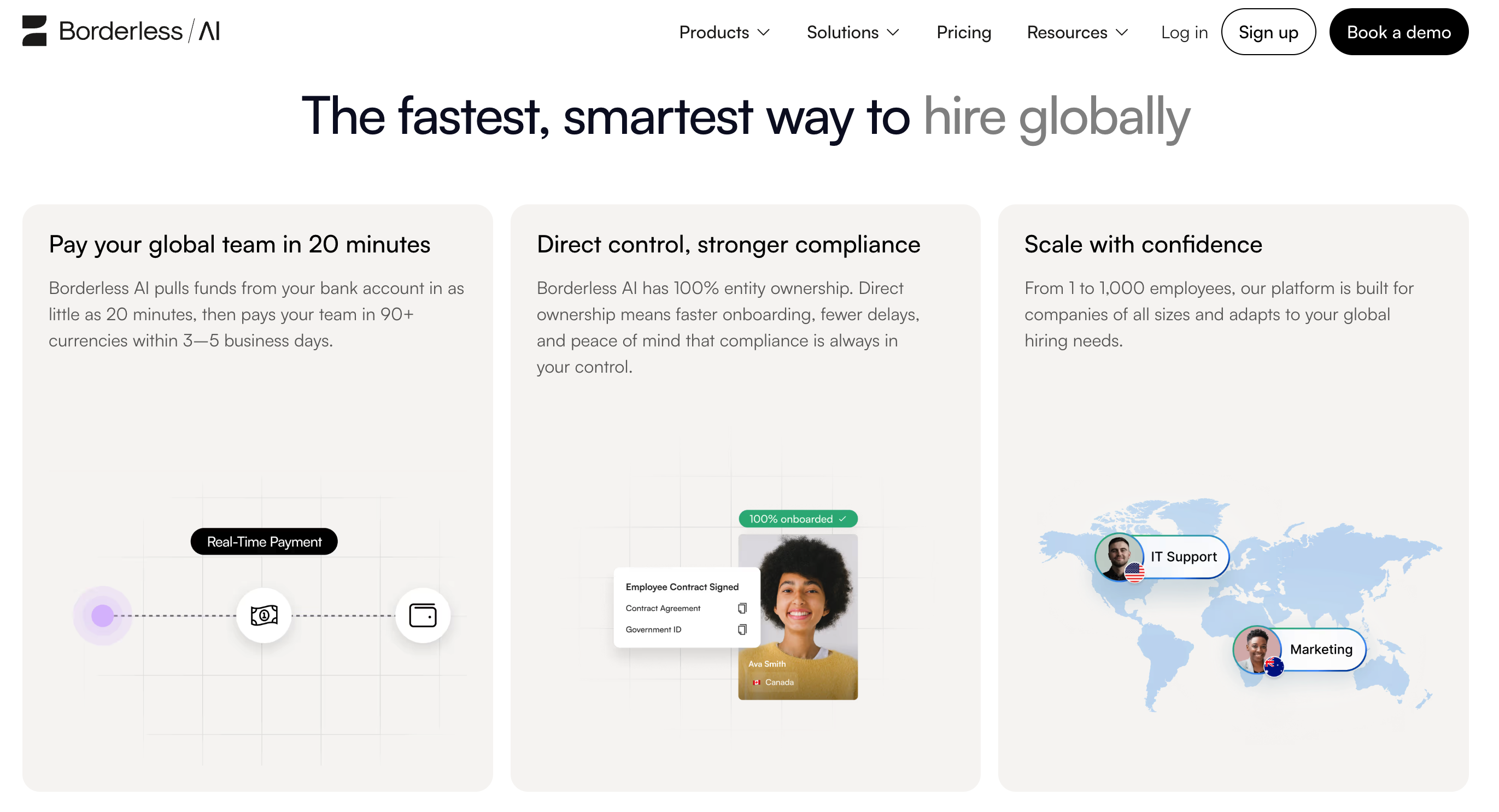
Borderless AI operates across 170+ countries and positions itself as an AI-native EOR designed for companies that want fast global hiring without establishing local entities. For Saudi Arabia, Borderless AI states that it owns its legal entities in every supported market rather than relying on third-party vendors or local partners.
The platform handles employment contracts, onboarding, payroll, taxes, benefits, and compliance, with country-specific employment agreements and local payroll expertise. Borderless AI’s Saudi Arabia coverage supports EOR hiring without the client establishing a Saudi entity, while its global model provides 100% entity ownership and direct control over employment infrastructure. Public Saudi-specific materials support handling of local payroll and compliance, but a specific Qiwa integration is not publicly confirmed.
Pricing starts at $579 per employee per month, with no upfront deposits or salary pre-funding. Borderless AI also offers contractor management from $49 per month and global payroll from $29 per employee per month. The company currently reports a 4.9/5 G2 rating.
Strengths:
-
100% owned-entity model, giving Borderless AI direct control over employment infrastructure rather than relying on third-party vendors.
-
End-to-end management of onboarding, payroll, taxes, benefits, and compliance, supported by local payroll experts and in-house legal and tax specialists.
-
Fast onboarding, with Borderless AI advertising onboarding as fast as 24 hours.
-
Transparent $579 per employee/month EOR pricing with no upfront deposits or salary pre-funding.
Limitations:
-
Saudi-specific public documentation does not clearly detail Borderless AI's handling of individual Saudi requirements such as Qiwa integration, Nitaqat monitoring, or Iqama processing; these capabilities should be confirmed directly before relying on them for a Saudi hiring program.
Best for:
Companies and growing teams that prioritize fast onboarding,
transparent pricing, direct entity ownership, and centralized payroll and
compliance management when hiring in Saudi Arabia and other international
markets.
Mercans
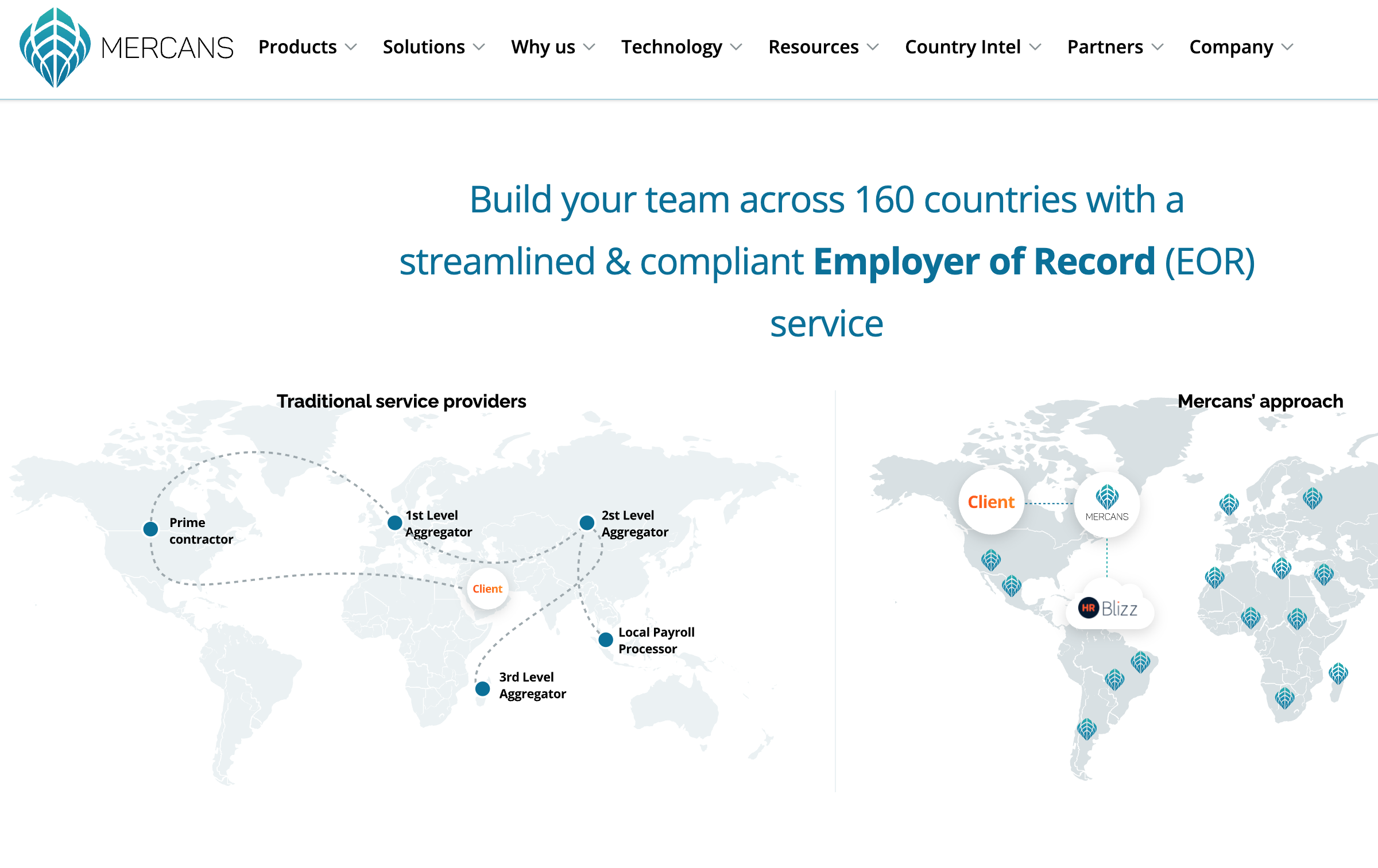
Mercans operates EOR and global payroll services across 160+ countries and uses its own local legal entities and in-country teams rather than an aggregator model. For Saudi Arabia, Mercans provides EOR services that allow companies to hire without establishing their own local entity, while Mercans acts as the legal employer and manages payroll, statutory obligations, benefits, and employment compliance.
The platform and local teams cover Saudi payroll, statutory filings, social insurance contributions, employment contracts, benefits, and HR administration. Mercans also manages expatriate visa sponsorship, work-permit applications and residency processes, including Iqama-related requirements. Its Saudi materials state that Mercans manages payroll contributions for both Saudi employees and expatriates, with non-GCC expatriates generally subject to occupational-hazard contributions.
Pricing is custom and not publicly disclosed. Mercans advertises employee onboarding within 48 hours for its EOR service, although Saudi visa and immigration requirements can affect the practical timeline. Its HR Blizz platform provides automated workflows, digital signatures, payroll, compliance management and HCM integrations.
Strengths:
-
Direct local-employer model with Mercans stating that it provides legal presence and on-ground support rather than relying on an aggregator model.
-
Strong Saudi-specific coverage across payroll, statutory filings, GOSI/social insurance, benefits, employment compliance, visa sponsorship and Iqama processes.
-
HR Blizz provides a unified platform with automated workflows, digital signatures, payroll and compliance functionality, alongside HCM integrations.
-
Local expertise supported by Mercans' in-country teams and global payroll infrastructure across 160+ countries.
Limitations:
-
Pricing is custom-quoted rather than publicly listed, making direct cost comparison more difficult.
-
Although Mercans advertises rapid onboarding, Saudi visa, work-permit and residency procedures can extend the actual time required for expatriate hires.
Best for:
Mid-market and enterprise companies hiring in Saudi Arabia that
need strong local payroll, statutory compliance, social-insurance, immigration
and Iqama support alongside broader multi-country workforce management.
What Are the Key Services of an EOR in Saudi Arabia ?
EOR services in Saudi Arabia carry more compliance complexity than most markets. Providers must manage Iqama sponsorship for expatriate workers, track Nitaqat quota bands under the Saudization framework, handle GOSI contributions at the dual rates that apply to Saudi nationals and expatriates respectively, and disburse salaries through the Wage Protection System.
WPS salary file submission requires registration on the Mudad platform. Buyers should confirm with any provider they evaluate that Mudad registration is in place before committing to a contract. A provider without active Mudad registration cannot legally disburse payroll in the Kingdom.
These requirements apply on top of standard EOR obligations such as employment contracts under Saudi Labor Law, Arabic-language documentation, and end-of-service benefit calculations. Confirming each capability before onboarding reduces compliance risk for both the employer and the employee.
Employment Contracts and Local Compliance
Saudi Labor Law requires all employment contracts to be written in Arabic. Contracts must be registered on the Qiwa platform before the employee's start date. Failure to register on time creates a compliance gap that the Ministry of Human Resources can act on.
Saudi Labor Law recognizes two contract types: fixed-term and open-ended. Fixed-term contracts that are renewed or continued beyond their term can convert to open-ended agreements under Saudi Labor Law provisions. An EOR issues contracts under its own commercial registration, not the client company's.
Probation periods are capped at 90 days. A written agreement between the employer and employee can extend this to a maximum of 180 days. No probation period may exceed that limit under Saudi Labor Law.
Payroll and Tax Administration
All salaries in Saudi Arabia must be disbursed through Wage Protection System (WPS) approved channels. Salary files are submitted through the Mudad platform, which is operated by the Ministry of Human Resources. Non-compliant disbursements can trigger penalties and affect a company's Nitaqat classification.
Saudi Arabia levies zero personal income tax on employees. General Organization for Social Insurance (GOSI) contributions apply, and the rates differ by nationality. Saudi nationals attract higher combined employer and employee contribution rates than expatriate workers.
End-of-service gratuity accrues on basic salary plus fixed allowances. For the first five years of service, the accrual rate is half a month's pay per year. After five years, the rate rises to one full month per year. This accrual represents approximately 4 to 8 percent of basic salary annually.
Benefits Administration
Saudi labor law mandates medical insurance for all employees and their dependents. Expatriate workers must be covered under the employer's group health plan, and this requirement is increasingly applied to Saudi nationals as well.
General Organization for Social Insurance (GOSI) enrollment is compulsory for both Saudi nationals and expatriate employees. End-of-service gratuity accrues as a statutory benefit and must be calculated and reserved throughout the employment period.
-
Annual leave: 21 days per year, increasing to 30 days after five years of service
Maternity leave: 10 weeks
Paternity leave: 3 days
-
Sick leave: 120-day tiered structure covering 30 days at full pay, 60 days at half pay, and 30 days unpaid
Employee Onboarding
Onboarding in Saudi Arabia follows different timelines depending on whether the hire is a Saudi national or an expatriate. Saudi nationals can typically be onboarded within 7 to 14 days. Expatriate hires require Iqama (residence permit) processing, which adds 4 to 8 weeks depending on nationality and documentation.
EOR providers sponsor the Iqama under their own commercial registration, covering work permit applications as part of the onboarding workflow. Registration on the Qiwa government labor platform is a mandatory step that must be completed before the employee's first day.
Work permit applications, Qiwa contract registration, and Iqama renewals are all managed within the EOR's onboarding process, reducing the administrative load on the hiring company.
Ongoing HR Support
A qualified EOR in Saudi Arabia manages Nitaqat quota monitoring as a continuous compliance function, tracking your Saudization ratio against Ministry of Human Resources thresholds each reporting cycle.
The EOR files labor contract amendments and employee updates through the Qiwa government platform, keeping digital records current with Saudi labor authority requirements. GOSI contributions are calculated, filed, and reconciled monthly for both Saudi nationals and expatriate employees.
Each pay cycle, the EOR runs Wage Protection System compliance checks to confirm salary disbursements meet WPS formatting and timing rules. For expatriate staff, the EOR manages Iqama renewals and exit or re-entry visa processing. PRO (Public Relations Officer) services, which cover government liaison and document processing, may be included in the core service or priced separately depending on the provider.
Employee Offboarding
When employment ends in Saudi Arabia, the EOR calculates and pays the end-of-service gratuity (EOSB) owed under Saudi Labor Law. The formula is half a month's wage per year of service for the first five years, then one full month's wage per year after that.
For expatriate employees, the EOR processes Iqama cancellation and exit visa applications following termination. Final settlement must cover the applicable notice period, any unused annual leave payout, and the EOSB amount. The standard notice period for indefinite-term contracts is 60 days under Saudi Labor Law.
The EOR also registers the contract termination on the Qiwa platform, closing the digital employment record with the Saudi labor authority.
How to Hire Through an EOR in Saudi Arabia
Hiring through an EOR in Saudi Arabia follows two phases: Selection and Setup, then Onboarding and Compliance. To understand how does EOR work in practice, the Saudi Arabia process adds steps not present in most other markets.
Those additional steps include Iqama sponsorship for expatriate workers, contract registration on the Qiwa government labor platform, Wage Protection System payroll setup, and General Organization for Social Insurance enrollment for both Saudi nationals and expatriate employees.
Throughout both phases, the EOR acts as the legal employer under its own commercial registration. The client company directs the work. The EOR carries the employment liability and manages all statutory filings with Saudi authorities.
Selection and Setup
The client selects a candidate and shares role details with the EOR, including job title, responsibilities, and target start date.
The EOR then drafts an employment contract that complies with Saudi Labor Law. Contracts must be written in Arabic and structured as either fixed-term or open-ended agreements depending on the role and workforce category.
Before the employee's start date, the EOR registers the contract on the Qiwa platform. Qiwa registration is a legal requirement under Saudi labor regulations and must be completed prior to Day 1.
The EOR also confirms its Nitaqat zone classification at this stage. The Nitaqat system governs Saudization quotas, and the EOR's own classification determines whether it can sponsor additional expatriate employees under its commercial registration.
Finally, the client and EOR agree on the compensation structure. Saudi payroll typically includes a basic salary, a housing allowance, and a transport allowance. General Organization for Social Insurance contributions and end-of-service benefit calculations are based on basic salary plus fixed allowances, so the split between components affects total employer cost.
Onboarding and Compliance
The EOR applies for the employee's work permit and residence permit (Iqama) under its own commercial registration. This process runs through the Ministry of Human Resources and Expatriate Affairs.
For payroll, the EOR registers the employee in the Wage Protection System (WPS) via Mudad, ensuring salary disbursements meet Ministry requirements. The EOR also enrolls the employee with the General Organization for Social Insurance (GOSI) and arranges mandatory medical insurance coverage.
Qiwa enrollment is confirmed before the employee's first day. The client retains full operational control throughout: day-to-day task assignment, performance management, and work scheduling remain with the client organization.
Saudi nationals: typical onboarding timeline is 7 to 14 days.
Expatriates requiring Iqama: typical timeline is 4 to 8 weeks.
What Are the Benefits of Using an EOR in Saudi Arabia ?
Using an EOR in Saudi Arabia removes the need to establish a local Saudi LLC before hiring. Setting up a Saudi LLC typically costs $13,333–$40,000 (SAR 50,000 to SAR 150,000) (approximately $15,000 to $40,000) and takes 2 to 4 weeks. An EOR can onboard employees in 7 to 14 days for Saudi nationals, with no entity registration required.
The compliance environment in Saudi Arabia adds further weight to this calculation. Iqama sponsorship, Nitaqat quota management, and the dual-rate GOSI contribution structure each carry administrative and legal risk. An EOR with current in-country expertise manages these obligations directly, reducing exposure for the client. For companies entering the Kingdom without an established legal presence, this is a practical way to employ workers compliantly from day one.
Faster Market Entry
An EOR can onboard a Saudi national employee in 7 to 14 days. Setting up a Saudi LLC takes a minimum of 2 to 4 weeks and requires $13,333–$40,000 (SAR 50,000 to 150,000) in setup costs before a single hire can be made.
For expatriate hires, an EOR begins Iqama processing immediately under its existing commercial registration. The client company does not need to obtain a Saudi commercial registration, Ministry of Commerce approval, or a Saudization quota allocation before the first employee starts.
This means companies testing the Saudi market or responding to a project opportunity can place workers in-country weeks ahead of what entity setup would allow, without committing to the full cost of a local legal structure.
Reduced Compliance Risk
Saudi Arabia carries several compliance risks that can directly affect a company's ability to operate. Nitaqat quota violations can result in a visa ban, blocking the company from sponsoring any further expatriate workers. Wage Protection System non-compliance triggers fines and a labor ban. GOSI under-reporting carries financial penalties, and incorrect End of Service Benefit calculations expose employers to labor court claims.
A new Nitaqat phase takes effect on 26 April 2026, raising the compliance stakes for any company with expatriate headcount. An EOR absorbs these obligations under its own commercial registration. Its Nitaqat classification protects the client from direct exposure to quota violations, and its existing WPS and GOSI infrastructure covers payroll filings from day one.
Simplified Payroll Administration
Saudi Arabia has no personal income tax, so employers do not withhold income tax from employee salaries. GOSI contributions still apply for both Saudi nationals and expatriate employees, and the EOR calculates, files, and remits these monthly on the employer's behalf.
Payroll is disbursed in Saudi Riyal through the Wage Protection System. The EOR submits the monthly salary file through the Mudad platform, keeping each payroll run WPS-compliant and within Ministry of Human Resources deadlines.
End-of-service benefit accrual is tracked throughout the employment lifecycle. The EOR manages EOSB calculations from day one, so the liability is recorded accurately and no manual reconciliation is required at termination.
Access to Local Benefits
An EOR in Saudi Arabia administers the full set of mandatory employment benefits required under Saudi Labor Law. These include GOSI enrollment, statutory medical insurance, annual leave of 21 days rising to 30 days after five years, ten weeks of maternity leave, three days of paternity leave, and a 120-day tiered sick leave entitlement. End-of-service benefit accrual is tracked and managed throughout employment.
Beyond statutory minimums, an EOR can source supplementary benefits such as enhanced medical cover and life insurance. A foreign company without a Saudi legal entity would find these difficult to arrange independently through local insurers.
Housing and transport allowances are standard components of Saudi compensation packages. These allowances affect both GOSI contribution calculations and EOSB accruals. An EOR structures these correctly from the start, so the payroll treatment is accurate and compliant from the first pay run.
Lower Entity Setup Costs
Setting up a Saudi LLC requires $13,333–$40,000 (SAR 50,000 to 150,000) in capital and registration fees, equivalent to roughly $15,000 to $40,000, before a single employee is hired. The process takes a minimum of two to four weeks.
Ongoing entity costs add further weight: annual audits, Ministry of Commerce filings, PRO services, and Nitaqat quota management all require dedicated resources. An EOR eliminates every one of these costs.
For most companies, the break-even point sits at eight to twelve employees. Below that threshold, an EOR is typically more cost-effective than maintaining a Saudi legal entity. Under the EOR model, the provider's commercial registration carries the Nitaqat quota obligation, not the client company.
More Flexible Workforce Scaling
An EOR lets companies grow or reduce their Saudi Arabia headcount without directly adjusting Nitaqat quota obligations. Expatriate headcount can increase as long as the EOR maintains a sufficient Nitaqat zone classification.
This model suits project-based hiring, including staffing for Vision 2030 giga-projects, where companies need workers on the ground without committing to a permanent entity structure. When a project ends, offboarding through the EOR covers End of Service Benefit payment and Iqama cancellation, leaving no residual entity obligations for the client.
Companies scaling across multiple markets can manage this through a single employment layer. EOR for startups entering Saudi Arabia and EOR for enterprises running large-scale deployments both benefit from this flexibility without the fixed costs of a local entity.

How to Find the Right EOR for Saudi Arabia
Selecting an EOR for Saudi Arabia requires evaluating factors that go beyond standard global EOR criteria. The Kingdom's regulatory environment is specific, frequently updated, and enforced through government platforms that not all providers support.
Five criteria matter most when shortlisting providers for Saudi Arabia: local compliance expertise, clear service scope, support model, technology and reporting, and scalability. Among these, owned-entity status and Qiwa platform integration are the two most critical Saudi-specific differentiators. They directly affect compliance risk and onboarding speed in the Kingdom.
Local Compliance Expertise
Saudi Arabia EOR compliance covers several distinct regulatory areas. Providers must demonstrate current knowledge of Saudi Labor Law under Royal Decree M/51, Nitaqat and Saudization quota regulations, GOSI contribution structures, WPS and Mudad payroll compliance, and Iqama sponsorship rules for expatriate workers.
Two recent regulatory changes require particular attention. The updated Nitaqat phase takes effect on 26 April 2026, introducing revised Saudization quota requirements that providers must already be applying. GOSI also introduced a new contribution scheme for employees registered on or after 3 July 2024, with different rates from the prior structure.
When evaluating providers, ask directly whether they employ in-country Saudi compliance counsel or rely on remote legal teams. The answer affects how quickly a provider can respond to regulatory updates and resolve employment issues on the ground.
Clear Service Scope
EOR fees in Saudi Arabia vary widely depending on what is included. Before signing, confirm exactly which services are covered and which carry additional charges.
Standard inclusions with most Saudi Arabia EOR providers:
Wage Protection System payroll disbursement
GOSI contributions for Saudi nationals and expatriates
Qiwa labor contract registration
End-of-service gratuity accrual
Work visa and Iqama sponsorship
Common extras that providers bill separately:
Premium medical insurance sourcing
Iqama and visa processing fees
Family and dependent visas
PRO services for government liaison
Equipment, housing, and relocation support
Ask each provider to confirm in writing whether Mudad filing, Nitaqat reporting, and Arabic-language contract preparation are included or priced separately.
Support Model
Support quality matters more in Saudi Arabia than in many other markets. Government platform issues, Iqama rejections, and Nitaqat compliance queries require fast, knowledgeable responses, not a generic ticket queue.
Key questions to ask any provider before committing:
-
Is Arabic-language HR support available for employees and managers?
-
Does the provider have an in-country team in Saudi Arabia or operate remotely from another time zone?
-
For expatriate-heavy workforces: is there a dedicated immigration case manager, or does each query go to a shared inbox?
-
What is the escalation path if a Nitaqat compliance issue or Iqama rejection occurs?
Saudi Arabia operates on Arabia Standard Time (UTC+3). Providers based outside the region may have limited overlap with local business hours. For large-scale deployments, confirm whether the provider maintains a Saudi-based account team or PRO network with direct Ministry of Human Resources access.
Technology and Reporting
Saudi Arabia requires EOR providers to operate across three government platforms: Qiwa for digital labor contract registration, Mudad for Wage Protection System payroll filing, and GOSI for social insurance reporting. A provider that handles these manually adds processing time and compliance risk to every payroll cycle.
When evaluating platforms, ask whether Qiwa integration is direct or requires manual document submission. Ask the same for Mudad: automated WPS salary file generation in the required format reduces errors and keeps payroll runs on schedule. GOSI reporting automation matters equally, particularly for workforces that include both Saudi nationals and expatriate employees.
Real-time Nitaqat zone visibility is a practical requirement for any employer managing Saudization ratios. A platform that shows the current ratio and alerts when headcount changes approach a threshold boundary gives HR teams time to act before a compliance breach occurs. Review employer of record software options with these Saudi-specific integrations in mind before shortlisting.
Scalability for Your Hiring Plans
An EOR provider's own Nitaqat zone classification sets a practical ceiling on how many expatriate employees it can sponsor in Saudi Arabia. Before committing to a provider, confirm its current zone and the maximum expatriate headcount it can support under that classification.
For Vision 2030 project staffing, the relevant question is whether the provider can deploy 50 or more employees within 90 days. Large infrastructure and technology projects often require rapid, coordinated onboarding across multiple roles and locations. A provider without that operational capacity becomes a bottleneck at the point when speed matters most.
If your hiring plan extends across the Gulf Cooperation Council alongside Saudi Arabia, confirm whether the same platform covers the UAE, Qatar, Kuwait, Bahrain, and Oman. Managing separate providers per country adds administrative overhead and reduces payroll visibility across the region.

Why Gloroots Is a Strong EOR Partner in Saudi Arabia ?
Gloroots operates through its own Saudi legal entity with direct registration on both Qiwa and Mudad. This means employee labor contracts are registered on the Qiwa government platform before Day 1, and salary files are submitted through Mudad for Wage Protection System compliance. Clients do not need a Saudi commercial registration to employ workers in the Kingdom.
Iqama sponsorship runs under Gloroots' own commercial registration. Expatriate employees receive residency permit sponsorship without the client establishing a local entity. GOSI contributions are calculated and filed under the correct rate scheme for both Saudi nationals and expatriate employees.
Payroll is disbursed in SAR and structured to meet WPS requirements. Gloroots uses predictable, country-specific pricing with full cost visibility before onboarding begins. There are no percentage-of-salary fees, so finance teams work from a fixed monthly figure per employee.
-
Owned Saudi legal entity with direct Qiwa and Mudad registration
-
Iqama sponsorship under Gloroots' own commercial registration, no client entity required
-
GOSI contribution handling for Saudi nationals and expatriates under the correct rate scheme
WPS-compliant payroll disbursement in SAR
-
Dedicated account manager with retained Saudi Arabia compliance context across every interaction
Gloroots is a strong fit for international technology and professional services companies entering Saudi Arabia without a local entity. The combination of entity-free employment, predictable monthly costs, and centralized governance across multiple countries makes it a practical choice for teams scaling across the GCC and beyond. Learn more about Gloroots EOR services or review Gloroots pricing before onboarding.
FAQs About the Best EOR in Saudi Arabia
The questions below address the most common due-diligence points from companies evaluating EOR options in Saudi Arabia. Topics cover the legal status of EOR in the Kingdom, Iqama sponsorship without a local entity, the difference between owned-entity and partner-based EOR structures, Iqama processing timelines, cost expectations, when EOR is the right structure, and the distinction between hiring Saudi nationals and foreign employees.
Is using an EOR legal in Saudi Arabia?
Yes. Saudi labor
law permits companies to employ workers through a licensed employer of record.
The EOR holds the employment contract and assumes legal employer obligations
under Saudi Labor Law.
Can an EOR sponsor an Iqama without the client having a Saudi
entity?
Yes. An EOR with its own Saudi commercial registration can sponsor
Iqama residency permits for expatriate employees. The client does not need to
establish a local entity.
What is the difference between an owned-entity EOR and a partner-based EOR
in Saudi Arabia?
An owned-entity EOR employs workers through its own registered Saudi
legal entity. A partner-based EOR relies on a third-party local company to
hold employment contracts. Owned-entity structures reduce the compliance risk
that arises when a partner relationship changes.
How long does Iqama processing take?
Processing
timelines vary depending on the employee's nationality, the completeness of
documentation, and current government processing volumes. Clients should
confirm expected timelines with their EOR provider before committing to a
start date.
How much does EOR in Saudi Arabia cost?
Pricing across
providers reviewed on this page ranges from approximately $199 to $699 per
employee per month. Some providers use flat monthly fees; others use
percentage-of-salary models. Flat-fee structures give finance teams a fixed
monthly figure per employee.
When should a company use EOR rather than setting up a Saudi
entity?
EOR is appropriate when a company wants to employ workers in Saudi
Arabia without the time and cost of registering a local entity. It suits
companies testing the market, running small teams, or managing multi-country
headcount from a single governance layer.
Can an EOR hire both Saudi nationals and foreign employees?
Yes. EOR providers in Saudi Arabia can employ both Saudi nationals and
expatriate workers. GOSI contribution rates differ between the two groups, and
Nitaqat Saudization quotas apply to the overall workforce composition. A
compliant EOR handles both correctly.
How does an EOR work in Saudi Arabia ?
An EOR in Saudi Arabia acts as the legal employer under its own commercial registration. The EOR handles employment contracts registered on the Qiwa government labor platform, General Organization for Social Insurance (GOSI) enrollment, and Wage Protection System-compliant payroll disbursement through Mudad.
For expatriate hires, the EOR manages Iqama sponsorship, covering work permit applications and renewals. The EOR also tracks Nitaqat quota requirements to keep the client within compliant Saudization bands. The client company retains day-to-day operational control and does not need its own Saudi legal entity.
EOR is legal in Saudi Arabia when operated through a licensed local entity. All engagements run under Saudi Labor Law, and mandatory benefits apply to both Saudi nationals and expatriate employees.
What does an EOR cost in Saudi Arabia ?
EOR fees in Saudi Arabia typically range from $349 to $699 per employee per month for global platforms. Local specialists often use custom pricing. Pricing varies by provider and headcount.
Standard EOR fees cover WPS-compliant payroll, GOSI contributions, Qiwa registration, and gratuity accrual. Total employer cost above base salary runs approximately 15 to 22 percent for Saudi nationals, accounting for GOSI, end-of-service benefit accrual, and medical insurance. For expatriate employees, the additional employer cost is typically 8 to 15 percent.
Common items billed separately include Iqama and visa processing fees, premium medical insurance, PRO services, and family or dependent visas. For a full breakdown of what drives employer of record cost across markets, see the linked guide.
When should a company use an EOR in Saudi Arabia ?
Companies should use an EOR in Saudi Arabia when testing the market before committing to a Saudi LLC. Entity setup costs range from $13,333–$40,000 (SAR 50,000 to SAR 150,000), which is difficult to justify for a team of one to ten employees.
An EOR is also the right structure when a company needs to hire expatriates quickly but does not yet hold a Saudi commercial registration to sponsor Iqama visas. Project-based workforces supporting Vision 2030 contracts benefit from EOR arrangements that avoid long-term entity commitments.
Companies without in-house expertise in Nitaqat, GOSI, and Wage Protection System requirements should use an EOR to manage those obligations from day one.
Can an EOR hire both local and foreign employees in Saudi Arabia ?
Yes. An EOR in Saudi Arabia can employ both Saudi nationals and expatriate workers under a single engagement.
For Saudi nationals, the EOR issues a standard employment contract, enrolls the employee in GOSI at Saudi national contribution rates, and processes salary through the Wage Protection System. For expatriate workers, the EOR sponsors the Iqama residence permit under its own commercial registration, obtains the required work permit, enrolls the employee in GOSI at the expatriate rate covering occupational hazard, and runs WPS payroll.
The EOR's capacity to sponsor expatriates depends on its current Nitaqat zone classification. Buyers should confirm the provider's Nitaqat zone before committing to an engagement.
How do I choose the right EOR in Saudi Arabia ?
To choose the right EOR for Saudi Arabia, evaluate seven factors. First, confirm whether the provider holds an owned Saudi legal entity or relies on a partner network, as an owned entity reduces compliance risk. Second, verify Qiwa and Mudad integration, both of which are mandatory for legal employment and Wage Protection System payroll. Third, check the provider's current Nitaqat zone classification, which determines expatriate sponsorship capacity. Fourth, confirm GOSI automation with correct rate application by nationality. Fifth, review pricing transparency and what is included versus charged separately for Saudi Arabia. Sixth, assess in-country support capability and Arabic-language availability. Seventh, ask for a track record with Saudi nationals and expatriate hires in your industry.