







- The Philippines requires statutory contributions to five agencies (SSS, PhilHealth, Pag-IBIG, BIR, and DOLE), and an EOR must handle all five accurately to avoid assessment penalties and employee benefit gaps.
- Minimum wage rates in the Philippines are set regionally, not nationally, so the correct floor wage depends on where each employee works; confirm that your EOR monitors Regional Tripartite Wages and Productivity Board orders across all relevant locations.
- Most providers on this list do not publicly disclose whether their quoted fee includes government contributions, BIR filing costs, 13th month pay accruals, or offboarding fees; request an itemized quote before signing to confirm total employer cost.
- Hiring through an EOR removes the requirement to register a local entity with the SEC, reducing market entry from several months to 3 to 7 days while the EOR assumes legal employer obligations under the Labor Code.
- Termination in the Philippines follows two distinct procedural tracks under the Labor Code, authorized cause and just cause, each with different notice requirements, separation pay calculations, and DOLE documentation obligations that the EOR must execute correctly.
Updated June 2026. Reviewed by the Gloroots editorial team. Providers were evaluated using publicly available pricing data, compliance documentation, and third-party research. Gloroots is included in this list as the publisher of this page.
The Philippines runs payroll on a bi-monthly cycle, meaning employees receive two salary payments each month, typically on the 15th and the last working day. Minimum wage rates are not set at the national level. Regional Tripartite Wages and Productivity Boards set rates independently, so the applicable floor wage depends on the region and industry where the employee works.
The BPO and IT-BPO sectors account for the largest share of foreign hiring in the Philippines. Most international companies entering the market do so to staff customer support, software development, or shared services functions. This context shapes what compliance coverage and payroll accuracy a Philippines best employer of record must deliver.
Our Top 8 Picks: Philippines EOR Comparison 2026
These eight providers were evaluated across five criteria: compliance depth for Philippines statutory obligations (SSS, PhilHealth, Pag-IBIG, BIR, DOLE), onboarding speed, pricing transparency, Philippines-specific statutory coverage, and support model. The list includes global platforms operating across 100-plus countries and providers with focused regional or local positioning. Government contribution handling (SSS, PhilHealth, Pag-IBIG) is noted in the pricing column where publicly confirmed.
| Provider | Pricing per month | Country coverage | Onboarding speed | Platform experience | Customer support | Scalability |
|---|---|---|---|---|---|---|
| Gloroots | From $199/employee/month; country-specific pricing with government contributions included | 150+ countries | 3–5 working days | Centralized workforce platform with hiring, onboarding, payroll, compliance, benefits, expenses, and workforce visibility | 24/7 human support with dedicated specialists | SMB to enterprise; supports compliant full-time employment across 150+ countries |
| G-P | Custom pricing / contact sales | 180+ countries | Not publicly listed as a fixed universal timeframe | G-P Global Employment Platform / Meridian covering hiring, onboarding, payroll, compliance, and workforce management | 24/7 support with in-country experts and customer-success resources | Mid-market to enterprise; designed for complex multinational workforce operations |
| RemoFirst | From $199/employee/month | 185+ countries | Days, not weeks; country-dependent | Centralized global employment platform covering EOR, payroll, tax filings, pensions, localized contracts, onboarding, and workforce management | 24/7 customer support with dedicated account managers | Startups to enterprise; supports global workforce expansion across 185+ countries |
| Borderless AI | From $579/employee/month | 170+ countries | 24–48 hours | AI-powered EOR and global workforce platform covering contracts, compliance, payroll, benefits, and workforce management | 24/7 in-house support with a dedicated point of contact | Startups to enterprise; designed for rapid international workforce expansion |
| Native Teams | From €99/employee/month | 95+ countries | Not publicly listed as a fixed universal timeframe | Unified platform covering EOR, payroll, contractor management, payments, compliance, benefits, and workforce management | Dedicated support specialists with local expertise | Startups to growing businesses; supports international workforce management across 95+ countries |
| Papaya Global | From $499/employee/month | 180+ countries | Get started in weeks | Global Workforce OS integrating EOR, payroll, payments, benefits, compliance, contracts, and workforce data | 24/7 support with in-country experts | Mid-market to enterprise; designed for large multi-country workforce and payroll operations |
| Remote | $699/employee/month monthly; $599/month with annual billing | 90+ EOR countries | Onboarding in minutes advertised; actual activation varies by country | Digital-first global employment platform covering EOR, payroll, benefits, compliance, contractors, and workforce management | 24/7 specialist support with local HR, legal, and finance expertise | SMB to enterprise; suited to standardized global hiring and distributed workforce operations |
| Boundless | From $199/employee/month | 110+ countries | Not publicly listed as a fixed universal timeframe | Global EOR platform covering employment contracts, payroll, taxes, benefits, compliance, and employee lifecycle management | Dedicated account management and local employment experts | SMB to enterprise; designed to support international workforce expansion |

Top 8 Best EOR Platforms in Philippines
These eight providers were selected based on Philippines compliance depth, pricing transparency, onboarding speed, support model, and statutory coverage across SSS, PhilHealth, Pag-IBIG, BIR, and DOLE requirements.
Most platforms on this list are global EOR providers operating across multiple countries, including the Philippines. A smaller number are locally headquartered or regionally anchored, with compliance infrastructure built specifically for the Philippine market.
Several providers also support contractor-to-employee conversion, allowing companies to transition independent contractors into full-time employed status without switching platforms or re-running onboarding from scratch.
Gloroots
Gloroots runs compliant full-time employment across 150+ countries, including the Philippines, as the legal employer of record. Its service covers Global Employer of Record (EOR), Global Payroll, Compliance and Employment Governance, and Benefits and Statutory Coverage.
Pricing follows a predictable, country-specific model with full cost visibility before onboarding. There is no percentage-of-salary pricing. The quoted fee covers payroll processing, BIR compliance, government contributions, and 13th-month pay accruals. Gloroots states that in the Philippines a flat monthly EOR fee from $199 covers SSS, PhilHealth, Pag-IBIG, BIR filings, and 13th‑month management, and lists setup cost as none.
Gloroots supports contractor-to-employee conversion, allowing companies to transition workers from independent contractor arrangements into full-time employment without re-platforming.
Strengths:
-
Predictable, country-specific pricing with full cost visibility before onboarding and no percentage-of-salary fees, reducing payroll budget risk for finance teams.
-
Centralized workforce visibility with human-led account support and retained business context, giving HR and operations teams a consistent point of contact across the employment lifecycle.
Limitations:
-
Public sources reviewed did not document a provider-specific limitation.
Best for:
Companies scaling international headcount who need entity-free employment in the Philippines with predictable pricing, centralized governance, and human-led account ownership. Gloroots is best suited for companies hiring 1 to 50 employees in the Philippines, including BPO operators. Cenon Marco M., Operations Analyst at a small business (50 or fewer employees), on G2: “we have a team member in the Philippines who has had issues with their pay.”


G-P
G-P operates as a global EOR platform with Philippines-specific capabilities covering legal employment, statutory contributions, and Labor Code compliance. It is noted for flexible global payment options, which suits companies managing payroll across multiple currencies and regions.
G-P handles SSS, PhilHealth, and Pag-IBIG enrollment and remittances, BIR withholding and filing, and 13th month pay processing for Philippine employees. Employment contracts are structured to meet DOLE requirements.
-
Legal employment in the Philippines without requiring a local entity
Statutory contribution management: SSS, PhilHealth, Pag-IBIG
BIR tax withholding, Form 2316, and annual filing support
13th month pay computation and payment management
Labor Code-compliant employment contracts
Flexible global payment options across multiple currencies
Strengths: Flexible payment infrastructure suited to companies paying across multiple countries. Established Philippines compliance coverage including statutory contributions and BIR filings.
Limitations: Pricing is not publicly listed in researched sources. It is not confirmed whether the quoted fee includes government contributions, BIR filing costs, 13th month pay accruals, and offboarding fees, so buyers should request a full cost breakdown before signing.
Best for: Companies managing global payroll across multiple currencies who need Philippines Labor Code compliance without establishing a local entity.
Pricing is available on request. Public sources reviewed did not confirm whether G-P's quoted fee includes SSS, PhilHealth, Pag-IBIG contributions, BIR filing, 13th month pay, or offboarding costs. Request an itemized quote to confirm total employer cost.
RemoFirst
RemoFirst positions itself as a low-cost EOR option suited to startups and SMBs expanding into the Philippines on a tight budget. Its Philippines coverage includes SSS, PhilHealth, and Pag-IBIG handling, BIR compliance, and 13th month pay processing under the Labor Code.
Onboarding is reported at 3 to 5 days for Philippine employees, which is competitive for budget-tier providers. Public sources do not confirm whether this timeline applies consistently to BPO or high-volume hiring scenarios, where additional DOLE documentation and multi-employee registration may extend the process.
-
SSS, PhilHealth, and Pag-IBIG enrollment and monthly remittances
BIR withholding tax compliance for Philippine employees
13th month pay computation and December payment management
Labor Code-compliant employment contracts
Rapid activation with reported 3 to 5 day onboarding
Strengths: Low entry-level pricing makes it accessible for startups and SMBs. Covers core Philippines statutory obligations including SSS, PhilHealth, Pag-IBIG, and BIR compliance.
Limitations: Public sources reviewed did not confirm whether RemoFirst's quoted fee includes government contributions or excludes them as a separate employer cost. High-volume or BPO hiring suitability is not documented in reviewed sources.
Best for: Startups and small businesses hiring one to five employees in the Philippines who need basic Labor Code compliance at a lower monthly cost.
Pricing starts from approximately $240 (₱15,000) to $560 (₱35,000) per employee per month based on the existing comparison data. Buyers should confirm directly with RemoFirst whether SSS, PhilHealth, Pag-IBIG contributions, BIR filing, and offboarding fees are included in or added to the base fee.
Borderless AI
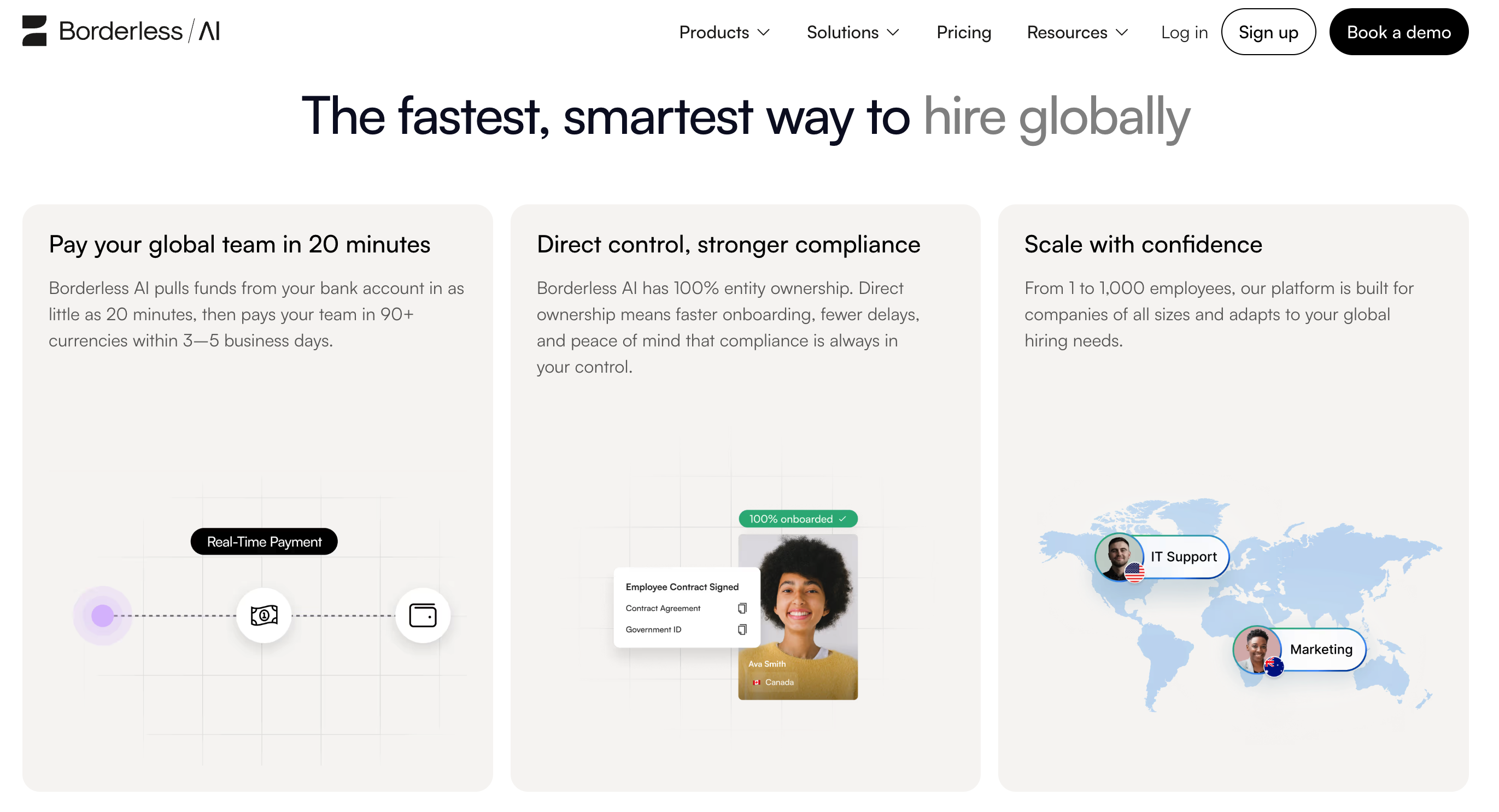
Borderless AI is an EOR platform designed to accelerate international hiring, including in the Philippines. Its AI-driven infrastructure is intended to reduce the time between contract signing and active employment, which suits companies that need to move quickly on Philippines headcount without establishing a local entity.
For Philippines-specific compliance, Borderless AI covers statutory contributions including SSS, PhilHealth, and Pag-IBIG, along with BIR tax withholding and Labor Code-compliant employment contracts. Whether its AI-driven processing maintains full accuracy across the Philippines' multi-agency statutory framework, including 13th month pay calculations and regional minimum wage variations, is not confirmed in publicly reviewed sources.
-
SSS, PhilHealth, and Pag-IBIG statutory contribution management
BIR tax withholding and remittance support
Labor Code-compliant employment contracts
-
Contractor-to-employee conversion capability: Borderless AI supports contractor-to-employee conversion through its EOR, allowing you to convert between models without switching vendors.
Strengths: AI-driven onboarding designed for speed; broad country coverage supporting multi-market expansion alongside the Philippines.
Limitations: Public sources reviewed did not document a provider-specific limitation for Borderless AI in the Philippines context.
Pricing: Pricing is not publicly listed in researched sources. Contact Borderless AI directly for a Philippines-specific quote.
Borderless AI has publicly attributed Philippines-based customer reviews on Trustpilot confirming EOR use. Donaldson Capanan from the Philippines states that Borderless has supported his employment for two years and helped with payroll and EOR-related support.
Native Teams
Native Teams positions itself as an EOR that supports direct hiring arrangements in the Philippines. In the context of the Philippines Labor Code, direct hiring means Native Teams acts as the legal employer on record, executing employment contracts that comply with DOLE requirements, managing statutory contributions, and assuming employer liability under Book VI of the Labor Code. This structure allows foreign companies to hire Filipino workers without routing employment through a third-party staffing agency, which carries separate regulatory obligations under DOLE Department Order No. 174.
-
DOLE-compliant employment contracts with direct employer-of-record structure
-
SSS, PhilHealth, and Pag-IBIG statutory contribution processing
BIR tax withholding and remittance management
13th month pay administration under Presidential Decree 851
Strengths: Direct hiring structure reduces misclassification risk under Philippines labor law; DOLE-compliant contract execution supports Labor Code adherence from day one.
Limitations: Public sources reviewed did not document a provider-specific limitation for Native Teams in the Philippines context.
Pricing: Pricing is not publicly listed in researched sources. Contact Native Teams directly for a Philippines-specific quote.
Native Teams has a Philippines-based customer review from Hanna Pineda on Trustpilot regarding payroll services for two employees, though Trustpilot does not publicly disclose the reviewer's job role or company size.
Papaya Global
Papaya Global positions itself as an enterprise payroll consolidation platform with an AI-based payroll engine designed to reduce manual calculation errors across multiple countries, including the Philippines.
For Philippine employment, the platform handles SSS, PhilHealth, and Pag-IBIG contributions, BIR withholding compliance, and 13th month pay processing. Its AI-based engine applies statutory rules automatically, which is intended to reduce errors in contribution rate changes and BIR filing cycles.
Strengths:
-
AI-based payroll engine applies Philippines statutory rules, including SSS, PhilHealth, Pag-IBIG, and BIR withholding, to reduce manual calculation errors.
-
Combines EOR and global payroll in a single platform, giving finance teams consolidated reporting across multiple countries.
-
Supports 13th month pay computation and BIR compliance within its payroll workflow.
Limitations:
-
Pricing ranges from approximately $480 (₱30,000) to $929 (₱58,000) per employee per month, placing it at the higher end of the market for teams that need only Philippines-specific compliance without broader payroll consolidation.
-
Papaya Global clarifies that the per‑employee‑per‑month EOR fee covers the service fee only, while employer contributions (statutory costs) are separate components of the total cost and not part of the base fee.
Best for: Enterprises that need to consolidate global payroll across multiple countries and want an AI-assisted engine to manage Philippines statutory contributions and BIR compliance within a unified platform.
Remote
Remote specializes in distributed workforce compliance, covering home office employment frameworks, multi-location payroll across Philippine regions, and API-first infrastructure for companies managing fully remote teams.
For Philippine employment, Remote handles SSS, PhilHealth, Pag-IBIG, and BIR withholding, and supports regional minimum wage variations across Metro Manila, Cebu, Davao, and provincial areas. Its employment contracts include home office provisions and connectivity allowances suited to remote-first hiring structures.
Strengths:
-
Distributed-workforce employment contracts include home office provisions and connectivity allowances within Labor Code compliance.
-
RESTful API and webhook integrations support automated data flows between Remote and existing HRIS or payroll systems.
-
Multi-location payroll processing accounts for regional minimum wage differences across Philippine provinces and cities.
Limitations:
-
Business hours support may create gaps for urgent compliance questions outside standard time zones.
-
Premium pricing relative to compliance-only providers makes it less accessible for small teams that do not require remote-work-specific contract features.
Best for: Companies with fully remote Philippine teams spread across multiple regions that need distributed-workforce employment contracts, regional payroll accuracy, and API connectivity with existing HR systems.
Boundless
Boundless is an employer of record platform that supports compliant employment in multiple countries. Public sources reviewed did not document specific Philippines statutory coverage details, pricing, or onboarding timelines for Boundless in the researched sources available for this draft.
Strengths:
-
Boundless’ Philippines EOR registers employees with SSS, PhilHealth, and Pag-IBIG, issues compliant contracts, runs payroll with tax withholding, and administers 13th month pay; it also enables hiring in the Philippines without a local entity, typically within weeks.
Limitations:
-
Public sources reviewed did not document a provider-specific limitation for Boundless in the Philippines context.
Best for: Not for companies hiring in the Philippines, as Boundless does not support the Philippines.
What Are the Key Services of an EOR in Philippines?
An EOR in the Philippines must cover statutory compliance across five government agencies as a baseline: SSS, PhilHealth, Pag-IBIG, BIR, and DOLE. Without accurate remittances to each agency, employers face assessment penalties and employee benefit gaps.
Core services typically include payroll processing, mandatory contribution enrollment and remittance, BIR tax withholding and filing, DOLE-compliant contract generation, and 13th-month pay administration. Service scope varies by provider. Some include contractor management and contractor-to-employee conversion; others focus exclusively on full-time employment.
Select providers also support converting existing contractors to full-time employees without requiring a new onboarding cycle, which reduces transition risk for companies that started with freelance arrangements before formalizing their Philippine workforce.
Employment Contracts and Local Compliance
Employment contracts in the Philippines must comply with the Labor Code and are subject to DOLE registration requirements. Foreign companies hiring locally need contracts that reflect the correct employment classification from day one.
Philippine law distinguishes between fixed-term and regular employment. Fixed-term contracts are valid only under specific conditions; otherwise, employees who complete a probationary period of up to six months and meet performance standards are entitled to regularization, which carries full statutory protections.
EOR providers generate DOLE-compliant contracts and manage the accompanying registration documentation, reducing the risk of misclassification penalties and regularization disputes before they arise.
Payroll and Tax Administration
The standard payroll cycle in the Philippines runs twice per month. Each cycle requires accurate computation of BIR withholding tax, which must be remitted monthly, reported in quarterly alphalists, and reconciled in the annual Form 2316 issued to every employee.
Statutory contributions add further obligations. SSS, PhilHealth, and Pag-IBIG each carry monthly remittance deadlines with contribution rates set by their respective agencies. Employers must also compute and pay 13th month pay no later than December 24 each year.
Payroll calculations must account for night differential pay at 10% and overtime at 125% of the regular hourly rate. EOR providers automate all of these calculations and remittances, reducing exposure to BIR deficiency assessments and SSS audit findings.
Benefits Administration
Philippine law mandates three statutory benefit programs as the baseline for all employees: SSS (Social Security System), PhilHealth, and Pag-IBIG. Employers must enroll workers in all three and remit contributions monthly.
Presidential Decree 851 requires a 13th month pay equal to one-twelfth of an employee's annual basic salary, paid no later than December 24 each year. This is a legal obligation, not a discretionary bonus.
Beyond statutory minimums, many employers in the Philippines offer supplemental private health insurance through providers such as PhilCare, Maxicare, and Allianz. EOR providers handle enrollment, premium coordination, and renewals for these plans.
Gloroots includes Benefits and Statutory Coverage as part of its employment operating layer, covering both mandatory government contributions and supplemental benefits administration. EOR providers that offer benefits benchmarking help companies set competitive packages without building internal compensation expertise for the Philippine market.
Employee Onboarding
Onboarding a Philippine employee through an EOR involves several government-facing steps: DOLE employment contract registration, SSS, PhilHealth, and Pag-IBIG enrollment, and BIR Tax Identification Number verification or issuance for new hires.
EOR providers complete this process digitally, collecting signed contracts, government ID copies, and pre-employment medical clearances through secure document portals. Pre-employment medical examinations are a common requirement in Philippine hiring practice.
The typical EOR onboarding timeline runs 3 to 7 days. Setting up a local legal entity in the Philippines takes several months and requires SEC registration, local directors, and ongoing corporate compliance filings.
Companies converting contractors to full-time employees follow a variant workflow: the EOR issues a new employment contract, re-enrolls the worker in statutory programs under the employment relationship, and closes out the prior contractor arrangement. Gloroots supports this contractor-to-employee transition as part of its Employment Lifecycle Management service.
Ongoing HR Support
EOR providers in the Philippines deliver ongoing HR support that covers Labor Code advisory, DOLE compliance monitoring, and BIR filing calendar management throughout the employment lifecycle.
Philippine labor law requires employers to follow specific procedures for employee relations issues. Grievance handling and disciplinary procedures must comply with the Labor Code, including due process requirements before any corrective action takes effect.
Payroll compliance does not end at onboarding. EORs track night differential pay (10% premium for hours worked between 10 PM and 6 AM) and overtime calculations (125% of the regular rate) on an ongoing basis to keep payroll accurate each cycle.
Regional minimum wage rates in the Philippines are set by Regional Tripartite Wages and Productivity Board orders, not a single national figure. EORs monitor board orders across Metro Manila, Calabarzon, Cebu, and provincial regions to apply the correct rate for each employee's work location.
Philippine operations often span multiple time zones and shift schedules. EOR teams provide HR support coverage that accounts for these schedules, so compliance questions and employee issues receive timely responses regardless of when they arise.
Employee Offboarding
Termination in the Philippines follows two distinct tracks under the Labor Code: authorized causes and just causes. Each track carries different procedural requirements and financial obligations for the employer.
Authorized cause terminations, such as redundancy, retrenchment, or business closure, require a 30-day written notice to both the employee and the DOLE before the termination date. Separation pay for most authorized causes is calculated at 0.5 month of salary per year of service, while retrenchment and closure cases require 1 month per year of service.
Just cause terminations, covering serious misconduct, willful disobedience, and similar grounds, require a full due process sequence: a written notice to explain, an opportunity for the employee to be heard, and a written notice of decision before the termination takes effect.
EORs manage termination risk by executing the correct procedural track, calculating separation pay liability accurately, and maintaining documentation that withstands DOLE scrutiny.
DOLE requires employers to release final pay within 30 days of the employee's separation date. EORs coordinate final pay computation, including any unpaid wages, prorated 13th month pay, and unused leave conversions, to meet this deadline.
How to Hire Through an EOR in Philippines
Hiring through an EOR in the Philippines removes the requirement to register a legal entity with the Securities and Exchange Commission (SEC). The EOR becomes the legal employer on record, handling all statutory obligations under the Labor Code.
This process applies to both new hires and contractor-to-employee conversions, giving companies flexibility in how they build their Philippine workforce. For BPO operations and high-volume hiring, an EOR provides a scalable employment structure without the overhead of local entity management.
Selection and Setup
Start by defining the role, employment type, and expected headcount. This determines which compliance obligations apply under the Philippines Labor Code and which EOR features you actually need.
When evaluating providers, confirm whether they operate through a direct Philippines legal entity or a local partner model. A direct entity generally means faster government remittance cycles and clearer accountability for SSS, PhilHealth, Pag-IBIG, and BIR filings.
-
Verify that pricing includes government contributions, BIR withholding, and 13th month pay accruals with no separate line items added after signing.
-
Confirm support hours align with Philippines time (UTC+8), particularly for payroll cut-off dates and government filing deadlines.
-
Check the provider's track record with SSS, PhilHealth, Pag-IBIG, and BIR compliance, including how they handle assessment errors or agency queries.
-
Clarify setup fees and onboarding timelines before signing. Some providers charge activation fees or require 30-plus days to complete government registrations.
Onboarding and Compliance
A Philippines EOR onboarding follows a defined sequence. The EOR generates a Labor Code-compliant employment contract, registers the employee with DOLE, and enrolls them in SSS, PhilHealth, and Pag-IBIG. BIR TIN verification runs in parallel, and the first payroll cycle executes once all government registrations confirm.
Philippine law allows a probationary period of up to six months. At the end of that period, the employee is regularized automatically unless the employer documents a performance-based reason for separation before the deadline.
For contractor-to-employee conversions, the EOR runs a separate onboarding variant that re-classifies the engagement, generates a new employment contract, and initiates statutory enrollment from the conversion date.
The Philippines requires physical copies of certain DOLE and BIR documents alongside digital records. The client company provides role details, compensation structure, and start date. The EOR handles all government filings, contribution remittances, and contract execution autonomously.
What Are the Benefits of Using an EOR in Philippines?
Using an EOR in the Philippines lets a foreign company employ workers legally without registering a local entity with the SEC. That removes months of setup time and significant legal overhead before a single employee starts work.
The EOR manages SSS, PhilHealth, Pag-IBIG, BIR withholding, and DOLE filings as part of the standard employment relationship. Payroll runs on a compliant schedule, and statutory obligations such as 13th month pay are tracked and paid on time.
-
No local entity required to employ full-time Philippine workers
-
Statutory contributions and government remittances handled by the EOR
Labor Code-compliant contracts with DOLE registration included
Onboarding in days rather than months
-
Scales from a single hire to large BPO-scale teams without structural changes
These benefits apply whether a company is hiring one specialist or building a full BPO team. They are especially relevant for companies testing the Philippines market before committing to a permanent entity setup.
Faster Market Entry
An EOR lets foreign companies hire in the Philippines within 3 to 7 days. SEC entity registration, by contrast, typically takes several months and requires DOLE employer registration and BIR employer registration before a single employee can be paid legally.
With an EOR, the client company carries none of those registration obligations. The EOR is the legal employer on record, so statutory enrollment and government filings begin immediately.
BPO and IT-BPO companies use this model frequently to place teams quickly without committing to a local entity. For any company testing the Philippines market before deciding on a permanent structure, EOR removes the setup cost and timeline risk entirely.
Reduced Compliance Risk
Philippine employment law creates five simultaneous obligations: SSS, PhilHealth, Pag-IBIG, BIR, and DOLE. Missing any one of them triggers real penalties. BIR deficiency assessments, SSS delinquency charges, and DOLE labor standards violations each carry financial and legal consequences that compound quickly for a foreign company without local expertise.
Regional minimum wage variation adds another layer of risk. Rates differ across Metro Manila, Calabarzon, Cebu, and provincial areas, and applying the wrong rate is a common error for companies managing payroll without local support.
Miscalculating 13th month pay is equally common and equally costly. An EOR computes, accrues, and pays 13th month correctly by default. Critically, the EOR assumes employer liability for Labor Code violations, so the client company is not the party exposed when a compliance gap occurs.
Simplified Payroll Administration
An EOR processes bi-monthly payroll in line with Philippine Labor Code requirements, handling BIR withholding calculations and remitting SSS, PhilHealth, and Pag-IBIG contributions each month on the employer's behalf.
Monthly, quarterly, and annual BIR returns, including Form 2316 and alphalist submissions, are filed directly by the EOR. This removes the in-house filing burden that typically requires dedicated tax staff or external accountants.
13th month pay accruals are tracked throughout the year and disbursed before December 24. Night differential premiums at 10% and overtime at 125% are calculated automatically, reducing manual errors in variable pay periods.
-
Bi-monthly payroll processing aligned with Labor Code pay cycle rules
-
BIR withholding, monthly remittances, and annual tax return filing
-
13th month pay accrual tracking with year-end disbursement management
Automated night differential and overtime calculations
-
Audit-ready payroll reports available for client review at any time
Access to Local Benefits
An EOR administers all mandatory statutory benefits required under Philippine law: SSS, PhilHealth, Pag-IBIG, and 13th month pay. Enrollment, monthly remittance, and government reporting are handled entirely by the EOR, reducing the HR workload on the client company.
Beyond statutory requirements, EOR providers can offer supplemental private health insurance through carriers such as PhilCare, Maxicare, and Allianz. These optional benefits are structured to match or exceed what local employers offer in the Philippines BPO and technology sectors.
Benefits benchmarking gives hiring companies a clear view of what competitive packages look like in the local talent market. This is particularly relevant in Metro Manila and Cebu, where demand for skilled BPO and tech workers is high and compensation expectations are rising.
Lower Entity Setup Costs
Setting up a legal entity in the Philippines through the SEC costs between $801 (PHP 50,000) and $3,203 (PHP 200,000) or more, depending on the corporate structure chosen. That figure excludes ongoing costs: annual SEC filing fees, BIR registration renewals, and local government unit business permits.
An EOR replaces those costs with a single monthly operating expense. For companies hiring fewer than 10 to 15 employees in the Philippines, that trade-off is straightforward. The employer of record cost covers payroll, statutory contributions, and compliance filings, replacing what would otherwise require dedicated local HR, legal, and accounting staff to manage entity obligations.
More Flexible Workforce Scaling
An EOR lets companies scale from one employee to 50 or more without restructuring a legal entity. Hiring across Metro Manila, Cebu, Davao, or provincial areas requires no regional office setup, since the EOR manages regional minimum wage compliance and statutory filings across all locations.
Contractors can convert to full-time employees through the same EOR structure, removing the need to re-onboard or change platforms. Headcount reductions are equally direct: companies reduce team size without the complexity of entity wind-down. This flexibility makes EOR well suited for BPO operations and project-based hiring where team size changes frequently. EOR for startups and growing teams benefits from this model as much as established enterprises do.

How to Find the Right EOR for Philippines
The Philippines has one of Asia's most detailed statutory compliance frameworks. That complexity makes provider selection more consequential here than in markets with simpler labor codes.
Buyers should evaluate both global platforms with Philippines coverage and locally-headquartered providers. Each model carries different accountability structures, and the right fit depends on your team size, compliance risk tolerance, and operational footprint.
Companies running BPO operations or high-volume hiring programs have specific requirements: providers must handle regional minimum wage variation, multi-agency remittances at scale, and rapid onboarding across locations. Not every platform is built for that volume.
Local Compliance Expertise
Philippines compliance requires simultaneous expertise across five agencies: SSS, PhilHealth, Pag-IBIG, BIR, and DOLE. A provider that handles one or two well but lacks depth in the others creates real exposure.
Regional minimum wage variation adds another layer. Rates differ across Metro Manila, Calabarzon, Cebu, and provincial areas, and applying the wrong rate is a common and auditable error.
13th month pay computation and accrual tracking
Night differential calculations at the correct 10% rate
Overtime rates for regular, rest day, and legal holiday work
When evaluating providers, ask for Philippines-specific compliance case studies or client references. Also confirm whether the provider operates through a local Philippines entity or via a partner arrangement. A direct local entity generally means clearer compliance accountability and faster resolution when issues arise.
Clear Service Scope
A Philippines EOR should cover, at minimum, payroll processing, statutory contributions (SSS, PhilHealth, Pag-IBIG), BIR tax filing, DOLE-compliant employment contracts, and 13th month pay computation and disbursement.
Some providers exclude supplemental benefits administration, contractor management, HR advisory services, and offboarding support from their base scope. Confirm which items are included before signing.
Government contribution remittances are sometimes billed as a pass-through cost rather than bundled into the monthly fee. Ask whether SSS, PhilHealth, and Pag-IBIG remittances are included or invoiced separately.
Two scope items worth confirming upfront: contractor-to-employee conversion workflows and separation pay handling. Providers that support both reduce the operational lift when employment arrangements change.
Support Model
The Philippines operates on Philippine Standard Time (UTC+8). Support availability during PST business hours is a baseline requirement, not a differentiator.
For urgent BIR or DOLE compliance questions, the difference between 24/7 and 24/5 support matters. A weekend filing deadline or a government notice cannot wait until Monday.
Evaluate whether the provider assigns a dedicated account manager or routes all requests through a shared ticket queue. A dedicated contact retains context about your workforce and responds faster on time-sensitive issues.
Local Philippines compliance specialists are more reliable for Labor Code edge cases than generalist global support teams. English is an official language in the Philippines, so English-language support is a baseline expectation, not a premium feature.
Technology and Reporting
A Philippines EOR platform should give finance and HR teams direct visibility into payroll, government contributions, and tax filings without requiring manual follow-up.
Look for a real-time payroll dashboard that tracks SSS, PhilHealth, and Pag-IBIG remittances alongside BIR filing status. Audit-ready reports should be available on demand, not generated only at year-end.
HRIS integration capability matters for companies with existing HR systems. Automated alerts for regional minimum wage updates and BIR filing deadlines reduce the risk of missed obligations.
-
Employee self-service portal covering payslips, leave requests, and government contribution records
-
Automated BIR filing status tracking including Form 2316 and quarterly alphalists
-
Alerts for regional minimum wage changes across Metro Manila, Cebu, Davao, and provincial rates
Data handling must comply with the Philippines Data Privacy Act (Republic Act 10173), which governs how employee personal data is collected, stored, and processed by any employer or third-party service provider.
Scalability for Your Hiring Plans
BPO and tech companies hiring in the Philippines often face variable headcount, making scalability a practical requirement rather than a secondary consideration.
Volume pricing for companies hiring 10 or more employees, or 50 or more, can reduce per-employee costs significantly. Confirm whether your EOR provider offers tiered rates before committing to a base contract.
-
Multi-region Philippines capability covering Metro Manila, Cebu, Davao, and provincial locations
-
Contractor-to-employee conversion capacity for teams that start with freelancers
-
Offboarding support for project-based hiring or high-turnover roles
For companies expanding beyond the Philippines, APAC multi-country scalability is a practical filter. An EOR for enterprises should support coordinated employment across multiple Asian markets from a single platform.
Early-stage companies should also evaluate whether the provider scales down as well as up. An EOR for startups that supports both rapid growth and controlled offboarding gives hiring teams more operational flexibility as headcount changes.

Why Gloroots Is a Strong EOR Partner in Philippines
Companies hiring in the Philippines need an employment partner that handles statutory complexity without requiring a local entity. Gloroots supports compliant full-time employment across 150+ countries, with Philippines-specific execution built into its core service model.
Gloroots combines Global Employer of Record (EOR), Global Payroll, Compliance and Employment Governance, and Benefits and Statutory Coverage into one integrated service. Finance and HR teams get full cost visibility before onboarding starts, with predictable, country-specific pricing and no percentage-of-salary fees.
Philippines-specific capabilities include:
-
Automated SSS, PhilHealth, and Pag-IBIG enrollment with monthly government remittances
-
BIR withholding tax compliance, including Form 2316 and annual returns
-
13th month pay computation, accrual tracking, and December 24 payment management
-
DOLE-compliant contract generation and registration documentation
-
Regional minimum wage coordination across Metro Manila, Calabarzon, Cebu, and provincial rates
Gloroots provides centralized workforce visibility and human-led account support with retained business context. Account teams carry forward the history of each engagement, so compliance questions do not restart from zero with each interaction.
The platform suits companies scaling from a single Philippines hire to larger distributed teams. EOR for mid-market companies is a documented use case, and Gloroots pricing is structured to give operators a clear cost picture before any commitment. To see how the full service model works, visit Gloroots EOR services or book a consultation with the team.
FAQs About the Best EOR in Philippines
The questions below cover both operational and compliance topics specific to hiring through an EOR in the Philippines. They address how EOR differs from a PEO, contractor classification risks, alternatives to entity setup, the termination process under the Labor Code, cost structure, and DOLE registration requirements.
Each answer is written for HR, Finance, and Operations teams making hiring decisions in the Philippines without in-house Philippine labor law expertise.
How does an EOR work in Philippines?
An EOR in the Philippines registers as the legal employer with DOLE, SSS, PhilHealth, Pag-IBIG, and BIR. The client company retains full day-to-day management of the employee's work and output.
The EOR runs payroll, withholds and remits BIR taxes, files statutory contributions, and maintains Labor Code compliance on the client's behalf. The client company does not need to register a legal entity with the SEC to hire Philippine workers.
In the Philippines context, an EOR is the legal employer of record. A PEO arrangement typically requires the client to already hold a local entity, making EOR the more practical structure for foreign companies entering the market without an established Philippine presence. For a fuller explanation, see how does EOR work.
What does an EOR cost in Philippines?
Philippines EOR pricing typically ranges from USD 200 to USD 600 per employee per month, depending on the provider and scope of services included.
Buyers should confirm whether employer-side SSS, PhilHealth, and Pag-IBIG contributions are included in the quoted fee or billed separately. Some providers also accrue 13th month pay within the monthly fee; others invoice it as a separate line item in December.
Setup fees and offboarding fees are additional cost items to verify before signing. Community discussions among buyers show some providers quoting around USD 200 per month as an entry-level market rate, though service scope at that price varies. For a detailed breakdown, see employer of record cost.
When should a company use an EOR in Philippines?
An EOR is appropriate when a company wants to hire in the Philippines without registering a legal entity with the SEC. Common use cases include testing the Philippine market, building a small team of 1 to 15 employees, running BPO or project-based hiring, and converting contractors to full-time employees.
An EOR also fits when compliance obligations across SSS, PhilHealth, Pag-IBIG, BIR, and DOLE exceed in-house HR capacity. Managing five separate government agencies simultaneously is a significant operational load for teams without local expertise.
At 15 to 20 or more employees, depending on the industry, establishing a local entity may become more cost-effective than ongoing EOR fees. Below that threshold, an EOR typically delivers better cost control and faster execution.
Can an EOR hire both local and foreign employees in Philippines?
An EOR in the Philippines can employ Filipino citizens and permanent residents as full-time employees. This covers the majority of remote and on-site hiring arrangements for foreign companies entering the market.
For foreign nationals, employment requires a 9G work visa and an Alien Employment Permit (AEP) issued by the Department of Labor and Employment. A qualified EOR can manage the AEP application process on behalf of the hiring company, reducing the administrative burden on the client's HR team.
EORs employ workers as employees, not contractors. Contractor classification is a separate arrangement, though some providers support both models. Contractor-to-employee conversion is a related capability that several EOR platforms offer when a company is ready to transition an existing contractor to full employment status.
How do I choose the right EOR in Philippines?
Start with Philippines compliance depth. Confirm the provider handles SSS, PhilHealth, Pag-IBIG, BIR withholding, and DOLE filings as standard inclusions, not add-ons.
Evaluate pricing transparency next. Ask for a full cost breakdown that separates the EOR fee from government contribution pass-throughs. Providers with predictable, country-specific pricing reduce budget surprises.
Assess the support model. A dedicated account owner who retains context on your workforce is more reliable than a shared queue. Check whether the provider offers contractor-to-employee conversion if you already work with Philippines-based contractors.
-
Verify real-time dashboard access and audit-ready compliance reports for SSS, PhilHealth, and BIR filings.
-
Confirm scalability across Philippine regions, including Metro Manila, Cebu, and provincial minimum wage zones.
-
Request Philippines-specific client references or compliance case studies from shortlisted providers before signing.
See the selection criteria section above for a detailed evaluation framework across all these dimensions.