







- Oman's Labour Law Decree 53/2023 requires employment contracts in Arabic, Social Protection Fund contributions at 12% of salary for Omani nationals, and salary payments through the Wage Protection System, making local compliance depth a critical EOR selection criterion.
- Before signing any EOR agreement for Oman, confirm in writing whether the provider employs workers through an owned Omani legal entity or a third-party partner arrangement, as the answer directly affects your liability exposure.
- Omanisation quotas set mandatory nationality ratios by sector under Vision 2040, and only an EOR with active local compliance capabilities can track and support quota fulfillment throughout the employment relationship.
- EOR providers in this comparison range from $199 to $599 per employee per month for published pricing, with Gloroots, Mercans, Auxilium Services, and FMC Group offering custom pricing available on request only.
- Entity setup in Oman typically takes three to six months, while EOR providers in this comparison offer onboarding timelines ranging from one to two days to a few weeks, making EOR the faster path for teams of one to fifty hires.
Oman's economy is expanding at a pace that rewards early movers. The IMF projected real GDP growth of 3.0% for Oman in 2025, supported by rising non-oil sector output (IMF World Economic Outlook, April 2025). FDI inflows into Oman grew by approximately 18% year-on-year in 2023, reaching OMR 1.8 billion, according to the National Centre for Statistics and Information (NCSI, 2024). Private sector employment among Omani nationals rose by 6.2% in 2023, reflecting the government's push under Vision 2040 to reduce public-sector dependency (NCSI, 2024).
For companies hiring in Oman, two compliance frameworks define the operating environment: Omanisation quotas, which set mandatory ratios of Omani nationals per sector, and Vision 2040, which shapes labour policy across energy, logistics, and technology. Any best employer of record shortlist for Oman must account for both.
The eight providers below were selected based on verified country coverage, published or sourced pricing, G2 ratings, Oman-specific compliance capabilities, and onboarding speed. Gloroots, the publisher of this page, is included and its placement reflects the same editorial criteria applied to every provider.
Our Top 8 Picks: Oman for EOR Comparison 2026
The table below compares eight EOR providers on the criteria most relevant to hiring in Oman: pricing, country coverage, onboarding speed, platform experience, customer support, and scalability. Gloroots is the publisher of this page; its inclusion reflects the editorial criteria stated in the methodology above.
| Provider | Pricing per month | Country coverage | Onboarding speed | Platform experience | Customer support | Scalability |
|---|---|---|---|---|---|---|
| Gloroots | From $199 per employee/month | 150+ countries | 3–5 working days | Centralized platform for hiring, onboarding, payroll, compliance and workforce management | 24/7 human support with dedicated specialists | SMB to Enterprise |
| Borderless AI | From $579 per employee/month | 170+ countries | 24–48 hours | AI-powered platform with automated contracts, payroll, compliance and employee self-service | Dedicated support contact and 24/7 support | SMB to Enterprise |
| Mercans | Custom pricing | 160+ countries | As fast as 48 hours | HR Blizz platform with global payroll, HR management and HCM integrations | Dedicated account management and local teams | SMB to Enterprise |
| Playroll | From $399 per employee/month | 180+ countries | 2–5 days | Global HR/payroll platform with automated workflows, payroll audits and analytics | Local experts and platform support | SMB to Enterprise |
| Payoneer | From $199 per employee/month | 160+ countries | 1–2 weeks | Unified dashboard for onboarding, payroll, compliance and workforce management with third-party integrations | Dedicated account managers and 24×5 support | SMB to Enterprise |
| Teamed | $599 per employee/month, flat; 0% FX markup | 187+ countries | As little as 24 hours | Global employment platform covering EOR, payroll, compliance and workforce operations | Named HR/legal specialist on every account | SMB to Enterprise |
| Pebl | Custom pricing | 185+ countries | Country-dependent | Global employment platform covering EOR, payroll, benefits, compliance and workforce management | Dedicated support and local HR specialists | SMB to Enterprise |
| G-P | $599 per employee/month | 180+ countries | Country-dependent; can be completed in days | Enterprise global employment platform with payroll, tax, benefits, compliance and G-P Gia AI capabilities | Dedicated customer success and in-country HR/legal support | Enterprise |

Top 8 Best EOR Platforms in Oman
The eight providers below were selected using five criteria: depth of Oman compliance coverage, pricing transparency, onboarding speed, published G2 or Capterra ratings, and entity ownership model. Each criterion reflects a real operational risk for companies hiring in Oman without a local entity.
Entity ownership is a key evaluation dimension. An EOR that operates through an owned Omani legal entity carries employer obligations directly. An EOR that relies on a third-party partner arrangement introduces an additional layer of contractual and compliance risk. Before signing any agreement, ask each provider in writing whether they employ your Oman workers through an owned local entity or through a partner arrangement. The answer affects your liability exposure under Labour Law Decree 53/2023.
Gloroots
Gloroots operates as the legal employer for companies hiring in Oman, managing payroll, statutory contributions, employment contracts, benefits, and compliance with Labour Law Decree 53/2023. The platform covers 150+ countries and is built for HR, Finance, Legal, and Operations teams that need centralized governance across multiple markets without establishing a local entity.
Gloroots uses predictable, country-specific pricing with full cost visibility before onboarding. There are no percentage-of-salary fees. Buyers receive a clear monthly cost per employee before any contract is signed, which supports budget control for teams scaling across Oman and other markets simultaneously.
Gloroots acts as the legal employer in Oman with an 12% employer Social Protection Fund contribution rate. 4.9/5 on G2.
Strengths:
-
Predictable, country-specific pricing with full cost visibility before onboarding and no percentage-of-salary fees, supporting budget control for finance teams.
-
Centralized workforce visibility through one platform covering payroll, compliance filings, and benefits across 150+ countries, with human-led account support that retains business context across engagements.
-
Global Employer of Record service combined with Global Payroll, Compliance and Employment Governance, and Benefits and Statutory Coverage under a single employment operating layer.
Limitations:
-
Public sources reviewed did not document a provider-specific limitation for Gloroots beyond the unresolved questions on entity ownership model and Social Protection Fund contribution rate, which buyers should confirm directly before signing.
Best for:
Companies that need entity-free employment in Oman with predictable pricing, centralized compliance governance, and human-led account support across multiple countries.


Borderless AI
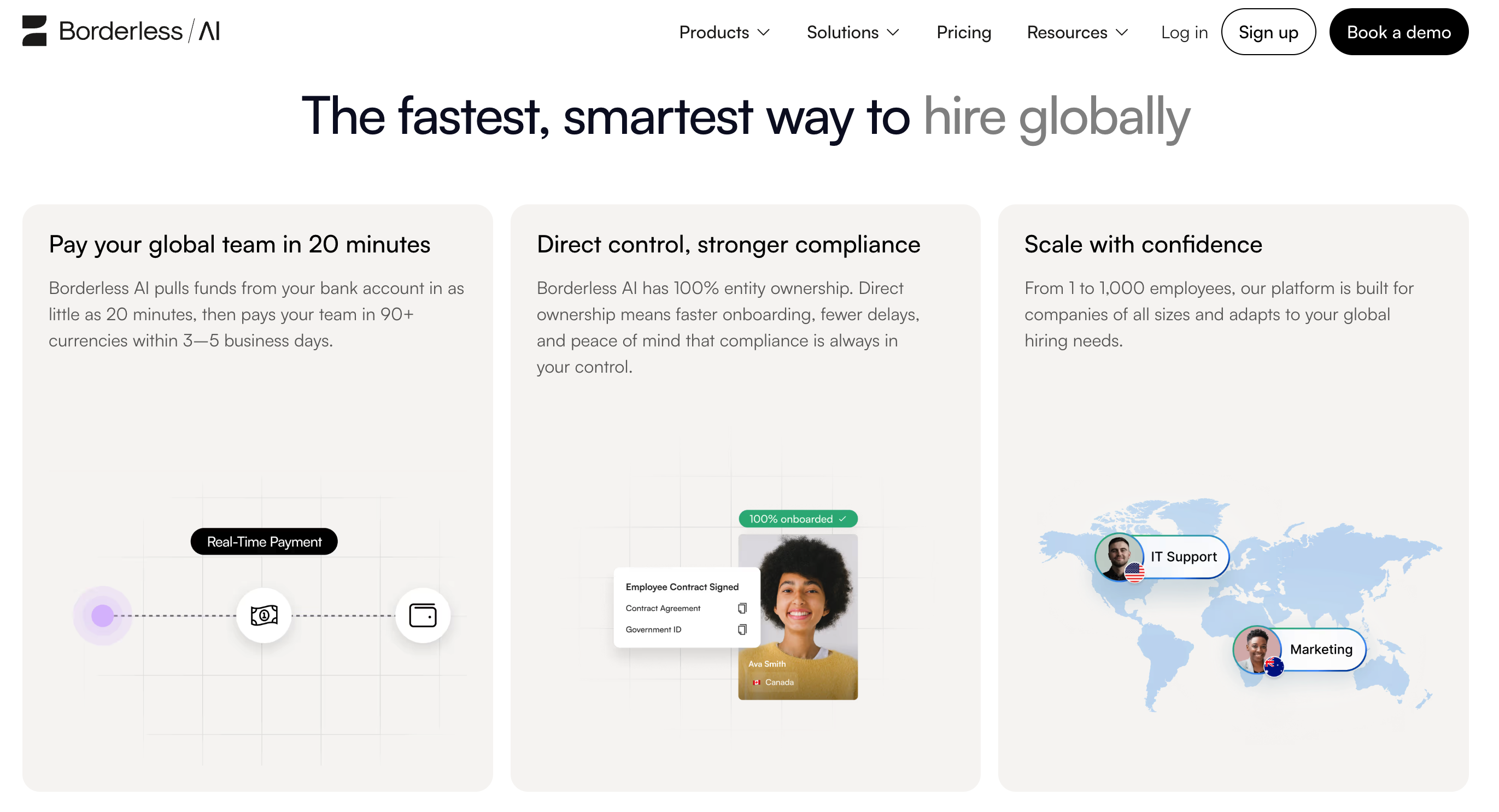
Borderless AI is an AI-powered employer of record covering 170+ countries. It operates an entity-ownership model in Oman, meaning it acts as the legal employer and handles all local obligations directly rather than through third-party partners.
The platform generates employment contracts using AI, processes global payroll in 90+ currencies, and manages Oman-specific requirements including Arabic-language contracts, end-of-service gratuity calculations, and Wage Protection System compliance. Onboarding is reported to take one to two days. Onboarding in 24 to 48 hours.
Starting price is listed at $579 per employee per month in third-party research. starts at $579 per employee per month The platform holds a 4.9/5 rating on G2. 4.9/5 on G2.
Strengths:
-
AI-powered contract generation with Arabic-language support and Wage Protection System compliance for Oman hires, managed under a direct entity-ownership model.
-
4.9/5 G2 rating with a modern employee self-service dashboard and 24/7 in-house support across all covered markets.
-
Global payroll processing in 90+ currencies across 170+ countries, with end-of-service gratuity calculations handled as part of the standard Oman employment package.
Limitations:
-
Starting price of $579 per employee per month is sourced from third-party research and has not been independently verified against Borderless AI's official pricing page.
Best for:
Companies prioritising AI-native global hiring with fast onboarding and broad country coverage, particularly where Arabic contract handling and Wage Protection System compliance are required in Oman.
Mercans
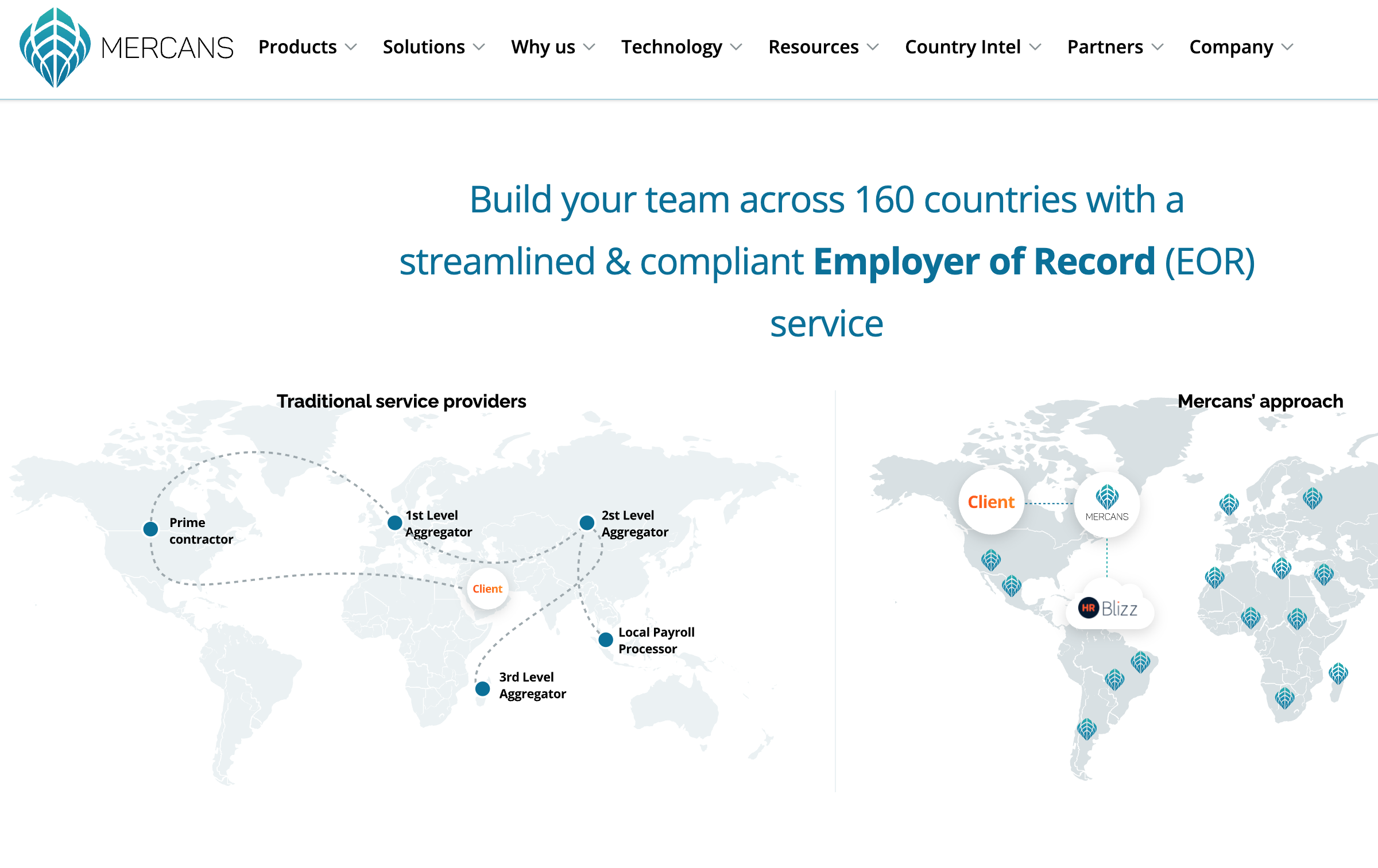
Mercans is a full-service employer of record covering 160+ countries. It operates an entity-ownership model in Oman and manages employment law compliance, payroll withholding, social contributions, benefits administration, and visa and immigration support directly.
The platform includes an AI-powered payroll suite with bi-directional HCM integrations connecting to Workday, Oracle, UKG, Dayforce, HiBob, and Darwinbox. Onboarding in Oman takes five to seven days. Pricing is custom and available on request only.
Mercans holds a 4.8/5 rating on G2. 4.8/5 on G2. The company has been named a Leader in the Avasant Payroll Business Process Transformation 2025-2026 RadarView and an ISG Provider Lens Leader.
Strengths:
-
AI-powered payroll suite with bi-directional integrations to Workday, Oracle, UKG, Dayforce, HiBob, and Darwinbox, supporting enterprise HCM environments without manual data transfer.
-
Named Leader in the Avasant Payroll Business Process Transformation 2025-2026 RadarView and ISG Provider Lens, with a 4.8/5 G2 rating reflecting enterprise-grade service delivery.
-
Full Oman compliance coverage including employment law, payroll withholding, social contributions, benefits, and visa and immigration support managed under one provider.
Limitations:
-
Five to seven day onboarding is slower than several competing EOR providers in this comparison, which may affect time-sensitive hiring decisions.
-
Pricing is custom with no published rate, making upfront cost benchmarking difficult without a direct sales engagement.
Best for:
Enterprises needing full-service EOR in Oman with deep HCM integrations, visa and immigration support, and enterprise-grade compliance across 160+ countries.
G-P
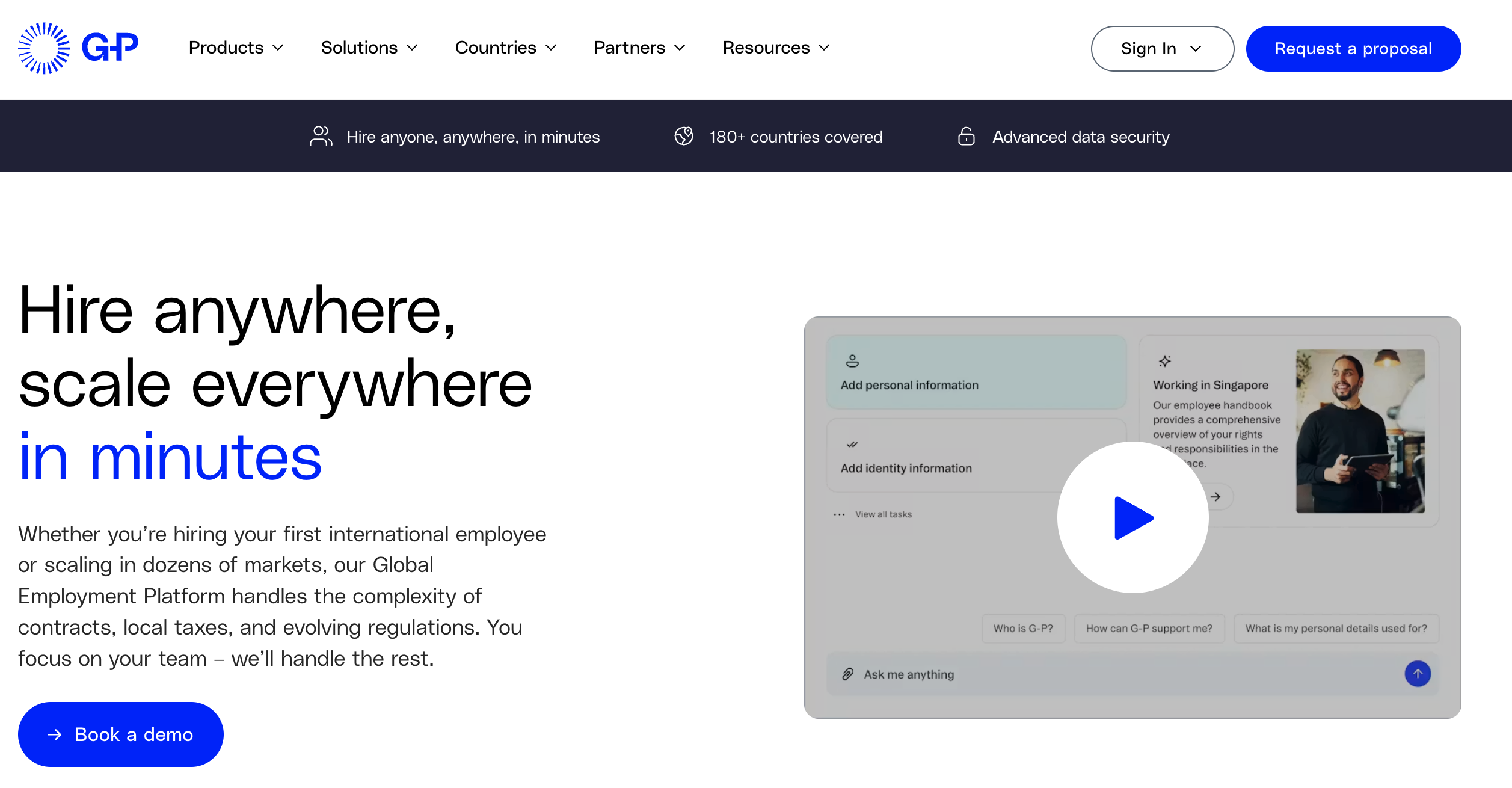
G-P is an enterprise-focused employer of record covering 180+ countries. It combines EOR services with a global employment platform and a network of 200+ global partners, allowing companies to hire internationally without establishing their own local entity. G-P’s public materials position its EOR offering as supported by a large team of local HR and legal experts, although they do not publicly confirm whether Oman specifically is served through a G-P-owned entity or a third-party partner.
The platform provides centralized global employment management covering onboarding, payroll, tax, benefits, and compliance. Its AI-powered G-P Gia provides employment-law guidance, contract review, document generation, and jurisdiction-specific compliance support. G-P states that global employees can be onboarded in minutes, while its broader materials describe onboarding in days; however, a specific Oman onboarding SLA is not publicly disclosed.
G-P's current EOR pricing is $599 per employee per month. Its contractor offering starts at $39 per contractor per month. G-P currently reports 180+ countries, 99% payroll accuracy, 200+ global partners, and a 96% customer satisfaction rating. The platform currently holds a 4.4/5 rating on G2 from 1,064 reviews.
Strengths:
-
Enterprise-grade global employment platform covering 180+ countries, supported by local HR and legal expertise and a network of 200+ global partners.
-
G-P Gia provides AI-powered employment-law guidance, contract review, document generation, translations, and compliance support.
-
Strong compliance and security posture, with G-P publicly documenting ISO/IEC 27001 and SOC 2 compliance.
-
Flat EOR pricing of $599 per employee/month, with payroll, tax, benefits and compliance capabilities included within the EOR offering; contractor management starts at $39/month.
Limitations:
-
The $599 per employee/month price is the published starting EOR price, but Oman-specific statutory costs and employee compensation can affect the total employment cost.
-
G-P does not publicly identify whether its Oman EOR employment is handled through a G-P-owned entity or a third-party partner, so the entity model should be confirmed before making a final provider decision.
-
A precise Oman-specific onboarding timeline is not publicly disclosed; G-P's global onboarding claims should therefore not be presented as an Oman-specific SLA.
Best for:
Enterprise and mid-market companies prioritising strong global compliance expertise, broad country coverage, centralized employment management, and AI-powered HR/legal support, particularly businesses that need to scale international hiring across multiple markets rather than only entering Oman.
Playroll
Playroll is an EOR platform covering 180+ countries, with a published starting price of $399 per employee per month. It operates an owned-entity compliance model, meaning it acts as the legal employer in each country rather than relying on third-party partners. Onboarding in Oman typically takes 2 to 4 days.
For Oman specifically, Playroll addresses Labour Law compliance, social insurance contributions for Omani nationals, payroll processing, tax obligations, termination support, and structured onboarding workflows. The platform includes a cost calculator tool that allows companies to estimate total employment costs in Oman before committing. Playroll cites an employer social insurance contribution rate of approximately 12.5% for Omani nationals, though this figure should be verified against the 12% rate cited in other sources and confirmed with Playroll directly before use in client-facing materials.
Playroll holds a 4.7 out of 5 rating on G2. The platform combines AI-powered payroll workflows with human support, and its pricing is described as transparent with costs visible before onboarding begins.
Strengths:
-
4.7 out of 5 G2 rating; owned-entity compliance model with AI payroll workflows, transparent pricing, and human support available throughout the employment lifecycle.
-
Cost calculator tool available for Oman hiring cost estimation, supported by local team and platform access for ongoing compliance management across 180+ countries.
Limitations:
-
The employer social insurance contribution rate cited by Playroll for Omani nationals (approximately 12.5%) differs from the 12% rate cited in other researched sources; this discrepancy requires editorial resolution before publication.
Best for:
Companies prioritising compliance-focused EOR with transparent pricing, a cost calculator for Oman, and human support across a broad global footprint.
Payoneer
Payoneer is an EOR and PEO hybrid platform covering 160+ countries, including Oman. It starts at $199 per employee per month and holds a 4.6/5 rating on G2. Companies use Skuad to employ workers in Oman without setting up a local entity, with Skuad acting as the legal employer of record.
Payoneer manages payroll, benefits, and compliance for Oman-based employees. It handles written employment contracts in Arabic as required under Oman labour law, processes payroll and statutory taxes, and completes onboarding within 2 to 3 business days. The platform takes a platform-first approach, combining global payroll, remote compensation management, and workforce analytics in a single interface.
Payoneer uses an entity-ownership model to fulfil local employer obligations in Oman. This means Skuad holds legal responsibility for employment compliance rather than routing obligations through a third-party partner network.
Strengths:
-
Rated 4.6/5 on G2; platform-first model with global payroll, remote compensation management, and analytics built into a single interface.
-
Covers 160+ countries with a global and local specialist team; handles Oman Arabic contract requirements, payroll, and statutory taxes with 2 to 3 day onboarding.
Limitations:
-
No free trial is available; prospective customers must book a demo to evaluate the platform before committing.
Best for:
Teams that want a platform-first EOR with built-in analytics and competitive entry pricing for hiring in Oman and across 160+ countries without a local entity.
Pebl
Pebl is an AI-powered employer of record covering 185+ countries. It allows companies to hire in Oman without setting up a local entity, while Pebl handles local employment, payroll, benefits, and compliance. Public documentation confirms Pebl provides EOR services in Oman, although it does not publicly specify whether Oman is served through a Pebl-owned entity or a third-party partner.
The platform provides locally compliant employment contracts, payroll and benefits management, and country-specific compliance support. Pebl states that employees can be onboarded in as little as 24–48 hours, although this is a global onboarding claim rather than an Oman-specific SLA.
Starting EOR pricing is currently listed at $399 per employee per month. Pebl also offers custom quotes depending on requirements. The platform holds a 4.7/5 rating on G2 according to Pebl's current website.
Strengths:
-
AI-powered global employment platform covering 185+ countries, with locally compliant contracts, payroll, benefits, and compliance managed through a centralized system.
-
Fast onboarding, with Pebl stating that employees can be onboarded in as little as 24–48 hours, although Oman-specific timing is not publicly disclosed.
-
Oman-specific EOR coverage allows companies to hire without establishing a local entity, with Pebl handling local employment, payroll, benefits, and compliance requirements.
Limitations:
-
The $399 per employee/month starting price is publicly listed, but final costs can vary by country and requirements; Oman-specific pricing is not separately disclosed.
-
Pebl does not publicly identify whether its Oman EOR employment is delivered through a Pebl-owned entity or a third-party partner, so this should be confirmed before relying on an entity-ownership model.
Best for:
Companies looking for an AI-powered EOR with broad global
coverage, fast onboarding, and centralized management of employment, payroll,
benefits, and compliance, particularly when entering Oman without establishing
a local entity.
Teamed
Teamed is a global employment partner covering 180+ countries, built for mid-market organisations that need EOR, contractor management, and entity advisory under one arrangement. It operates through curated in-country legal and payroll partners rather than owned entities. Teamed's own published research notes that no provider on its Oman comparison list has confirmed ownership of a local Omani entity, and the same transparency standard applies here: Teamed's Oman coverage is delivered via in-country partners, not a Teamed-owned legal entity.
Pricing is flat at $599 per employee per month as of February 2026, with foreign exchange absorbed at zero markup and no setup or exit fees. The quote equals the invoice. Onboarding runs one to three business days for standard EOR engagements, and each account includes a named specialist and an entity roadmap for clients modelling when a local entity becomes cost-effective.
Strengths:
-
Flat-fee pricing with FX absorbed at zero markup and no hidden setup or exit fees: the quoted amount is the invoiced amount.
-
Named account specialist and entity advisory included as standard, supporting VP People and CFO teams modelling entity breakeven across multiple countries.
-
Covers 180+ countries via curated in-country legal and payroll partners, with one to three business day onboarding for standard EOR engagements.
Limitations:
-
Not well suited for very small teams of under ten international employees who prioritise the lowest possible monthly fee and do not yet require strategic advisory.
Best for:
VP People and CFO teams at mid-market organisations operating across five or more countries who need a single adviser to consolidate vendors, model entity breakeven, and reduce vendor sprawl.
What Are the Key Services of an EOR in Oman ?
An EOR in Oman takes on the legal employer role so that a foreign company can employ workers in the country without registering a local entity. Every service the EOR delivers must comply with Labour Law Decree 53/2023 and the Wage Protection System (WPS) requirements that govern electronic salary transfers.
Core services cover payroll processing, Social Protection Fund contributions, end-of-service gratuity calculations, Arabic employment contract drafting, and statutory benefits administration including annual leave, sick leave, and maternity entitlements.
Omanisation adds a distinct service dimension. Oman's Vision 2040 framework sets nationality ratio requirements across sectors, and an EOR with local expertise can advise on quota fulfillment, track compliance, and reduce the administrative burden of meeting Ministry of Labour obligations. Visa and work permit support for expatriate hires rounds out the standard service scope.
Employment Contracts and Local Compliance
Oman law requires employment contracts to be written in Arabic as the legally binding language. Employers hiring international staff typically issue bilingual contracts, with the Arabic version taking legal precedence in any dispute.
Contracts must cover the role, compensation, working hours, and termination conditions. Probation periods run between three and six months under Oman's Labour Law Decree 53/2023. During probation, either party may terminate with shorter notice than the standard post-probation requirement.
An EOR in Oman prepares compliant Arabic contracts, manages bilingual documentation for international employees, and tracks probation timelines to reduce misclassification and termination risk.
Payroll and Tax Administration
Employers in Oman contribute to the Social Protection Fund (SPF) at a rate of 12% of an Omani national employee's salary. For Omani nationals, the employer social insurance contribution totals 14.5%. Employees contribute 8% of their salary to the SPF, per competitor source data pending primary-source verification.
Oman applies a corporate income tax rate of 15%. Oman’s standard corporate income tax rate is 15%. The statutory minimum wage for Omani nationals stands at OMR 325 per month. The minimum wage for Omani nationals in the private sector is OMR 325 per month, effective July 1, 2013.
Salaries must be paid through the Wage Protection System (WPS), which requires electronic transfers via approved banks. An EOR manages SPF calculations, WPS submissions, and statutory deductions on behalf of the employing company.
Benefits Administration
Oman's Labour Law Decree 53/2023 sets the statutory floor for employee benefits. Workers are entitled to 30 days of paid annual leave per year and sick leave under the Labour Law, with specific entitlements governed by the applicable provisions of the decree.
Male employees are entitled to one week of paid paternity leave, per the World Bank Women, Business and the Law 2026 report. Oman does not mandate a 13th-month salary payment, so no additional month of pay is required beyond the contracted wage.
Voluntary benefits can supplement these statutory minimums. Private health insurance, transport allowances, and housing support are common additions in Oman's energy, logistics, and construction sectors. An EOR manages both statutory obligations and any agreed voluntary benefits within a single employment structure.
Employee Onboarding
Onboarding an employee in Oman involves several regulatory steps that must be completed before work begins. For foreign nationals, the process includes obtaining a residence permit, completing a mandatory medical examination, and processing a labour card through the Ministry of Manpower.
All new employees must be registered under the Wage Protection System (WPS) to ensure salaries are paid electronically through approved channels. Employers must also verify compliance with Omanisation quota requirements at the point of onboarding, confirming that the hire does not breach the applicable nationality ratio for the relevant sector or company size.
An EOR manages each of these steps as part of a structured onboarding workflow, reducing the administrative load on the hiring company while keeping every hire compliant with Labour Law Decree 53/2023 from day one.
Ongoing HR Support
An EOR in Oman does not stop at onboarding. Ongoing compliance requires active monitoring of Ministry of Labour filing obligations, Omanisation quota ratios, and Social Protection Fund submission records throughout the employment relationship.
Labour Law Decree 53/2023 continues to evolve. A qualified EOR tracks regulatory amendments and updates employment practices accordingly, reducing the risk of non-compliance between contract signing and termination.
Labour dispute management is a distinct obligation under Oman law. The EOR acts as the legal employer in any Ministry of Labour proceedings, managing documentation, response timelines, and resolution procedures on the client company's behalf.
Employee Offboarding
Offboarding in Oman involves several statutory obligations that must be completed in the correct sequence. End of Service Benefit (EOSB) calculations follow a formula of 15 to 30 days of salary per year of service, based on tenure, under Labour Law Decree 53/2023.
Notice period requirements and final salary payments must comply with Wage Protection System rules. The final payroll run must clear through WPS electronic transfer before the employment relationship closes.
For expatriate employees, offboarding also requires visa cancellation and labour card cancellation through the relevant government authorities. The EOR manages this process as the legal employer, coordinating with immigration and Ministry of Labour systems to close the record correctly.
How to Hire Through an EOR in Oman for
Companies entering Oman have three hiring paths: set up a local entity, engage an how does EOR work provider, or contract independent workers. Each path carries different timelines, costs, and compliance obligations.
Entity setup in Oman typically takes several months and requires capital commitment, registered premises, and ongoing Ministry of Commerce filings. An EOR activates employment in days or weeks, with no entity required. This makes EOR the practical choice for teams of 1 to 50 hires.
Omanisation quotas add another layer to hiring decisions. Certain sectors require a minimum ratio of Omani nationals in the workforce. An EOR with local compliance depth can track and support quota fulfillment, which a contractor arrangement cannot address.
Selection and Setup
Choosing an EOR for Oman requires more than comparing headline prices. The criteria that matter most are Oman compliance depth, entity ownership model, Omanisation support, pricing transparency, and onboarding speed.
The most important structural question is whether the EOR owns a legal entity in Oman or relies on a third-party partner. An owned-entity model gives the EOR direct control over payroll filings, labour card processing, and Ministry of Labour submissions. A partner-dependent model introduces an additional layer of coordination that can slow resolution when compliance issues arise.
-
Confirm the EOR handles Social Protection Fund contributions directly, including the 12% employer rate.
-
Verify that Wage Protection System payments are processed through the EOR's own banking integration, not routed through a subcontractor.
-
Check that End of Service Benefit calculations and accruals are managed in-platform, with clear audit trails.
Before signing any agreement, ask the provider to confirm in writing how SPF submissions, WPS payments, and EOSB accruals are handled. These three obligations carry direct regulatory exposure under Labour Law Decree 53/2023.
Onboarding and Compliance
Hiring in Oman requires several compliance steps before an employee can start work. Every employment contract must be executed in Arabic, or include a certified Arabic version, to satisfy Ministry of Labour requirements under Labour Law Decree 53/2023.
Employers must register with the Social Protection Fund (SPF), enroll in the Wage Protection System (WPS), and process a labour card for each hire. Companies subject to Omanisation quotas must verify their nationality ratio before onboarding any new position.
Onboarding timelines differ by worker type. Local employees typically complete the process in two to four weeks. Expatriate hires take longer because work permit applications require a medical examination, and residence permit processing adds additional time to the overall timeline.
What Are the Benefits of Using an EOR in Oman ?
An EOR in Oman manages both statutory and voluntary benefits on behalf of the hiring company. Statutory minimums under Labour Law Decree 53/2023 include 30 days of annual leave, sick leave, maternity leave, and end-of-service gratuity calculated at 15 to 30 days of salary per year of tenure.
Beyond statutory floors, an EOR can administer supplementary benefits such as private medical cover and allowances that help attract qualified candidates in a competitive market. Omanisation requirements make local benefits knowledge especially important, because benefit structures for Omani nationals and expatriate employees differ in areas such as Social Protection Fund contributions and applicable entitlements.
Working with an EOR that understands both layers reduces the risk of underpaying statutory obligations or misconfiguring voluntary packages for a mixed workforce.
Faster Market Entry
Setting up a limited liability company in Oman typically takes three to six months, covering commercial registration, Ministry of Commerce approvals, and capital deposit requirements. An EOR removes that process entirely.
With an EOR, companies can employ workers in Oman within days or weeks. That speed matters in sectors where Oman's Vision 2040 programme is actively attracting foreign investment: energy, logistics, and technology.
Oman's private sector has expanded steadily as the government diversifies away from oil revenues. Companies that can place staff on the ground quickly gain a real advantage over competitors still working through entity formation. An EOR provides that operational start without long-term structural commitments.
Reduced Compliance Risk
Oman's employment framework carries specific penalties for non-compliance. Employers who miss Wage Protection System deadlines, fail Social Protection Fund contribution obligations, or breach Omanisation quotas face Ministry of Labour enforcement action.
Labour Law Decree 53/2023 also introduced updated rules on worker classification. Misclassifying an employee as a contractor can trigger back-payment obligations and regulatory scrutiny. For foreign companies operating without a local entity, there is an additional permanent establishment risk: sustained commercial activity in Oman can create an unintended taxable presence.
An EOR assumes the legal employer role, which transfers these compliance obligations to a provider with established Ministry of Labour relationships and current knowledge of Oman's regulatory requirements. That transfer reduces the direct exposure companies carry when hiring across borders.
Simplified Payroll Administration
Payroll in Oman involves several distinct obligations that must run in parallel. Employers must process salaries through the Wage Protection System (WPS), which requires electronic transfers through approved banks. Social Protection Fund (SPF) contributions must be calculated and submitted accurately each cycle.
End of Service Benefit (EOSB) accruals add another layer. These must be tracked per employee from day one, calculated at 15 to 30 days of salary per year of service depending on tenure, and reconciled against Labour Law Decree 53/2023 requirements.
For companies with expatriate staff, multi-currency payroll adds further complexity. An EOR manages all of these obligations within Oman's Vision 2040 regulatory framework, giving finance teams a single point of accountability for payroll compliance rather than coordinating across multiple local vendors.
Access to Local Benefits
Oman law sets a clear floor for employee entitlements. Workers are entitled to 30 days of annual leave, sick leave, and paid public holidays under Labour Law Decree 53/2023. Maternity leave stands at 50 days for female employees in the private sector. Paternity leave of one week applies per the World Bank 2026 data. A 13th-month salary is not a statutory requirement in Oman.
Beyond statutory minimums, the Oman market has established norms around voluntary benefits. Health insurance and housing allowances are common, particularly for expatriate employees, and competitive benefit packages are a standard part of attracting skilled workers in sectors such as energy and logistics.
An EOR gives companies access to locally compliant benefit structures without building internal HR infrastructure. Statutory entitlements are administered accurately, and voluntary benefits can be added to match local market expectations, supporting both retention and compliance.
Lower Entity Setup Costs
Setting up an LLC in Oman involves registration fees, minimum capital requirements, and ongoing compliance costs. Buyers should obtain direct quotes rather than rely on generic figures, as costs vary by sector and structure.
An EOR removes these upfront costs entirely. For small headcounts, a monthly EOR fee (such as OMR 120 per employee) is typically far lower than the combined cost of entity registration, local legal counsel, and annual compliance maintenance.
The breakeven point is commonly cited at 10 to 15 employees. Below that threshold, an EOR is usually the more cost-effective path. Above it, companies may find that establishing their own entity becomes financially justified. For teams testing the Oman market or running project-based operations, the EOR model preserves capital and reduces fixed overhead.
More Flexible Workforce Scaling
Oman's energy, construction, and logistics sectors frequently require project-based hiring. An EOR lets companies bring on workers for defined project periods without committing to a permanent local entity or long-term payroll infrastructure.
Scaling down is equally straightforward. End of Service Benefit (EOSB) calculations, notice period obligations, and Ministry of Labour requirements are managed by the EOR, reducing the administrative burden on the hiring company when a project concludes or headcount needs to decrease.
Omanisation quota requirements also factor into workforce planning. When scaling, companies must maintain compliant nationality ratios. An EOR with Oman-specific expertise can advise on quota obligations as headcount changes, reducing the risk of non-compliance during periods of rapid growth or contraction.

How to Find the Right EOR for Oman
Choosing an EOR for Oman requires evaluating dimensions specific to Omani employment law, not just global coverage claims. The key areas to assess are: Social Protection Fund and Wage Protection System compliance depth, Omanisation quota support, entity ownership model, Arabic contract capability, and End of Service Benefit management.
Before signing any agreement, request written disclosure of the provider's entity ownership model. Some providers use third-party partners in Oman rather than owned entities, which affects accountability and compliance continuity.
G2 ratings and security certifications such as SOC 2 and ISO 27001 are useful shortlisting signals. They indicate platform maturity and data governance standards. Use them to narrow your list before conducting deeper due diligence on Oman-specific compliance capabilities. Reviewing employer of record software criteria can also help structure your evaluation.
Local Compliance Expertise
An EOR operating in Oman must demonstrate working knowledge of Labour Law Decree 53/2023, the Wage Protection System, Social Protection Fund contributions, End of Service Benefits, Omanisation quotas, and the Arabic contract requirement. These are not interchangeable with generic GCC compliance knowledge.
Compliance expertise should be verifiable. Ask prospective providers for case studies or references from Oman-specific engagements, not just regional or global client lists. A provider that can cite named Oman engagements is more credible than one citing country coverage alone.
An established relationship with the Ministry of Labour is a positive signal. It indicates the provider has direct regulatory experience and can respond to filing queries or labour disputes without relying solely on external legal counsel.
Clear Service Scope
A clear service scope tells you exactly what the EOR covers in Oman before you sign. Ask whether the provider handles visa and work permit processing, Omanisation quota advisory, free zone employment, and End of Service Benefit (EOSB) calculations. These are not optional extras in Oman; they are statutory obligations under Labour Law Decree 53/2023.
Confirm whether the provider operates through its own legal entity in Oman or relies on a third-party partner model. Entity ownership generally means faster resolution of Ministry of Labour filings and clearer accountability when compliance issues arise.
Pricing transparency matters equally. Verify that all Oman-specific statutory costs, including Social Protection Fund contributions and WPS payment fees, are included in the quoted rate rather than billed separately. Gloroots uses predictable, country-specific pricing with full cost visibility before onboarding and no percentage-of-salary charges.
Support Model
Support quality in Oman depends on three practical factors: Arabic-language capability, time zone coverage at GMT+4, and the ability to liaise directly with the Ministry of Labour when filings or disputes arise.
Ticket-only systems create delays on time-sensitive compliance matters. For Oman hiring, 24/7 human support is preferable, particularly when payroll deadlines, WPS submissions, or labour card renewals require same-day resolution. Ask providers whether their support team can communicate in Arabic and whether they hold established Ministry of Labour relationships.
In-country presence in Muscat adds a further layer of reliability. Providers with local staff can attend government offices, verify document submissions, and respond to regulatory changes faster than those operating entirely from offshore service centres. Gloroots provides human-led account support with retained business context, giving teams a consistent point of contact rather than rotating agents.
Technology and Reporting
A strong EOR platform for Oman must integrate with the Wage Protection System (WPS) for electronic salary transfers and track Social Protection Fund (SPF) submissions in real time. Look for a dashboard that monitors Omanisation quota compliance as headcount changes, and that generates End of Service Benefit (EOSB) accrual reports on demand.
Security certifications matter as a buyer signal. SOC 2 Type II and ISO 27001 certification indicate that a provider has passed independent audits of its data controls. Check each provider's trust page before signing.
Real-time compliance dashboards reduce audit risk by giving your finance and HR teams a single view of all Ministry of Labour filings, payroll submissions, and statutory obligations without waiting for manual reports.
Scalability for Your Hiring Plans
As your Oman headcount grows, Omanisation quota requirements become more complex. An EOR that can adjust to shifting nationality ratio rules across Muscat, Salalah, Sohar, and Duqm gives you operational continuity without compliance gaps.
Coverage across free zones and mainland Oman also matters. Some providers handle only one employment context, which limits your options as you expand into special economic zones or industrial areas.
Most companies reach a point where running an EOR is no longer the most cost-effective structure. A commonly cited threshold is 10 to 15 employees in a single country. At that scale, setting up a local entity often becomes more economical. Ask any provider whether they support a transition to your own entity if you reach that point, including contract novation, payroll migration, and compliance handover.

Why Gloroots Is a Strong EOR Partner in Oman
Gloroots runs compliant employment in Oman without requiring a local entity. It manages payroll, Social Protection Fund contributions, Wage Protection System submissions, and end-of-service benefit calculations under Labour Law Decree 53/2023.
Oman-specific compliance is built into the platform. Arabic contract localization, Omanisation quota advisory, and real-time tracking of Ministry of Labour filings are included as standard features, not add-ons.
-
WPS compliance: Electronic salary transfers processed through the Wage Protection System with automated bank integration and payment verification.
-
Social Protection Fund management: Employer contribution calculations and electronic submissions aligned with Ministry of Labour requirements. 13.5% SPF employer contribution.
-
Arabic contract localization: Bilingual employment contracts compliant with Labour Law Decree 53/2023, with Arabic as the mandatory language.
-
EOSB management: End-of-service gratuity calculated at 15 to 30 days salary per year of tenure, with accruals tracked and managed throughout the employment lifecycle.
-
Omanisation quota advisory: Strategic support for local hiring requirements and nationality ratio compliance under the Vision 2040 framework.
Pricing starts at OMR 120 per employee per month with no hidden fees. All costs are disclosed before onboarding, and there are no percentage-of-salary charges. See Gloroots pricing for a full breakdown.
Support is available 24 hours a day, seven days a week, through dedicated account managers who retain context across the employment relationship. A compliance dashboard gives HR and Finance teams real-time visibility into WPS submissions, Social Protection Fund filings, and statutory obligations. Learn more about Gloroots EOR services or explore options for EOR for enterprises scaling into Oman.
Gloroots acts as the legal employer in Oman and manages contracts, payroll, SPF filings, and Omanization compliance. The ownership model of its underlying Omani legal entity is not publicly disclosed; confirm directly with Gloroots before publication.
FAQs About the Best EOR in Oman
The questions below address the most common topics buyers raise when evaluating an employer of record for Oman operations. Answers reflect the current regulatory framework under Labour Law Decree 53/2023 and associated Ministry of Labour guidelines.
How does an EOR work in Oman ?
An Employer of Record in Oman becomes the legal employer of your workers. Your company retains full control over day-to-day work direction, tasks, and performance management.
The EOR handles all statutory obligations under Labour Law Decree 53/2023. This includes Social Protection Fund contributions, Wage Protection System salary payments, Arabic-language employment contracts, End of Service Benefit accruals, and Omanisation quota compliance.
For more detail on the mechanics, see how does EOR work.
What does an EOR cost in Oman ?
Gloroots' Oman-specific pricing starts at OMR 120 per employee per month. EOR fees from other providers typically range from OMR 85 to OMR 220 per employee per month, depending on the provider and scope of services.
Statutory employer costs sit on top of the EOR fee. For a worker on OMR 1,000 per month gross salary, the total monthly employer cost includes the 12% Social Protection Fund contribution, an EOSB accrual, and the EOR platform fee.
Always request a full cost breakdown before signing. For a detailed guide, see employer of record cost.
When should a company use an EOR in Oman?
An EOR in Oman works best when a company wants to test the Oman market before committing to a local entity. It is also the right fit for hiring one to ten employees in sectors such as energy, logistics, or technology, where Omanisation quota complexity makes direct entity setup costly and slow.
Project-based hiring is another common use case, particularly for Vision 2040 infrastructure and industrial contracts. EOR arrangements are typically most cost-effective for teams of fewer than ten to fifteen employees. Beyond that threshold, establishing a local entity often becomes more economical. EOR for startups and EOR for small business teams entering Oman covers both scenarios.
Can an EOR hire both local and foreign employees in Oman ?
Yes. An EOR in Oman can employ both Omani nationals and expatriate workers on behalf of a client company. The two groups are subject to different statutory obligations, so the EOR must manage each correctly.
Social Protection Fund contributions apply to Omani nationals. Expatriate employees are generally not covered under the same SPF rules, though the EOR should confirm the current position with the Ministry of Labour for each hire. For expatriates, the EOR manages work permit applications, residence permits, and labour card processing.
Hiring a mix of local and foreign employees also affects Omanisation quota calculations. The EOR tracks the nationality ratio and advises on compliance with the applicable sector quota under Labour Law Decree 53/2023.
How do I choose the right EOR in Oman ?
Start by confirming the provider operates under a full entity-ownership model in Oman, not a third-party reseller arrangement. Ask for written disclosure of the entity ownership structure before signing any contract.
Check that the provider supports Social Protection Fund and Wage Protection System compliance, can issue Arabic employment contracts, and offers Omanisation quota advisory. Review the provider's G2 rating and any published security certifications as independent quality signals.
See the methodology section above for the full set of selection criteria used in this comparison.