







- The default KiwiSaver employer contribution rate increases to 3.5% from April 2026, and any EOR managing New Zealand payroll must apply this updated rate from the effective date or risk non-compliance.
- New Zealand's Holidays Act 2003 requires payroll systems to compare ordinary weekly pay against average weekly earnings on every leave event and apply whichever is higher; incorrect application is a documented compliance risk across EOR providers, so buyers should request written confirmation of each provider's methodology before onboarding.
- Because EORs aggregate headcount across all client companies, the small-employer exemption for 90-day trial periods does not apply, meaning employees hired through an EOR hold personal grievance rights from day one regardless of any trial clause in the employment agreement.
- Pricing among the eight providers reviewed ranges from $199 to $699 per employee per month, but statutory employer costs including KiwiSaver contributions and ACC levies of approximately 1.67% are additional to every EOR service fee and must be factored into workforce budgeting.
- For companies hiring between one and five employees in New Zealand, an EOR removes the need to establish a local entity, which otherwise requires a resident director and costs between $1,762 and $7,047 USD to set up.
Editorial note: Gloroots produces this guide and is one of the listed providers. The same evaluation criteria apply to every provider in the list.
New Zealand is home to approximately 5.28 million people. The currency is the New Zealand dollar (NZD), official languages are English, Maori, and New Zealand Sign Language, and the corporate tax rate is 28%.
One regulatory update affects every employer hiring in New Zealand from April 2026: the default KiwiSaver employer contribution rate increased to 3.5%, up from 3%. Any EOR managing New Zealand payroll must apply this rate correctly from the effective date.
This guide covers eight providers selected on compliance depth, pricing transparency, onboarding speed, platform experience, and support quality. The methodology section explains how providers were evaluated so readers can assess fit for their own hiring context.
Our Top 8 Picks: New Zealand EOR Comparison 2026
The eight providers below were evaluated on six axes: New Zealand compliance depth (Employment Relations Act, Holidays Act 2003, KiwiSaver, ACC), pricing transparency, onboarding speed, platform experience, customer support quality, and scalability across company sizes. Providers with direct evidence of New Zealand statutory coverage received higher weight on compliance criteria.
| Provider | Pricing per month | Country coverage | Onboarding speed | Platform experience | Customer support | Scalability |
|---|---|---|---|---|---|---|
| Gloroots | From $199/employee/month | 150+ countries | 3-5 working days; country-dependent | Centralized workforce dashboard covering hiring, payroll, compliance, benefits and workforce visibility | 24/7 human support with dedicated account management | SMB to enterprise; built for multi-country programs |
| Deel | $599/employee/month; country-specific statutory costs are additional | 130+ EOR countries; broader global hiring footprint is larger | Automated onboarding; country-dependent | Unified platform for EOR, payroll, contractors, HR, benefits, compliance and integrations | 24/7 HR, legal and tax expertise | SMB to enterprise; strong fit for fast-scaling distributed teams |
| Remote | $699/employee/month standard; annual/contract arrangements may offer different pricing | 90+ EOR countries | Dedicated onboarding specialist; country-dependent | Owned-entity EOR platform with payroll, benefits, compliance, IP protection and workforce management | In-house local experts and dedicated specialist support | SMB to enterprise; particularly strong for companies prioritizing owned entities/IP |
| Multiplier | $499/monthly / $459 annually for Core; approximately 11% of countries have adjusted pricing | 150+ countries | Country-dependent | Multi-country EOR/payroll platform with employment, payroll, benefits, compliance and workforce management | Human-first support and local expertise | SMB to enterprise; supports companies from first hire to large distributed teams |
| Teamed | $599/employee/month flat; statutory costs and benefits vary by country | 187+ countries | 24 hours to first hire claimed; actual timing remains country-dependent | EOR platform covering employment, payroll, tax, benefits, compliance and IP | Dedicated country specialist on every account | SMB to enterprise |
| G-P | From approximately $599/employee/month; custom quote available; country-specific pricing | 180+ countries | 2-7 days in published country comparisons; country-dependent | G-P Meridian platform covering hiring, onboarding, payroll, benefits and compliance | Dedicated Customer Success Manager and in-country expertise | Mid-market to enterprise |
| Rippling | Custom EOR pricing; country-specific | 80 EOR countries | Not publicly listed in researched sources | Unified HR + IT + payroll + finance platform | In-app/customer support; depth varies by plan | SMB to enterprise; particularly strong for automation-heavy HR/IT environments |
| Velocity Global (Pebl) | From approximately $599/employee/month; promotional/country-specific pricing may differ | 185+ countries | Not publicly listed in researched sources | Global EOR platform covering employment, payroll, benefits, compliance and immigration | Dedicated support and global HR specialists | SMB to enterprise |
Pricing figures above are indicative. Statutory employer costs in New Zealand, including the KiwiSaver employer contribution (3.5% effective April 2026) and the ACC workplace levy (approximately 1.67%), are additional to any EOR service fee.

Top 8 Best EOR Platforms in New Zealand
All eight providers below were evaluated against the same criteria covered in the comparison table: pricing, country coverage, onboarding speed, platform experience, customer support, and scalability.
Not every provider fits every situation. Use these four scenarios as a starting point. For the fastest onboarding, Multiplier or Deel are strong options. For the most thorough Holidays Act and KiwiSaver compliance coverage, Gloroots or Remote are worth prioritising. For enterprise teams managing 50 or more employees, G-P or Rippling offer the governance depth and dedicated support that larger programs require. For budget-conscious SMBs hiring their first New Zealand employee, Multiplier offers one of the lower starting prices among the providers reviewed.
Gloroots
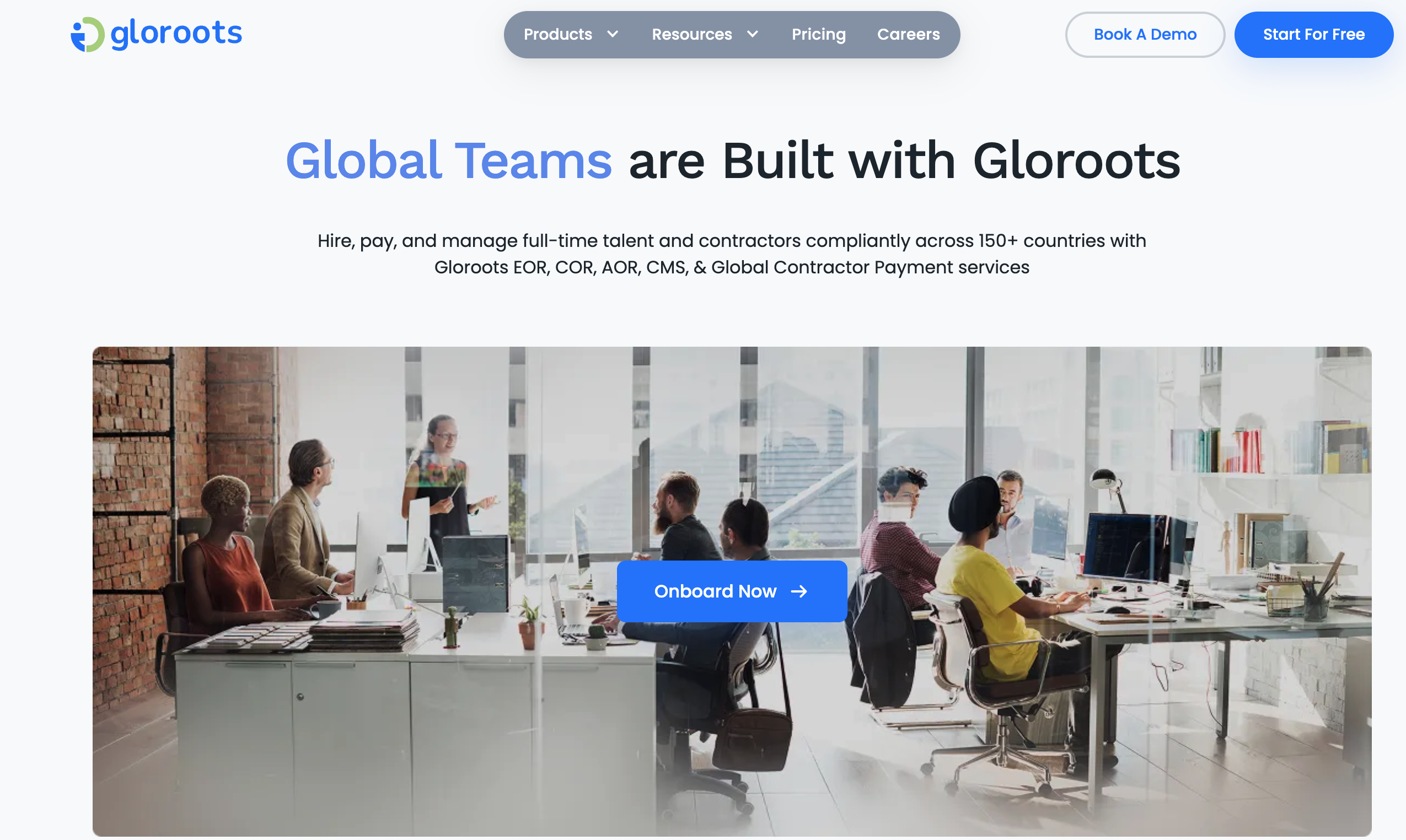
Gloroots runs compliant full-time employment across 150+ countries, including New Zealand, without requiring companies to set up a local entity. Its service covers Global Employer of Record, Global Payroll, Compliance and Employment Governance, and Benefits and Statutory Coverage.
The platform provides a centralized workforce dashboard covering hiring, payroll, compliance, and benefits, giving HR and Finance teams a single point of control across their international headcount. Human-led account support with retained business context means teams work with people who already know their program, not a rotating help queue.
Pricing starts from $199 per employee per month (USD). The actual amount varies by country, and the NZD equivalent will depend on the exchange rate at time of billing. Gloroots uses predictable, country-specific pricing with full cost visibility before onboarding and no percentage-of-salary pricing. KiwiSaver employer contributions in New Zealand are set to increase to 3.5% effective April 2026, and Gloroots accounts for country-specific statutory changes of this kind within its compliance and payroll execution.
Strengths:
-
Centralized workforce dashboard covering hiring, payroll, compliance, and benefits gives operations teams visibility across all active employment relationships in one place.
-
Predictable, country-specific pricing with full cost visibility before onboarding removes uncertainty from budget planning. No percentage-of-salary pricing applies.
-
24/7 human support with dedicated account management means compliance questions, including those related to New Zealand statutory changes such as the April 2026 KiwiSaver rate update, are handled by people with context on the account.
Limitations:
-
Public sources reviewed did not document a provider-specific limitation for Gloroots beyond the general note that onboarding speed is country-dependent and ranges from 3 to 5 working days.
Best for:
Companies that want entity-free employment in New Zealand with centralized workforce visibility, predictable country-specific pricing, and human-led compliance governance across a multi-country program.


Deel
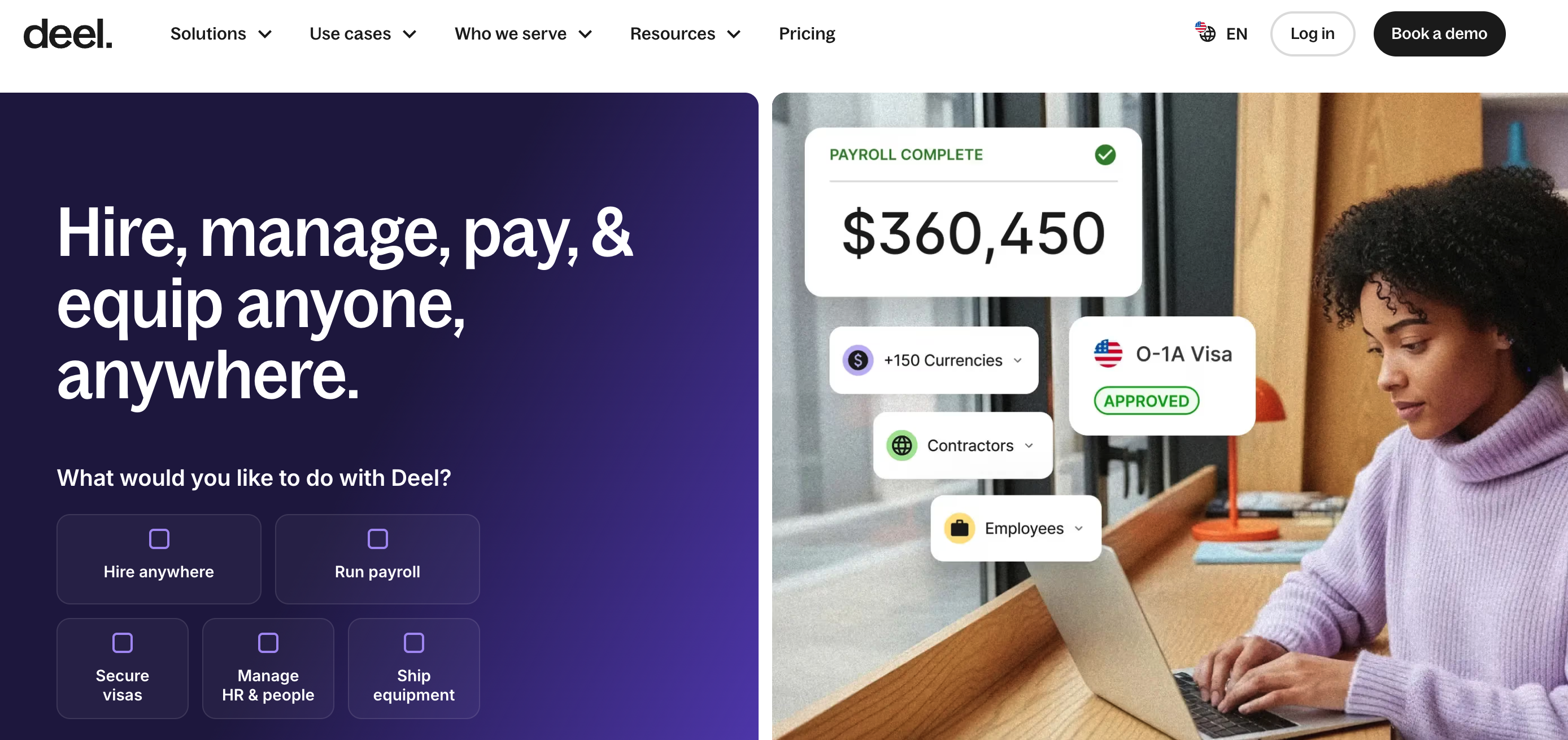
Deel enables companies to hire and pay employees in New Zealand without a local entity, handling PAYE, KiwiSaver contributions, ACC levies, and localized employment contracts. Onboarding can be completed in as little as two days.
Deel's payroll engine applies New Zealand statutory rules automatically, including minimum wage updates, paid-leave entitlements under the Holidays Act 2003, KiwiSaver contributions, and workplace-safety obligations. Built-in benefits cover holiday accrual, KiwiSaver pension management, ACC workplace accident insurance, and private healthcare through Unisure and Allianz.
Buyers should confirm Deel's specific calculation methodology for Holidays Act 2003 compliance. The Act uses four distinct statutory pay formulas, and correct application varies by provider. KiwiSaver employer contribution references should reflect the 3.5% default rate effective April 2026. Pricing is $599 per employee per month; statutory costs are additional.
Strengths:
-
Deel's localized employment contracts and payroll engine automatically apply New Zealand statutory rules, covering minimum wage updates, paid-leave entitlements, KiwiSaver contributions, and workplace-safety obligations.
-
Automated onboarding reduces time-to-hire significantly. One customer reported cutting their hiring process from four days to one day after switching to Deel's EOR model.
-
The platform covers the full employment lifecycle, including PAYE, KiwiSaver, ACC, Holidays Act leave, and IRD reporting, within a single unified interface.
Limitations:
-
New Zealand's Holidays Act 2003 uses four different statutory pay formulas that many payroll systems apply incorrectly. Buyers should verify Deel's specific OWP and AWE calculation methodology before committing.
Best for:
Startups hiring their first remote employee in New Zealand and multinationals expanding across the Pacific that need fast onboarding and an automation-first platform.
Remote
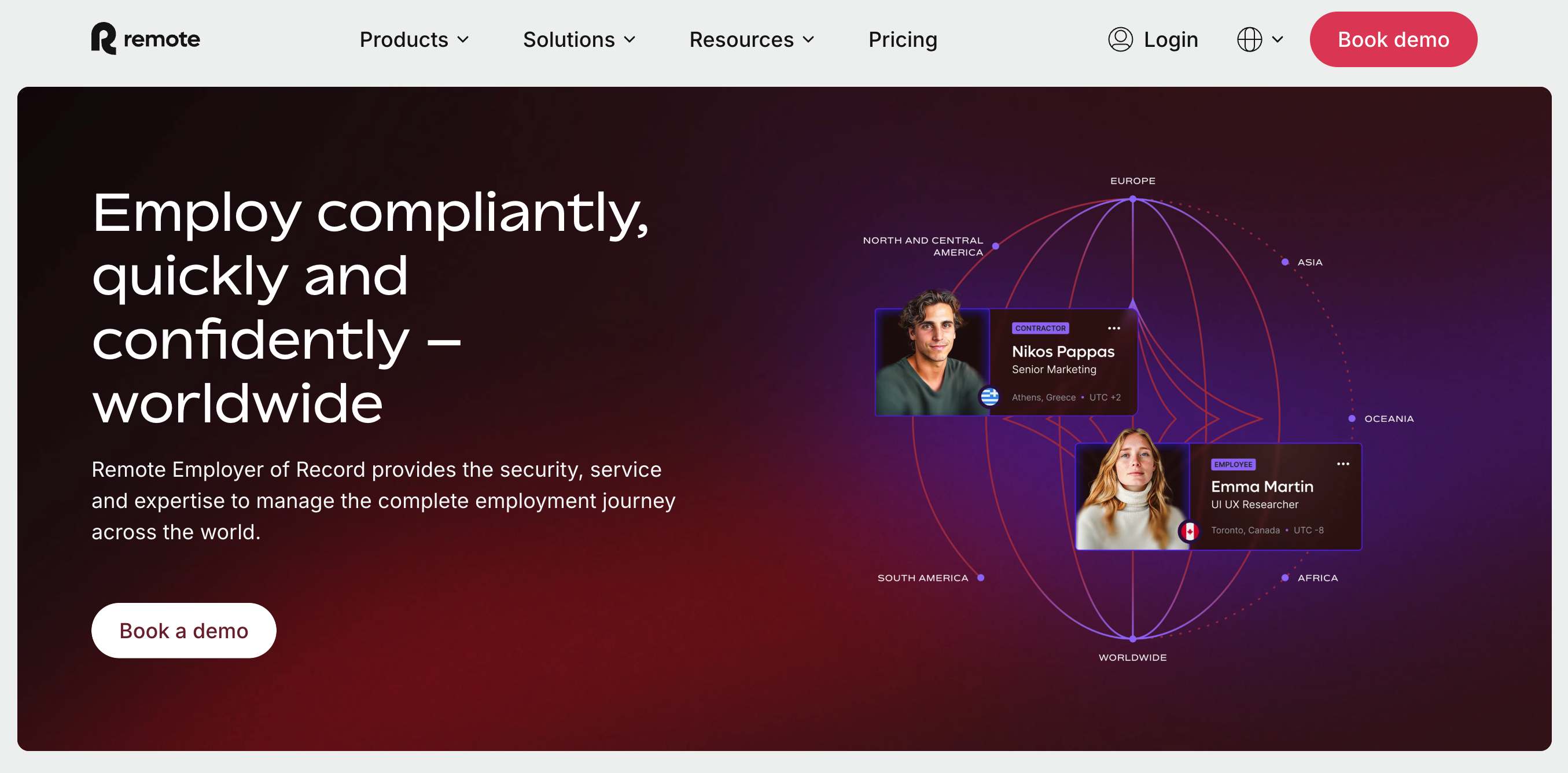
Remote operates an owned-entity EOR model across 90+ countries, employing workers directly through its own legal entities rather than third-party partners. For New Zealand, this structure means employment contracts, payroll, and statutory filings run through Remote's local entity.
Remote's New Zealand coverage addresses several active compliance risks: the KiwiSaver default employer contribution rate moving to 3.5% from April 2026, ACC levy classification, Payday Filing obligations to Inland Revenue, and the 2026 contractor gateway reforms that affect worker classification. Buyers should confirm whether Remote applies the ordinary weekly pay or average weekly earnings methodology under the Holidays Act 2003, as both formulas are valid but produce different leave payment outcomes.
Pricing is $699 per employee per month under the standard plan. Annual or volume arrangements may carry different terms. Statutory costs and benefits are additional to the platform fee.
Strengths:
-
Remote's owned-entity model means workers are employed directly by Remote's local legal entity, reducing reliance on third-party partners and supporting stronger IP protection for distributed teams.
-
Remote addresses key New Zealand compliance risks including the April 2026 KiwiSaver rate change, ACC levy classification, Payday Filing requirements, and the 2026 contractor gateway reforms.
-
Dedicated onboarding specialists and in-house local experts support employment setup and ongoing compliance management.
Limitations:
-
Buyers should confirm Remote's specific Holidays Act 2003 methodology. The Act permits both ordinary weekly pay and average weekly earnings calculations, and the approach used affects leave payment amounts.
Best for:
Companies prioritizing an owned-entity EOR model and IP protection for distributed teams hiring in New Zealand.
Multiplier
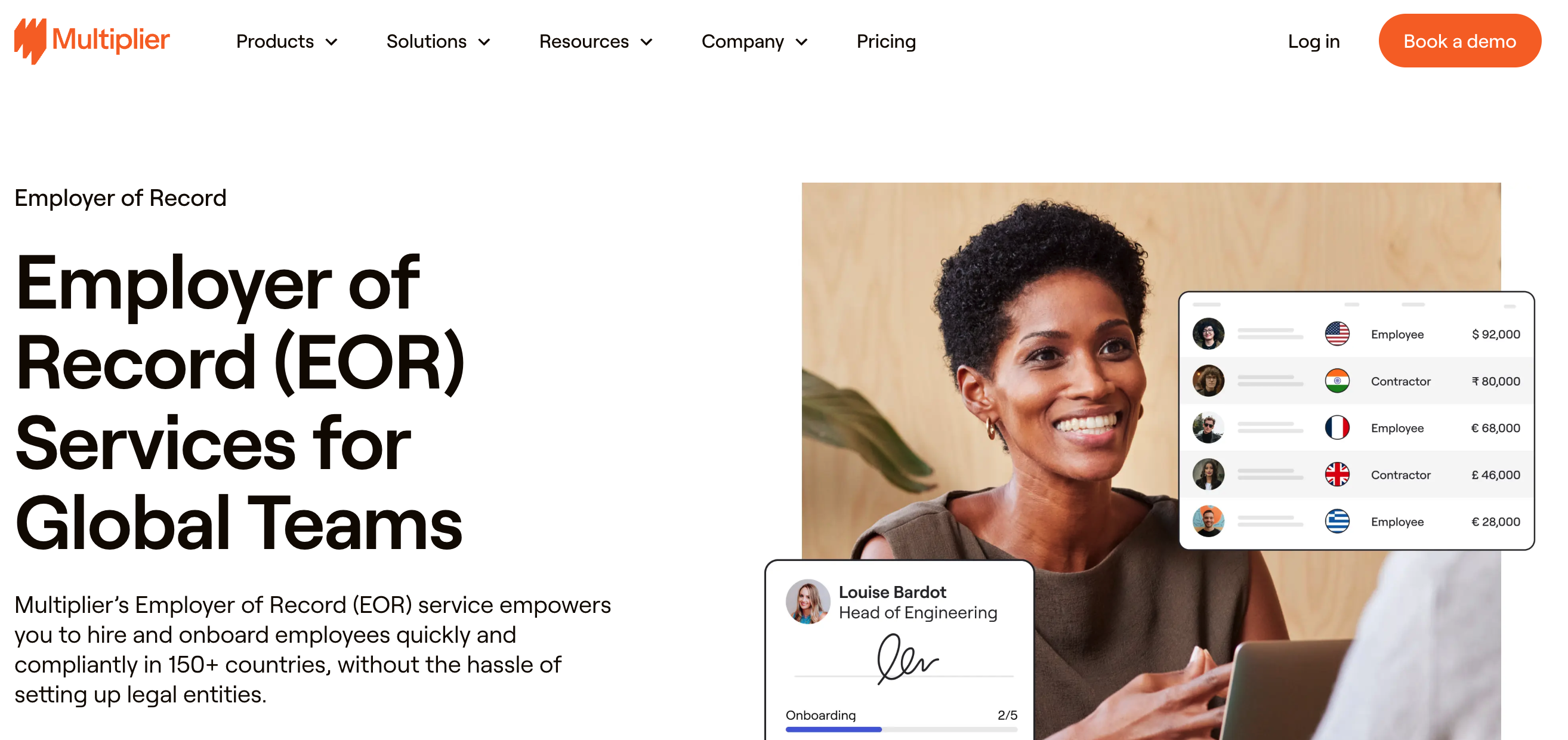
Multiplier is an EOR provider covering 150+ countries, positioned as a cost-accessible option for growing businesses that want multi-country employment without enterprise-level pricing. Its platform covers employment, payroll, benefits, and compliance across APAC and beyond.
For New Zealand specifically, Multiplier handles PAYE, KiwiSaver contributions, and ACC levy administration. Pricing starts at $499 per employee per month (monthly) or $459 annually for Core. Buyers should confirm exact New Zealand country pricing directly, as approximately 11% of countries carry adjusted rates. KiwiSaver employer contributions reflect the updated default rate of 3.5%, effective April 2026.
New Zealand's Holidays Act 2003 requires payroll systems to apply four distinct statutory pay formulas correctly. Buyers should confirm with Multiplier whether their payroll engine applies the ordinary weekly pay (OWP) or average weekly earnings (AWE) methodology for each leave type, as incorrect application is a documented compliance risk across EOR providers operating in New Zealand.
Strengths:
-
Covers 150+ countries with a multi-country EOR and payroll platform, supporting companies from first hire to distributed teams across APAC and globally.
-
Pricing starts at $499 per employee per month (monthly) or $459 annually for Core, making it one of the lower entry points among major EOR providers.
-
Human-first support model with local expertise, suited to SMBs that need responsive account access without enterprise contract requirements.
Limitations:
-
Public sources reviewed did not document Multiplier's specific Holidays Act OWP vs AWE methodology for New Zealand leave calculations. Buyers should request written confirmation before onboarding.
Best for:
Budget-conscious SMBs and APAC-focused hiring programs that need fast, affordable onboarding across multiple countries without committing to enterprise-tier pricing.
Teamed
Teamed is an EOR provider covering 187+ countries, with a stated focus on advisory-led service and compliance depth for complex employment markets. For New Zealand, Teamed evaluated eight EOR providers against a public rubric built around six axes: the Employment Relations Act, the Holidays Act, and KiwiSaver. Teamed ranked itself at the top of that rubric.
Teamed explicitly addresses the Holidays Act 2003 ordinary weekly pay (OWP) versus average weekly earnings (AWE) complexity, which is a documented compliance risk for EOR providers operating in New Zealand. This public disclosure of methodology is a meaningful trust signal for buyers who need to demonstrate payroll compliance to auditors or legal counsel.
Pricing is $599 per employee per month flat. Statutory costs and benefits vary by country. Teamed also supports companies planning a transition to their own New Zealand Limited company, making it a practical option for businesses that want EOR as a bridge rather than a permanent structure.
Strengths:
-
Teamed scored top on a public NZ-specific rubric covering the Employment Relations Act, Holidays Act, and KiwiSaver, and explicitly documents its OWP vs AWE methodology for leave calculations.
-
Dedicated country specialist on every account, supporting buyers who need advisory-led guidance on New Zealand employment law rather than a self-serve platform model.
-
Covers 187+ countries with a flat $599 per employee per month fee, and supports planned transitions to a client's own New Zealand Limited company.
Limitations:
-
Teamed's comparison rubric is self-published, meaning its top ranking reflects its own scoring criteria and weightings rather than an independent third-party audit.
Best for:
Businesses that want expert, advisory-led EOR service in New Zealand with explicit Holidays Act compliance documentation and a planned path to establishing their own New Zealand Limited company.
G-P
G-P, formerly Globalization Partners, is an enterprise-grade EOR provider covering 180+ countries. It operates through the G-P Meridian platform, which handles hiring, onboarding, payroll, benefits, and compliance in a single system. Third-party comparisons place G-P among the top contenders for New Zealand EOR services, particularly on pricing transparency and country coverage.
In New Zealand, G-P manages PAYE withholding, KiwiSaver employer contributions (note the default rate increases to 3.5% from April 2026), ACC levy administration, and employment contracts compliant with the Employment Relations Act 2000. The Holidays Act 2003 requires four distinct statutory pay formulas, and G-P's in-country expertise supports accurate leave calculation across ordinary weekly pay and average weekly earnings methodologies.
Each account receives a dedicated Customer Success Manager supported by in-country HR specialists. Onboarding typically runs two to seven days depending on country-specific requirements. Pricing starts from approximately $599 per employee per month, with custom quotes available for larger programs.
Strengths:
-
G-P Meridian platform consolidates hiring, onboarding, payroll, benefits, and compliance in one interface, reducing the number of systems HR teams manage across countries.
-
Dedicated Customer Success Manager on every account provides consistent, named support rather than rotating ticket-based service, which matters for Employment Relations Act queries and Holidays Act recalculations.
-
Listed as a top contender for New Zealand EOR on pricing transparency and coverage, alongside Teamed and Remote, in third-party provider comparisons.
Limitations:
-
G-P is positioned for mid-market to enterprise buyers. Companies with fewer than 50 employees or limited budgets may find the pricing and service model less suited to their scale.
-
Public sources reviewed did not document G-P-specific Holidays Act OWP versus AWE methodology details for New Zealand payroll execution.
Best for:
Enterprise companies with 50 or more employees that need a dedicated account manager, a unified platform, and proven global scale across 180+ countries.
Rippling
Rippling is a software-first EOR platform covering 80+ countries, built around a unified HR, IT, payroll, and finance system. It scored 4.85 out of 5 in an Australian EOR comparison, recognized for managing employment, payroll, compliance, and IT device management in one platform. For New Zealand, Rippling covers PAYE withholding, ACC levy administration, and KiwiSaver employer contributions, with the default KiwiSaver contribution rate increasing to 3.5% from April 2026.
Rippling's platform model suits companies that want a single system for HR operations and IT management rather than a specialist compliance-advisory service. New Zealand's Holidays Act 2003 requires payroll systems to apply four distinct statutory pay formulas correctly. Public sources reviewed did not confirm whether Rippling applies ordinary weekly pay or average weekly earnings methodology for New Zealand leave calculations, which is a compliance consideration for buyers in this market.
Pricing is custom and estimated at $599 or more per employee per month. The existing content on this page cited $822 (NZD 1,400) to $1,644 (NZD 2,800) per month. The application will resolve the verified USD or NZD figure after the full draft is assembled.
Strengths:
-
Unified platform covering HR, IT, payroll, and compliance in one system reduces tool fragmentation for companies managing distributed teams across multiple functions.
-
Scored 4.85 out of 5 in a published Australian EOR comparison, with recognition for the breadth of its all-in-one system across HR, IT, payroll, and compliance management.
-
Covers 80+ countries for EOR services, supporting mid-market to enterprise companies that need consistent platform experience across multiple hiring markets.
Limitations:
-
Public sources reviewed did not confirm Rippling's specific methodology for New Zealand Holidays Act leave calculations, including whether it applies ordinary weekly pay or average weekly earnings, which is a material compliance risk in this market.
-
Customer support depth varies by plan, and the platform-first model may provide less advisory depth on Employment Relations Act or Holidays Act queries compared to providers with dedicated in-country specialists.
Best for:
Mid-market to enterprise companies that want HR, payroll, IT, and compliance managed in one unified platform across multiple countries.
Pebl

Pebl, formerly Velocity Global, provides entity-free employment across 185+ countries, including New Zealand. The platform covers employment contracts, payroll, benefits, and statutory compliance without requiring companies to establish a local entity.
New Zealand's compliance layer includes PAYE withholding, KiwiSaver administration (employer contributions rising to 3.5% from April 2026), ACC levy payments, and Holidays Act 2003 leave calculations. Pebl's global coverage positions it for companies expanding into complex compliance regions across multiple markets simultaneously.
Pricing starts at $599 per employee per month. Pebl suits companies that need flexible, multi-country employment solutions rather than a single-country specialist.
Strengths:
-
Coverage across 185+ countries with flexible solutions designed for complex compliance regions, including New Zealand's statutory requirements.
-
Dedicated support and global HR specialists available to assist with employment governance across markets.
Limitations:
-
Public sources reviewed did not document Pebl-specific Holidays Act 2003 compliance methodology or New Zealand onboarding timelines.
Best for:
Best for companies pursuing emerging market expansion across multiple complex compliance regions who need a single provider with broad global coverage.
What Are the Key Services of an EOR in New Zealand?
An EOR in New Zealand runs the full employment layer on behalf of the hiring company. Core services cover payroll, statutory contributions, tax filings, employment contracts, leave administration, and work visa support.
New Zealand's Holidays Act 2003 is a known compliance trap. Each time an employee takes leave, the EOR must compare ordinary weekly pay against average weekly earnings and apply whichever is higher. Widespread employer underpayment under this formula has resulted in Labour Inspectorate enforcement action, which is why in-country EOR expertise matters.
KiwiSaver employer contributions are set to rise to 3.5% of gross earnings from April 2026. Any EOR operating in New Zealand must apply this updated rate accurately from the effective date.
The 90-day trial period carries a specific risk for EOR arrangements. Because an EOR aggregates headcount across all client companies, it typically employs well over 20 people. This means the small-employer exemption does not apply, and employees retain personal grievance rights from day one regardless of any trial period clause in the employment agreement.
Employment Contracts and Local Compliance
Every employee hired through an EOR in New Zealand must have a written employment agreement before starting work, as required by the Employment Relations Act 2000. The agreement must include the role, pay rate, hours, and a plain-language explanation of the employee's rights.
The minimum wage in New Zealand is $14 (NZD 23.95) per hour from April 2026. Verify the current rate at employment.govt.nz, as the government reviews it annually on 1 April.
The 90-day trial period requires careful attention in the EOR context. Because an EOR aggregates headcount across multiple clients, it typically employs 20 or more people. The small-employer exemption that once limited personal grievance rights during a trial period almost certainly does not apply. Employees hired through an EOR generally hold personal grievance rights from day one, regardless of any trial clause in the contract. Buyers should confirm this with their EOR provider before signing.
Payroll and Tax Administration
EORs in New Zealand run payroll in NZD and handle all statutory deductions on the employer's behalf. This includes PAYE tax withholding based on each employee's IRD tax code, ACC employer levies at approximately 1.67% of gross earnings (verify for the 2026-27 levy year), and KiwiSaver employer contributions.
From 1 April 2026, the default KiwiSaver employer contribution rate increases to 3.5% of gross earnings, up from the previous 3% minimum. EORs must apply this updated rate to remain compliant.
New Zealand also requires Payday Filing. Employers must file employment information with Inland Revenue on or before each payday, not on a monthly schedule. This is a distinct obligation that differs from payroll filing practices in many other countries. A qualified EOR handles this filing automatically as part of its standard payroll cycle, reducing IRD penalty exposure for the client company.
Benefits Administration
An EOR in New Zealand administers the full statutory benefits stack on behalf of the employer. This includes KiwiSaver enrollment and employer contributions, which rise to 3.5% effective 1 April 2026, up from the previous 3% default rate.
Employer KiwiSaver contributions are subject to ESCT (employer superannuation contribution tax), which affects the net cost of each hire and must be factored into workforce budgeting. ACC (Accident Compensation Corporation) levies are a separate statutory obligation, covering workplace injury insurance funded by the employer.
Supplementary benefits such as private health insurance and life insurance are not legally required but are commonly offered to attract skilled New Zealand talent. An EOR can administer these optional benefits alongside statutory obligations within a single employment arrangement.
Employee Onboarding
EOR onboarding in New Zealand typically takes 2 to 5 days from contract signing to an employee's first working day, though exact timelines vary by provider and individual circumstances.
For companies hiring foreign workers, Immigration New Zealand requires the employer to hold accredited employer status before sponsoring a visa. An EOR manages this accreditation on behalf of the client company, removing a significant administrative burden from the hiring process.
The Accredited Employer Work Visa (AEWV) framework was reformed in December 2024, with changes taking effect through 2025. Key updates include removal of the median wage threshold, reduction of the work experience requirement to two years, new seasonal pathways from November 2025, and an increase in visa duration to three years for roles classified at ANZSCO Levels 4 and 5. An EOR tracks these changes and applies the current rules to each visa application it manages.
Ongoing HR Support
New Zealand's Holidays Act 2003 requires leave pay to be recalculated each time an employee takes leave, not just at accrual. An EOR recalculates ordinary weekly pay versus average weekly earnings on every leave event and applies whichever figure is higher.
Minimum wage updates take effect on 1 April each year. An EOR monitors the annual rate change and applies it to payroll automatically, so employers do not need to track IRD announcements or manually update pay runs.
KiwiSaver contribution rates are also subject to legislative change. The default employee and employer rate is scheduled to increase to 3.5% from April 2026. An EOR tracks these changes and updates payroll deductions before the effective date.
Employee Offboarding
Because an EOR aggregates headcount across all its clients, the small-employer exemption for 90-day trial periods does not typically apply. Employees have personal grievance rights from day one, and any termination must follow the Employment Relations Act good faith process regardless of how long the employee has worked.
Notice periods in New Zealand are set by the employment agreement, generally ranging from one to four weeks. There is no statutory minimum beyond reasonable notice, so the EOR drafts and enforces the agreed terms.
Redundancy requires genuine justification and good faith consultation under the Employment Relations Act. The EOR manages this process. Final pay must include an accurate Holidays Act leave payout, calculated at ordinary weekly pay or average weekly earnings, whichever is higher.
How to Hire Through an EOR in New Zealand ?
For companies testing the New Zealand market or hiring between one and five employees, an EOR is typically the practical starting point. Setting up a New Zealand limited company takes one to three weeks and costs $1,762 (NZD 3,000) to $7,047 (NZD 12,000), and requires a resident director who is a New Zealand or Australian resident under the Companies Act 1993.
An EOR removes that requirement entirely. Once you select a provider and confirm employee details, contract setup typically completes within one to three business days. The EOR becomes the legal employer, running payroll, KiwiSaver contributions, ACC levies, and PAYE filings on your behalf.
The selection criteria that matter most for New Zealand are covered in the evaluation section below.
Selection and Setup
When evaluating EOR providers for New Zealand, apply these seven axes in order of compliance risk.
-
Legal entity model: Confirm whether the provider operates a New Zealand-owned legal entity or uses a local partner. Owned-entity providers carry employment liability directly.
-
KiwiSaver and ACC accuracy: Verify the provider applies the correct KiwiSaver employer contribution rate, including the 3.5% default rate effective April 2026, and classifies ACC levies by the correct industry code.
-
Holidays Act calculation method: Ask specifically how the provider calculates ordinary weekly pay versus average weekly earnings under the Holidays Act 2003. Incorrect application of these four statutory formulas is a documented compliance risk across the industry.
-
Onboarding speed: Confirm the provider's stated onboarding SLA in business days for New Zealand specifically.
-
Pricing transparency: Require a full cost breakdown before signing, covering the EOR fee, statutory employer costs, and any per-transaction charges.
-
Employment Relations Act termination support: Confirm the provider supports the good faith process and Employment Relations Authority procedures if a dispute arises.
-
Support model and time zone coverage: Check whether account support covers New Zealand Standard Time (UTC+12) and whether you have a named contact.
Once a provider is selected and employee details are confirmed, EOR contract setup in New Zealand typically takes one to three business days.
Onboarding and Compliance
A qualified EOR configures Payday Filing with Inland Revenue (IRD) on or before the first payday, registers for ACC levies under the correct industry classification, and enrolls eligible employees in KiwiSaver with the updated 3.5% employer contribution rate effective April 2026.
For hires requiring an Accredited Employer Work Visa (AEWV), the EOR must hold or obtain Immigration New Zealand employer accreditation before the foreign worker can begin employment. This step adds lead time and should be confirmed with the EOR before extending an offer.
Employment agreements that include a 90-day trial period clause carry a specific risk in the EOR context. Because headcount is aggregated across the EOR's legal entity, the clause is likely unenforceable. Legal review is recommended before including it in any New Zealand employment agreement issued through an EOR.
What Are the Benefits of Using an EOR in New Zealand?
Using an EOR in New Zealand removes the need to register a New Zealand Limited company, which typically costs $1,762 (NZD 3,000) to $7,047 (NZD 12,000) and takes one to three weeks before a single employee can be hired. An EOR makes employment possible within days at a predictable monthly fee.
Statutory employer add-on costs in New Zealand run approximately 5 to 7 percent of gross salary. That figure covers the KiwiSaver employer contribution (3.5% from April 2026), the ACC workplace injury levy (approximately 1.67%), and Employer Superannuation Contribution Tax (ESCT). An EOR calculates, withholds, and remits all three on your behalf.
For a detailed cost breakdown comparing EOR fees against local entity setup and ongoing compliance overhead, see the employer of record cost guide.
Faster Market Entry
Registering a New Zealand limited company takes one to three working days at the Companies Office ($68 (NZD 115) fee), but full operational setup including IRD registration, ACC enrollment, and a business bank account typically takes one to three weeks.
The Companies Act 1993 adds a further complication: at least one director must be ordinarily resident in New Zealand or Australia. Foreign companies without a qualifying director face delays before they can legally operate.
An EOR removes both obstacles. Gloroots can place a compliant employee in New Zealand within two to five days, with no entity, no resident director, and no registration queue. The employment layer is already in place.
Reduced Compliance Risk
New Zealand's Holidays Act 2003 requires employers to pay annual leave at the higher of ordinary weekly pay (OWP) or average weekly earnings (AWE). That comparison must be made each time an employee takes leave.
Variable pay and irregular hours make AWE calculations complex. Widespread underpayment across New Zealand employers has triggered Labour Inspectorate enforcement actions, and the liability sits with the legal employer of record.
An EOR absorbs that liability. One further point applies to the 90-day trial period: because an EOR aggregates headcount across all its clients, the small-employer threshold is rarely met, so trial periods are generally not available under an EOR arrangement. A qualified EOR accounts for this from day one of the employment contract.
Simplified Payroll Administration
Running payroll in New Zealand involves more than salary transfers. Employers must calculate PAYE, remit ACC levies, manage KiwiSaver contributions, and file employment information with Inland Revenue on or before each payday under Payday Filing rules. Missing a filing deadline triggers IRD penalties.
An EOR handles all of this automatically. From April 2026, the default KiwiSaver employer contribution rate rises to 3.5%. Combined with ACC levies of approximately 1.67% and ESCT, total statutory employer costs run roughly 5 to 7% of gross salary. The EOR calculates, withholds, and remits each component, so payroll closes correctly every cycle without manual intervention from your finance team.
Access to Local Benefits
KiwiSaver is a significant talent attraction tool in New Zealand. Employees expect employer contributions, and opt-out rates remain low. From April 2026, the default employer contribution rate increases to 3.5%, making accurate administration a baseline requirement for competitive hiring.
An EOR enrolls employees in KiwiSaver, manages contributions, and can also facilitate supplementary benefits such as private health insurance and life insurance, which are common in competitive New Zealand hiring markets.
ACC provides no-fault workplace injury cover funded by employer levies. Correct industry levy classification matters: misclassification leads to over-payment or under-payment. An EOR applies the right levy category from day one, keeping costs accurate and avoiding compliance exposure.
Lower Entity Setup Costs
Setting up a New Zealand limited company costs $68 (NZD 115) in Companies Office fees, plus $1,762 (NZD 3,000) to $7,047 (NZD 12,000) in professional fees for legal and accounting work. That is relatively affordable compared to many markets, but ongoing compliance overhead adds up: annual returns, IRD registration, ACC registration, and a resident director requirement that may require a paid nominee.
An EOR removes those fixed costs entirely. For companies hiring one to five employees in New Zealand, the EOR management fee is typically lower than the combined cost of entity setup and ongoing compliance. At three to five employees, the monthly EOR fee may approach entity running costs, so buyers should model their specific headcount trajectory before committing to either path. Understanding the full employer of record cost across both options helps Finance teams make a grounded decision.
More Flexible Workforce Scaling
An EOR lets companies add New Zealand headcount without committing to entity setup, which makes it a practical option for testing the market before a longer-term investment. New Zealand's entity setup timeline is relatively fast compared to other Asia-Pacific markets, but the compliance obligations that follow are ongoing.
Scaling down, however, is not frictionless. New Zealand's Employment Relations Act 2000 requires genuine redundancy justification and good faith consultation before any role is disestablished. That obligation applies whether the employer is a local company or an EOR. Companies should factor termination timelines and consultation requirements into workforce planning from the start.
For companies at an early stage of New Zealand expansion, an EOR provides a lower-commitment entry point. Headcount can grow as the business case develops, and the transition to a local entity remains an option once volume justifies it. Gloroots supports that progression with predictable, country-specific pricing and centralized workforce visibility across the full employment lifecycle.

How to Find the Right EOR for New Zealand ?
With eight providers reviewed in this guide, most buyers can narrow to two or three strong candidates by matching their situation to specific criteria rather than comparing every feature across every provider.
The provider introductions above outline scenario-based matching to help you identify which providers fit your company size, hiring volume, and compliance priorities. Use those scenarios as a starting filter, then apply the criteria below to make a final call.
New Zealand's compliance environment is more demanding than it appears. The Holidays Act 2003 calculation methodology, the KiwiSaver 3.5% rate taking effect in April 2026, and Employment Relations Authority termination procedures each carry real liability. Weight NZ-specific compliance depth heavily when comparing providers.
Local Compliance Expertise
Ask each provider whether it employs New Zealand workers through an owned local legal entity or through a third-party partner. A partner model adds a layer of liability that the hiring company may not see until a dispute arises.
On payroll, ask specifically how the provider calculates ordinary weekly pay versus average weekly earnings for Holidays Act leave payments. Many payroll engines apply the wrong formula, which creates back-pay exposure. Also confirm whether the provider has updated its payroll engine for the KiwiSaver default contribution rate moving to 3.5% from April 2026.
For termination, ask whether the provider has in-house experience supporting Employment Relations Authority personal grievance defense. Finally, note that the 90-day trial period available to employers under New Zealand law does not apply in a standard EOR arrangement, since the EOR is the legal employer. Buyers should confirm how their chosen provider handles this gap before onboarding.
Clear Service Scope
Service scope varies significantly between EOR providers operating in New Zealand. Before signing, confirm whether the provider handles AEWV employer accreditation and job check processing with Immigration New Zealand, or whether immigration support is excluded or priced separately.
Buyers should also verify that the provider manages Payday Filing obligations with IRD, registers and classifies ACC levies by industry, and produces Holidays Act leave calculation reports. These are not universal inclusions. Some providers cover payroll and KiwiSaver administration but stop short of immigration or ACC classification work, leaving compliance gaps that fall back on the hiring company.
Support Model
New Zealand operates at UTC+12 in standard time and UTC+13 during daylight saving. Buyers should confirm whether the provider offers support during NZ business hours or routes all queries through US or EU teams, which can add a full business day to response times.
Response speed matters most when an Employment Relations Authority (ERA) claim is filed. Ask how quickly the provider can engage qualified NZ employment law expertise in that scenario. A dedicated account manager with retained context on your workforce is a material advantage over a shared support pool, particularly for compliance-sensitive employment situations where continuity and speed both affect outcomes.
Technology and Reporting
A platform operating in New Zealand must generate the specific records IRD and WorkSafe require. Ask each provider whether their system produces IRD employer deduction schedules, Payday Filing records, KiwiSaver contribution confirmations, and ACC levy records as standard outputs.
Holidays Act compliance adds a further requirement. The Act's four statutory pay formulas create an audit trail obligation that many payroll systems handle poorly. Confirm that the platform generates an audit-ready leave calculation record before you commit.
Xero dominates accounting in New Zealand. If your finance team runs on Xero, verify that the EOR platform integrates directly so payroll data flows without manual re-entry.
Scalability for Your Hiring Plans
At three to five employees, the economics of EOR versus a New Zealand Limited company shift. Model both options at that headcount and confirm your provider can support a transition to your own entity if that becomes the right move.
If you plan to hire foreign workers, check whether the provider can manage multiple concurrent Accredited Employer Work Visa applications and handle employer accreditation renewals with Immigration New Zealand.
For companies treating New Zealand as part of a broader APAC expansion, confirm the provider covers Australia, Singapore, and other target markets under a single contract. Gloroots supports employment across 150+ countries, including APAC markets, through a centralized workforce dashboard with consistent governance across regions.

Why Gloroots Is a Strong EOR Partner in New Zealand
Gloroots EOR services cover New Zealand as part of a 150+ country employment operating layer. Companies can employ, pay, and manage New Zealand workers without setting up a local entity.
Gloroots combines four service pillars: Global Employer of Record, Global Payroll, Compliance and Employment Governance, and Benefits and Statutory Coverage. Each pillar applies to New Zealand employment, including KiwiSaver administration, ACC levy payments, and PAYE withholding.
Three New Zealand-specific capabilities stand out. First, Gloroots applies both the ordinary weekly pay and average weekly earnings methodologies required under the Holidays Act 2003, reducing the recalculation risk that affects many payroll systems. Second, the team supports Employment Relations Authority personal grievance processes, providing in-house guidance when a dispute arises. Third, Gloroots holds Accredited Employer Work Visa sponsorship capability, so companies can hire visa-dependent workers without engaging a separate immigration provider.
Pricing is country-specific and fixed before onboarding begins. There is no percentage-of-salary pricing. Gloroots pricing gives Finance teams a predictable per-employee cost with full visibility before the first hire.
Gloroots is a strong fit for companies running multi-country programs that include New Zealand. For businesses that need a single-country NZ specialist with advisory-led service and a path to their own NZ Limited company, a provider such as Teamed may be worth comparing.
FAQs About the Best EOR in New Zealand
How does an EOR work in New Zealand?
An EOR in New Zealand acts as the legal employer for workers hired on behalf of a foreign or domestic company. The EOR registers with Inland Revenue (IRD), handles Payday Filing obligations, enrolls employees in KiwiSaver, and pays ACC levies. The client company directs the day-to-day work but holds no New Zealand legal presence.
This model differs from a PEO arrangement. An EOR is the sole legal employer; a PEO co-employs alongside the client. The New Zealand market predominantly uses the EOR model, which removes the need for a local entity and transfers statutory employer obligations to the EOR. For more on how this works across markets, see how does EOR work.
What does an EOR cost in New Zealand?
Major EOR providers charge approximately USD 199 to USD 699 per employee per month for New Zealand hires. Statutory employer costs add roughly 5 to 7 percent of gross salary on top, covering KiwiSaver contributions (3.5% employer minimum from April 2026), ACC levies (approximately 1.67%), and ESCT.
Some providers charge a percentage of salary, which scales costs unpredictably as salaries rise. Gloroots uses predictable, country-specific flat-fee pricing with full cost visibility before onboarding. By comparison, setting up a New Zealand entity costs $1,762 (NZD 3,000) to $7,047 (NZD 12,000) upfront, plus ongoing compliance overhead. For a broader view of employer of record cost, see our full breakdown.
When should a company use an EOR in New Zealand?
An EOR works well for companies hiring one to five employees in New Zealand to test the market before committing to a local entity. It also suits companies that lack a New Zealand resident director, which is required for the entity route, and those that need to place workers within days rather than weeks.
New Zealand's compliance layer adds further weight to the EOR case. The Holidays Act 2003, KiwiSaver administration, and Employment Relations Act obligations can exceed the capacity of an internal HR team with no local experience. At three to five employees, model the full cost of an EOR against entity setup and ongoing administration. An EOR is not always the right long-term answer as headcount grows.
Can an EOR hire both local and foreign employees in New Zealand?
Yes. An EOR can employ New Zealand citizens, permanent residents, and foreign nationals under a single employment framework. For foreign workers, the EOR can support employer accreditation with Immigration New Zealand and manage job check processing under the Accredited Employer Work Visa (AEWV) scheme.
The 2025 AEWV reforms reduced the work experience requirement to two years, extended visa duration for ANZSCO Level 4 and 5 roles to three years, and introduced new seasonal pathways from November 2025. The median wage threshold requirement was also removed.
Regardless of nationality, all EOR employees in New Zealand receive the same statutory minimums: KiwiSaver enrollment, ACC coverage, Holidays Act leave entitlements, and the applicable minimum wage. The 90-day trial period applies to both local and foreign EOR employees, subject to the conditions set out in the Employment Relations Act 2000.
How do I choose the right EOR in New Zealand?
Start by confirming whether the provider operates through an owned New Zealand entity or a third-party partner, as this affects liability and compliance accountability.
Then verify KiwiSaver compliance at the 3.5% default rate, accurate Holidays Act leave calculations using the correct ordinary weekly pay or average weekly earnings methodology, and Employment Relations Authority termination support.
Also check onboarding SLA, pricing transparency, and whether the provider offers support during New Zealand business hours. The best employer of record comparison table and the scenario-based guidance above can help match these criteria to your specific hiring situation.