






Compare the top 9 EOR providers in Germany for 2026. Evaluate pricing, social security compliance, and onboarding speed to hire compliant German employees without setting up a local entity.
- EOR providers operating in Germany must hold a valid license under the Labor Leasing Act; buyers should request the license number and confirm it is current before selecting a provider, as this is a legal requirement for compliant employment arrangements in Germany.
- Owned-entity models provide direct regulatory accountability for employment contracts, payroll, and social insurance filings, while partner-network models introduce a third-party layer that requires additional due diligence on the partner's own compliance standing.
- Employer social insurance contributions in Germany cover pension, statutory health insurance, unemployment, and long-term care, adding approximately 12,000 to 13,000 euros per year on a 60,000 euro gross salary; total employment cost must account for these statutory additions beyond the EOR service fee.
- Works council consultation rights apply to certain employment decisions, and any EOR operating in Germany must be able to support the notification and documentation obligations tied to this process, including at the point of onboarding.
- Termination in Germany is governed by the Protection Against Dismissal Act after six months of employment in companies with more than ten employees, with statutory notice periods scaling up to seven months for long-tenured staff; buyers should confirm that their chosen EOR can support the full offboarding sequence, including works council consultation where required.
- Employee leasing under the Labor Leasing Act is limited in principle to 18 months per employee with the same client, and equal pay with comparable direct employees applies after nine months. Buyers should plan the long-term structure, such as a direct hire or a German entity, before the first contract is signed.
This page compares 9 employer of record providers operating in Germany, covering pricing, onboarding speed, compliance model, and support quality for each. Last updated: September 2026.
Germany's labor framework sets strict requirements for any company hiring without a local entity. The Arbeitnehmerüberlassungsgesetz (AÜG) (Labor Leasing Act) governs employment through EOR arrangements, and providers must hold a valid license under this law. Termination rules under the Protection Against Dismissal Act and collective bargaining obligations are covered in detail later on this page.
Each provider profile addresses entity structure, statutory cost handling, and fit for different hiring contexts in the German market. Pricing figures appear in the comparison table below.
Our Top 9 Picks: Germany EOR Comparison 2026
The table below compares EOR providers operating in Germany across seven dimensions. Owned-entity status and license compliance are included as Germany-specific signals. For a broader view of global options, see the best employer of record comparison.
Plan global employment with control
Talk through your country-specific EOR requirements with the Gloroots team.

Top 9 Best EOR Platforms in Germany
The nine providers below cover a range of compliance models, pricing structures, and service depths for companies hiring in Germany. Each profile addresses how the provider handles German employment law, payroll, and statutory obligations.
Starting prices appear in the comparison table above and, where a provider publishes them, in the individual profiles. Each profile also notes the provider's approach to Germany-specific obligations, including works council process support, collective bargaining agreement handling, and visa and immigration support.
Profiles are ordered with Gloroots first, followed by additional providers evaluated across compliance model, entity structure, and fit for different hiring contexts in the German market.
Gloroots
Gloroots operates as a Global Employer of Record supporting compliant full-time employment across 150+ countries, including Germany. The platform combines Global EOR, Global Payroll, Compliance and Employment Governance, and Benefits and Statutory Coverage into one integrated employment operating layer.
In Germany, Gloroots manages social insurance administration, statutory leave management, and works council process support through a centralized platform. Workforce visibility is maintained through a live dashboard that tracks headcount, payroll liabilities, and compliance status in real time. Gloroots also provides data processing agreements to support GDPR compliance obligations for companies employing workers in Germany.
Gloroots uses predictable, country-specific pricing with full cost visibility before onboarding. There is no percentage-of-salary pricing, and all services are itemized upfront. Account support is human-led, with retained business context across every interaction.
Strengths:
-
Combines Global EOR, Global Payroll, Compliance and Employment Governance,
and Benefits and Statutory Coverage in one platform, reducing the need for
separate vendors.
-
Predictable, country-specific pricing with full cost visibility before
onboarding and no percentage-of-salary fees, supporting accurate budget
planning for German hires.
-
Centralized workforce visibility through a live dashboard, with human-led
account support that retains business context across engagements.
Limitations:
- Public sources reviewed did not document a provider-specific limitation for Gloroots in the German market.
Best for:
Companies scaling full-time employment in Germany that require centralized governance, predictable costs, and integrated payroll and compliance management across 150+ countries.
What our clients are saying

“China's employment regulations are highly nuanced, and we needed confidence that our offers would meet local expectations without risking compliance issues or losing candidates.”
HR Manager
Agratas Corp UK

Deel
Deel employs people in Germany through Deel Germany GmbH, its own entity, which Deel says holds an unlimited AUG licence. The platform covers 130+ countries and combines EOR with contractor management, payroll, and HR tools. That suits companies that manage several kinds of workers at once.
Deel lists EOR pricing from $599 per employee per month. Independent reviews report that Deel asks for a refundable deposit of one to one and a half times monthly employment cost per employee, with higher multiples in Germany, and that FX and benefits charges can add to the bill. Ask for a full cost breakdown before signing. Deel holds a 4.8 out of 5 rating on G2 from more than 13,000 reviews.
Strengths:
- Own German entity with an unlimited AUG licence, so employment runs through a single Deel company and no partner sits in the chain.
- One platform for EOR, contractors, payroll, and HR, with contractor-to-employee conversion built in.
- A 4.8 out of 5 rating on G2 from more than 13,000 reviews.
Limitations:
-
Public sources indicate less documented depth on works council coordination
and sector-specific collective bargaining agreement handling compared to
Germany-specialist providers, which may create gaps for companies in
regulated industries.
-
Third-party reviews report that Deel requires a refundable deposit of one to
one and a half times monthly employment cost per employee, with higher
multiples in Germany; buyers should confirm deposit terms and any FX or
benefits charges before signing.
Best for:
Companies managing mixed contractor and employee teams across multiple countries where Germany is one market among many and contractor-to-employee conversion is a priority.
WorkMotion
WorkMotion employs people in Germany through its own licensed entity and covers 160+ countries. Alongside EOR, it offers a Direct Hiring product and contractor management.
WorkMotion says it was the first EOR to earn IEC Gold Compliance Certification, awarded in July 2025 after an independent audit of more than 1,000 checkpoints. Pricing starts from €499 ($549) per employee per month, and WorkMotion quotes onboarding in 3 to 5 business days. It holds a 4.6 out of 5 rating on G2 from more than 470 reviews.
Strengths:
- Own German entity with a labor leasing licence.
- IEC Gold Compliance Certification, an independent audit that WorkMotion says no other EOR held at the time it was awarded.
- A Direct Hiring product sits next to EOR, which matters given Germany's 18-month limit.
Limitations:
- Public sources reviewed did not document specific works council support documentation or full sector-level collective bargaining agreement coverage for WorkMotion in Germany; buyers in regulated industries should confirm this scope directly with the provider.
Best for:
Companies prioritising independently audited compliance credentials for European hiring, particularly those for whom verified GDPR and employment law compliance is a procurement requirement.
Remote
Remote employs people in Germany through its own German legal entity and says it delivers all EOR services, including local specialist support, in-house. The EOR service covers 90+ countries. Each new hire gets a dedicated onboarding specialist.
Remote's Germany page lists EOR at $699 per employee per month, and independent reviews report $599 on annual billing. Remote also offers IP protection terms and stock option administration, which helps when hiring engineers.
Strengths:
- Own German entity, with no third party in the employment chain.
- IP protection terms and equity administration suit technical hiring.
- Dedicated onboarding specialist and in-house local experts.
Limitations:
- Public sources reviewed did not document a provider-specific limitation for Remote in the German market beyond the pricing point, which sits at the higher end of the market; refer to the comparison table for figures.
Best for:
Companies prioritising IP ownership and direct entity employment in Germany, particularly those hiring technical or product staff where intellectual property protection is a named requirement.
G-P
G-P, formerly Globalization Partners, covers 180+ countries and says it holds the AUG licence needed to employ people in Germany. It employs through its own entities and positions itself for enterprise programs that span many countries.
G-P lists a starting price of $599 per employee per month, with final quotes depending on country and headcount. Its security program includes ISO 27001, 27017, 27018, and 42001 certifications and a SOC 2 Type II report.
Strengths:
- The widest coverage in this comparison, at 180+ countries.
- Documented security certifications, including ISO 42001 for AI management.
-
Own-entity infrastructure with a stated AUG licence for Germany.
Limitations:
-
Pricing beyond the $599 starting figure is quote-based, which adds a step to
the evaluation compared with providers that publish country-level rates.
-
Typically positioned and priced for enterprise engagements, which may not
suit SMBs or companies hiring a small number of employees in Germany.
Best for:
Enterprise companies requiring end-to-end employee management in Germany and across multiple countries, with deep compliance infrastructure and dedicated customer success support.
Boundless
Boundless is a Dublin-founded EOR with a European focus, covering 110+ countries for EOR. Payoneer announced its acquisition of Boundless in January 2026. Boundless says it holds an active AUG licence and employs people in Germany through its own German entity. It also states that employment under its licence lasts up to 18 consecutive months.
Pricing starts from €175 ($199) per employee per month, and the final fee depends on the country and its regulatory complexity.
Strengths:
- An entry price at the low end of this comparison, in line with Gloroots.
- AUG licence and own German entity, according to Boundless.
- A European compliance focus, which shows in its Germany guidance.
Limitations:
- Pricing is not publicly listed beyond the starting figure, which may complicate detailed budget planning for companies evaluating total employment cost in Germany.
- No public compliance certification evidence has been found, and entity ownership in Germany is not publicly disclosed, which limits independent verification of the direct-entity compliance model.
Best for:
Companies that want deep German and European compliance expertise with a dedicated account manager and a compliance-first approach to AUG-regulated employment.
Atlas HXM
Atlas HXM, which changed its name from Atlas in January 2026, describes itself as a direct EOR that employs through wholly owned legal entities in 160+ countries. Third-party listings show a German entity, Atlas Technology Solutions Germany GmbH.
Its pricing page lists $599 per employee per month for teams of one to five, with quotes and volume discounts for larger teams. Atlas HXM quotes onboarding in as little as two weeks.
Strengths:
- Wholly owned entities across 160+ countries, according to Atlas HXM.
- A published starting price for small teams.
Limitations:
- Pricing is not publicly listed beyond the starting figure, which may complicate detailed budget planning for companies evaluating total employment cost in Germany.
- Public documentation on works council coordination and collective bargaining agreement handling in Germany is limited, which may require additional due diligence for companies in regulated sectors.
Best for:
Mid-market and enterprise companies that require a direct EOR model with wholly owned entities and 24-hour human support across a broad multi-country footprint.
Multiplier
Multiplier covers 160+ countries and states that it employs through its own legal entities and does not use a partner network. An independent listing names a Cologne-based German entity that holds an AUG licence.
Independent reviews put pricing at $459 per employee per month on annual billing and $499 monthly. Multiplier holds ISO 27001:2022 and SOC 2 Type 2 certifications, and a 4.7 out of 5 rating on G2 from more than 1,400 reviews.
Strengths:
- A mid-range published price compared with Deel, Remote, and G-P.
- Formal security certifications and a 4.7 rating on G2.
- Broad coverage at 160+ countries.
Limitations:
- CBA sector coverage depth for specific German industries should be confirmed directly with Multiplier before relying on this capability for regulated-sector hiring.
- Entry pricing is a "from" rate that varies by country, so the Germany rate should be confirmed before budgeting.
Best for:
Mid-market companies in regulated German sectors that require collective bargaining agreement compliance tooling and automated payroll without enterprise-level pricing.
FMC Group
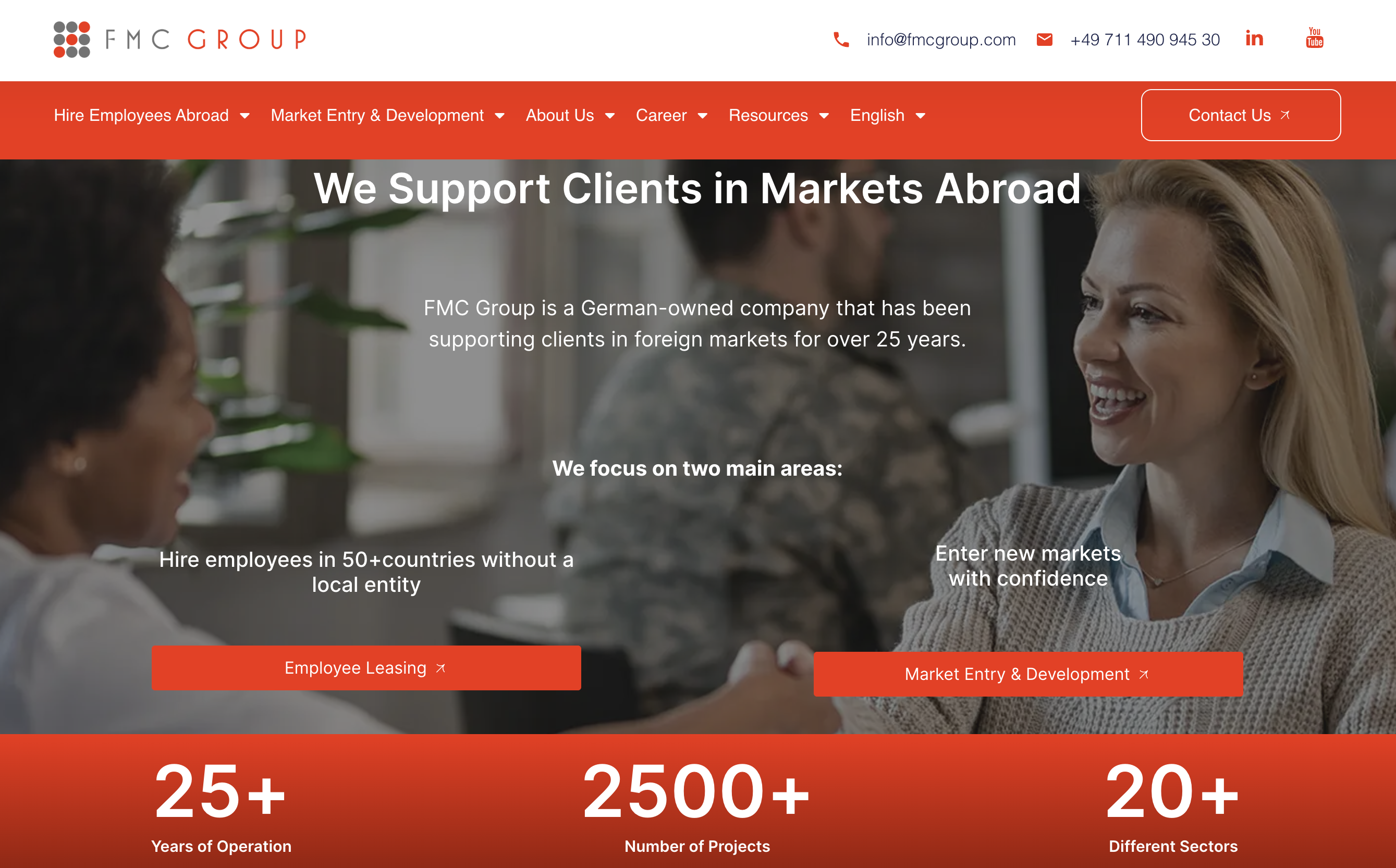
FMC Group is a German-owned Employer of Record provider that has operated since 2010 and supports hiring in more than 50 countries. In Germany, it employs workers through its own legal entity, FMC Group GmbH, and holds a valid labor leasing licence under the Arbeitnehmerüberlassungsgesetz (AÜG), which allows it to employ workers and assign them to client companies.
FMC Group manages employment contracts, payroll, taxes, social security contributions, statutory benefits, leave administration, and ongoing HR administration in Germany. Employees sign a local employment agreement directly with FMC Group GmbH, while the client company remains responsible for day-to-day work and performance. FMC Group states that onboarding typically takes 1 to 2 business days once the required documents and employment terms are finalized.
The service is built around people. Clients and employees each get dedicated contacts for onboarding and employment administration, and FMC Group also supports company cars, travel-expense reimbursement, and employee benefits where required. Works council support, collective bargaining agreement coverage, GDPR data processing terms, and visa support should be confirmed directly with FMC Group for individual hiring scenarios. For pricing, refer to the comparison table above.
Strengths:
-
German-owned provider that employs workers through FMC Group GmbH and holds
a valid AUG licence, giving direct regulatory accountability for compliant
Employer of Record arrangements in Germany.
-
Dedicated human contacts for both clients and employees, which provides
continuity across onboarding, payroll, HR administration, and ongoing
employment management.
-
Onboarding is typically completed within 1 to 2 business days after
documents and employment terms are finalized.
Limitations:
-
EOR coverage extends to 50+ countries, which is narrower than the 90 to 180+
countries covered by the other providers in this comparison.
-
Standard Germany EOR pricing is not listed on the provider's Germany
service page, so companies need to request a quote to compare total
costs.
Best for:
Companies hiring in Germany that prioritize direct German employment infrastructure, AUG compliance, fast onboarding, and dedicated human support over a self-service global platform.
What Are the Key Services of an EOR in Germany?
An EOR in Germany takes on legal employment responsibility for workers hired by a client company. Germany-specific obligations, including works council consultation, Arbeitnehmer-Überlassungsgesetz compliance, and collective bargaining agreement administration, run across every service category an EOR delivers in this market.
- Employment contracts: The EOR issues compliant German employment agreements covering probation periods, notice terms, and statutory entitlements.
- Payroll and tax filings: Monthly payroll is processed in euros, with employer social insurance contributions remitted to the relevant German authorities.
- Benefits administration: Statutory leave entitlements, including maternity leave, parental leave, and sick pay, are administered alongside any supplementary benefits the client elects to offer.
- Compliance and regulatory support: The EOR manages AUG licensing obligations, works council coordination, and ongoing changes to German labor law.
- Offboarding: Termination processes follow statutory notice periods and severance rules under German employment law
How Does an EOR Work in Germany?
An EOR becomes the legal employer of a worker in Germany. It issues the employment contract, runs payroll, remits taxes and social insurance, and administers statutory benefits, while your company directs the daily work. For people who work in Germany, German law classes this as employee leasing. That adds a licence requirement and time limits most countries don't have. For a general primer, see how does EOR work.
Licence and contract
Every provider needs an AUG licence from the Federal Employment Agency (Bundesagentur für Arbeit). If a provider doesn't hold one, the contract with it is void and the worker can be treated as your own employee from day one, which is the outcome an EOR exists to prevent. Employment contracts must also record key terms in writing under the Nachweisgesetz (Evidence Act), and leasing arrangements add their own disclosure requirements.
The 18-month limit and equal pay
In principle, the same employee can be assigned to the same client for no more than 18 months. Time already worked for that client counts even if a different provider placed the person, so switching EORs doesn't restart the clock. A break of at least three months is generally needed before the same person can return.
Equal treatment applies from the first day. After nine uninterrupted months, the employee is generally entitled to pay comparable to a directly employed colleague in the same role. A sector-level collective agreement can change both periods, for example by extending the equal pay period to 15 months.
Because of these limits, most companies use an EOR in Germany as a first step. If you plan a permanent team, start preparing your own German entity well before month 18. Ask each provider how it handles the deadline and what help it offers with the transition. The rules are technical, so have German employment counsel review your setup.
Payroll, contributions, and cost
Germany runs payroll monthly. The EOR withholds income tax (Lohnsteuer) and the solidarity surcharge, which applies only above an income tax threshold and so doesn't appear on most payslips. Church tax (Kirchensteuer) applies where the employee has declared a religious affiliation, and the rate depends on the state.
Employer social insurance contributions for 2026 are 9.3% for pension, 1.3% for unemployment, 1.8% for long-term care, and 7.3% for health insurance plus half of the health fund's supplementary contribution. The 2026 average supplementary contribution is 2.9%, so the employer's half is about 1.45%. Pension and unemployment contributions apply to earnings up to €101,400 a year, and health and long-term care contributions apply up to €69,750. Employers also pay accident insurance, which varies by industry, and some small levies. For employees below the ceilings, the core employer contribution rate comes to roughly 21% of gross salary.
On a gross salary of €60,000, that is about €12,700 a year. Add an EOR fee of around €500 a month (€6,000 a year) and the annual cost comes to roughly €78,700, before accident insurance, levies, and any collective agreement obligations. For what drives EOR fees, see our employer of record cost guide.
Leave and benefits
Statutory minimums include 20 days of annual leave on a five-day week, six weeks of employer-paid sick pay, 14 weeks of maternity protection (six weeks before birth and eight after), and up to three years of parental leave. Germany has nine national public holidays, and states add their own: Berlin observes 10 and Bavaria up to 13. Common extras a provider may administer include an occupational pension scheme (bAV), a public transport subsidy (Jobticket), and meal vouchers.
Works councils and dismissal
Employees in a workplace with at least five permanent employees can elect a works council (Betriebsrat). Setting one up is the employees' right, and employers can't obstruct it. A works council has co-determination rights on matters such as hiring, working hours, and dismissals, and it must be consulted before any dismissal. Ask providers how they handle notification and documentation when a council exists.
The Protection Against Dismissal Act applies after six months of employment in workplaces with more than ten employees and limits dismissals to socially justified grounds. Statutory notice grows with tenure, from four weeks up to seven months after 20 years of service. Probation can last up to six months, with two weeks' notice. Sector collective agreements can set higher standards for pay, hours, and leave than the statutory minimums, and the employment contract has to reflect them where they apply.
How to Choose the Right EOR for Germany
Work through these checks in order. A provider that fails an early one rarely needs a look at the later ones.
-
Licence and entity. Ask for the AUG licence number and the name of the
German entity that signs the contract. Confirm whether the licence is held
directly or through a partner, and whether it is limited or unlimited. If a
partner holds it, check the partner's licence and track record.
-
Month-18 plan. Ask how the provider handles the 18-month limit and the
nine-month equal pay rule, and what it offers when the deadline nears.
-
Compliance scope. Confirm written support for works council notification and
for the collective agreements in your sector, such as metalworking,
construction, or retail. Get a data processing agreement that covers GDPR
and the Federal Data Protection Act (BDSG).
-
Full cost. Compare flat fees with percentage-of-salary pricing, and ask for
a breakdown that includes employer contributions, deposits, and FX
charges.
-
Onboarding and support. Get the onboarding timeline in writing. Ask whether
you get a named contact or a shared queue, what the support hours are, and
whether the provider has German-speaking HR and legal staff.
-
Scope and reporting. Confirm benefits administration, EU Blue Card and visa
support under the Skilled Immigration Act, contractor-to-employee
conversion, and German statutory outputs such as payslips, social insurance
filings, and the annual wage tax certificate (Lohnsteuerbescheinigung).
Run global employment from one system
Set up compliant employment with
centralized payroll and workforce oversight.
Start for Free
EOR or German Entity: Which Fits Your Plan?
Incorporating a GmbH requires at least €25,000 in share capital plus notary and commercial register fees, and it typically takes six to eight weeks. Accounting and audit duties follow. An EOR avoids all of that, and the providers here quote onboarding from one or two business days to about two weeks.
For a handful of hires, an EOR usually costs less than setting up and running an entity. It also suits companies testing the German market, and it lets you convert contractors who risk being reclassified as employees. Misclassified workers can lead to back-dated social insurance contributions and penalties. Moving them onto an EOR contract removes that risk going forward, though not for earlier periods.
The 18-month limit changes the comparison for permanent roles. If you expect to keep the team in Germany, plan the switch to an entity or direct employment from the start. Our guides on EOR for startups and EOR for enterprises cover how that plays out at different company sizes.
Why Gloroots Is a Strong EOR Partner in Germany
Gloroots supports compliant full-time employment in 150+ countries, including Germany, and holds a valid labor leasing licence. In Germany, it manages social insurance administration, statutory leave, and employment documentation, and works council process support and GDPR and BDSG compliance are part of the scope. Pricing is country-specific, with no percentage-of-salary fees and full cost visibility before onboarding, and account support is human-led.
See Gloroots pricing for country figures, or talk to the team about Gloroots EOR services to review Germany costs and compliance requirements before you commit.
FAQs About the Best EOR in Germany
How does an EOR work in Germany?
An EOR becomes the legal employer in Germany. It handles the employment contract, payroll, social insurance filings, and statutory compliance, while your company directs the daily work. Because German law treats this as employee leasing, the provider must hold an AUG licence, and assignments to one client are capped at 18 months in principle.
What does an EOR cost in Germany?
EOR platform fees in Germany typically range from about $199 to $700 per employee per month. Gloroots and Boundless publish starting rates from about $199, Multiplier from $459, and Deel, WorkMotion, Remote, G-P, and Atlas HXM from $549 to $699. FMC Group doesn't list Germany pricing, so you need to request a quote.
Employer social insurance adds roughly 21% of gross salary, about €12,700 a year on a €60,000 salary. With an EOR fee of around €500 a month, the total comes to roughly €78,700 for that salary, before accident insurance, levies, deposits, and FX charges. See the employer of record cost guide for detail.
When should a company use an EOR in Germany?
Use an EOR when you want to hire in Germany without setting up a GmbH. That covers first hires, tests of the German market, small teams, and cases where speed matters. It also fits companies with contractors who risk being reclassified as employees. Because EOR employment is limited to 18 months per client in principle, plan the move to a direct hire or entity if the role is permanent.
Can an EOR hire both local and foreign employees in Germany?
Yes. An EOR can employ German nationals and foreign nationals under one structure. For non-EU nationals, the EU Blue Card is the main route for skilled workers who meet the salary thresholds, and the Skilled Immigration Act widened the routes from 2023 onward.
How do I choose the right EOR in Germany?
Start with the licence number and the contracting entity, then check the month-18 plan, works council and collective agreement scope, data processing terms, full cost, and support. The checklist above walks through each one.
Ready to Build?
Whether you're hiring one brilliant mind or building an entire distributed team, Gloroots has your back. Onboard now