





![Best Employer of Record (EOR) Service Providers in China [2026 Review]](/assets/vendor/cdn.prod.website-files.com/68c510b68e14d08336fa01cd/6984264f074482724416fc6b_64a51774cba4950b254a81ae_Frame%252035.webp)

- China requires all employment contracts to be written in Mandarin, and statutory social insurance contributions vary by city, meaning an EOR must calculate and remit contributions at the correct municipal rate for each employee rather than applying a national average.
- Entity ownership is the primary compliance signal when selecting a China EOR provider: providers that employ workers through their own Chinese legal entity carry compliance liability directly, while those using local partners introduce an intermediary the client cannot audit or instruct.
- Pricing across reviewed providers ranges from $199 to $699 per employee per month, but the published starting price does not always confirm which statutory filings, bilingual contracts, visa support, or offboarding services are included versus priced as add-ons.
- Statutory severance in China follows a defined formula of one month's salary per completed year of service, capped at three times the local average monthly wage per year, and wrongful termination claims require a documented trail covering grounds for termination, notice served, and all payments made.
- An EOR removes the need to register a local legal entity, which otherwise takes three to six months and requires minimum registered capital, allowing employment to begin without that structure.
China is one of the most regulated employment markets in the world. Hiring here without a licensed local entity or a compliant labour dispatch partner carries real regulatory risk. This guide evaluates eight EOR providers operating in China against five defined criteria: entity ownership, compliance depth, pricing transparency, city coverage, and verified customer ratings.
Each criterion carries equal weight in the overall assessment. Providers are ranked by their combined score across all five dimensions. Each candidate was assessed using publicly available pricing data, published compliance documentation, and customer ratings from G2, Capterra, or Trustpilot where scores were available at the time of review. Where a verified score was not available, this is noted per provider.
Three sections later in this guide address topics outside the provider comparison: how EOR compares to a Wholly Foreign-Owned Enterprise (WFOE) structure, your obligations under China's Personal Information Protection Law (PIPL), and how statutory severance is calculated under the Labour Contract Law. The country facts below frame the regulatory context before the reviews begin.
Our Top 8 Picks: China EOR Comparison 2026
The table below compares all eight providers across seven dimensions. Full reviews appear in the sections below.
| Provider | Pricing per month | Country coverage | Onboarding speed | Platform experience | Customer support | Scalability |
|---|---|---|---|---|---|---|
| Gloroots | $199/employee/month | 150+ countries | 3–5 working days; country-dependent | Centralized workforce dashboard covering hiring, payroll, compliance, benefits and workforce visibility | 24/7 human support with dedicated account management | SMB to enterprise; built for multi-country programs |
| Deel | $599/employee/month | 130+ EOR countries | Automated onboarding; country-dependent | Unified platform for EOR, payroll, contractors, HR, benefits, compliance and integrations | 24/7 HR, legal and tax expertise | SMB to enterprise; strong fit for fast-scaling distributed teams |
| Rippling | Custom EOR pricing; country-specific | 80 EOR countries | No universal public EOR SLA | Unified HR + IT + payroll + finance platform | Support available through Rippling's platform; service depth varies by product and plan | SMB to enterprise; particularly strong for automation-heavy HR/IT environments |
| Remote | $699/employee/month; $599 when billed annually | 100+ EOR countries | Dedicated onboarding specialist; country-dependent | Owned-entity EOR platform with payroll, benefits, compliance, IP protection and workforce management | In-house local experts and dedicated specialist support | SMB to enterprise; particularly strong for companies prioritizing owned entities and IP |
| Horizons | From $199/employee/month; country-specific pricing may apply | 150+ countries | Up to 48 hours in standard workflows; country-dependent | Centralized global employment platform covering payroll, leave, compliance and workforce management | Dedicated account manager plus HR/legal support | SMB to enterprise; EOR, payroll, recruitment and entity setup |
| RemoFirst | From $199/employee/month; country-specific requirements may affect pricing | 185+ countries | As fast as 48 hours; country-dependent | Centralized EOR platform covering payroll, tax, benefits, visa support and compliance | Dedicated account manager and in-country experts; 24/7 support | Startups to enterprise |
| Multiplier | $499/employee/month monthly; $459 annually for Core | 160+ countries | Days rather than weeks; country-dependent | Multi-country EOR/payroll platform with employment, payroll, benefits, compliance and workforce management | Human-first support with local expertise; 24/7 support | SMB to enterprise; supports companies from first hire to large distributed teams |
| Oyster | $699/employee/month | 120+ EOR countries | Country-dependent; onboarding/offboarding specialists | Remote-first platform covering hiring, onboarding, payroll, benefits, expenses and compliance | Local experts plus onboarding/offboarding specialists | Startups to enterprise |

Top 8 Best EOR Platforms in China
Each provider profile below follows the same structure: strengths, limitations, and a best-for statement. This format makes direct comparison straightforward across all eight platforms.
Each profile also flags whether the provider employs workers through its own Chinese entity or through a local partner. Entity ownership is a primary compliance signal in China, where the legal employer carries direct liability under PRC labour law.
Gloroots
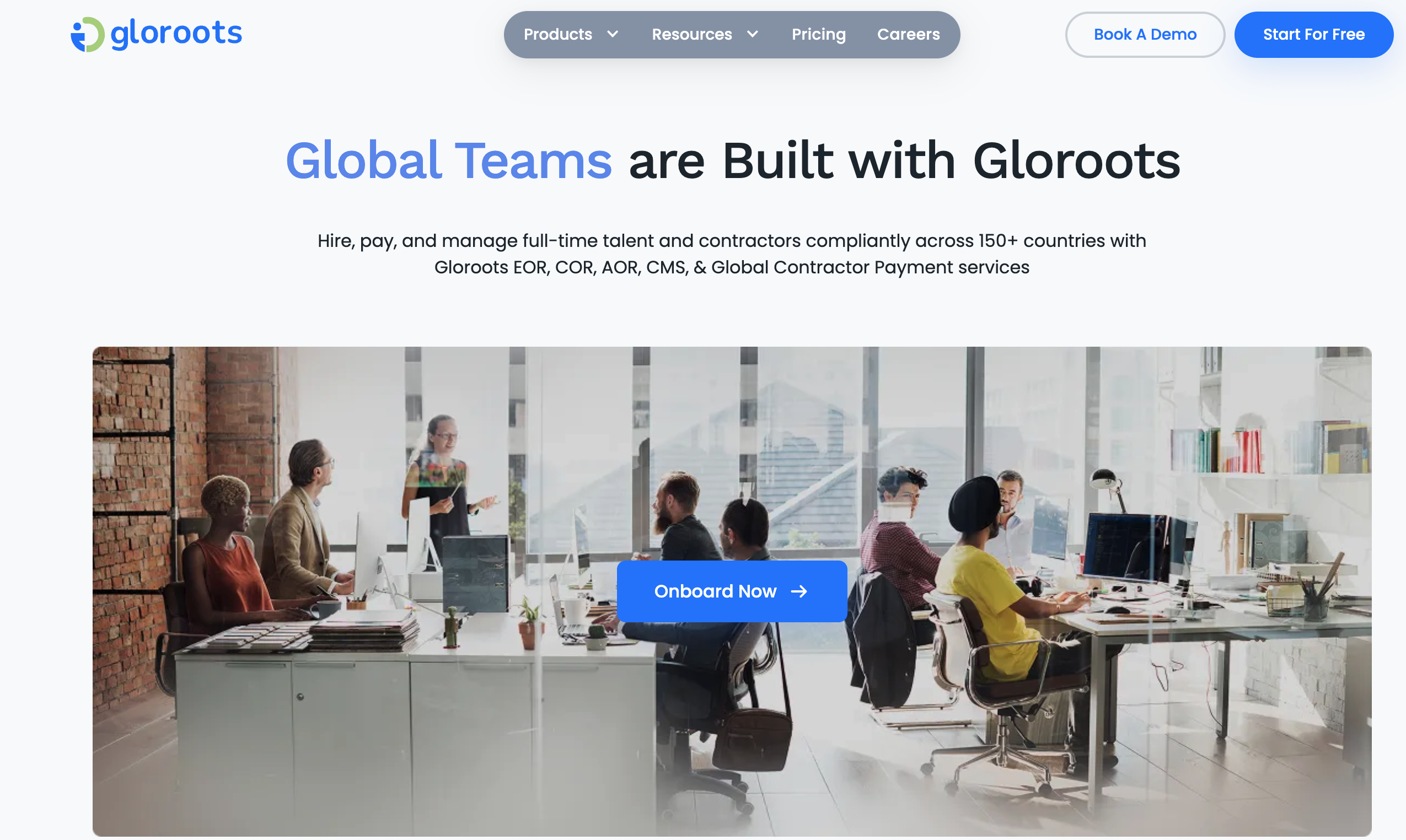
Gloroots is a Global Employer of Record platform that supports compliant full-time employment across 150+ countries, including China. It combines Global EOR, Global Payroll, Compliance and Employment Governance, and Benefits and Statutory Coverage into a single employment operating layer.
Gloroots uses predictable, country-specific pricing with full cost visibility before onboarding begins. All included services are itemised before the engagement starts, so clients see the full cost before committing. Gloroots does not use percentage-of-salary pricing. Onboarding speed is 3 to 5 working days, country-dependent.
Pricing starts from $199 per employee per month. The China-specific plan price should be confirmed directly with Gloroots before budgeting, as city-level costs vary. G2 lists Gloroots at 4.9/5 based on 21 reviews. Gloroots’ China EOR overview lists Personal Information Protection Law compliance among the core service areas an EOR covers. Gloroots’ pricing page lists localized agreements, payroll handling all taxes and deductions, and compliance document collection as included.
Strengths:
-
Gloroots administers all statutory benefits required under Chinese law, covering social insurance and the housing provident fund, with contribution rates calculated per city and updated in line with each municipality's annual adjustment cycle.
-
The platform provides centralised workforce visibility and human-led account support with retained business context. The Advanced plan includes dedicated account management, giving clients a consistent point of contact who understands their workforce structure.
-
Pricing is predictable and country-specific. Gloroots does not use percentage-of-salary pricing, and all included services are itemised before onboarding begins.
Limitations:
-
The China-specific starting price is not publicly listed in researched sources. Buyers should request a direct quote to confirm city-level cost before budgeting.
Best for:
Gloroots suits SMB to enterprise teams scaling into China that require predictable, country-specific pricing and centralised compliance visibility without registering a local legal entity.


Deel
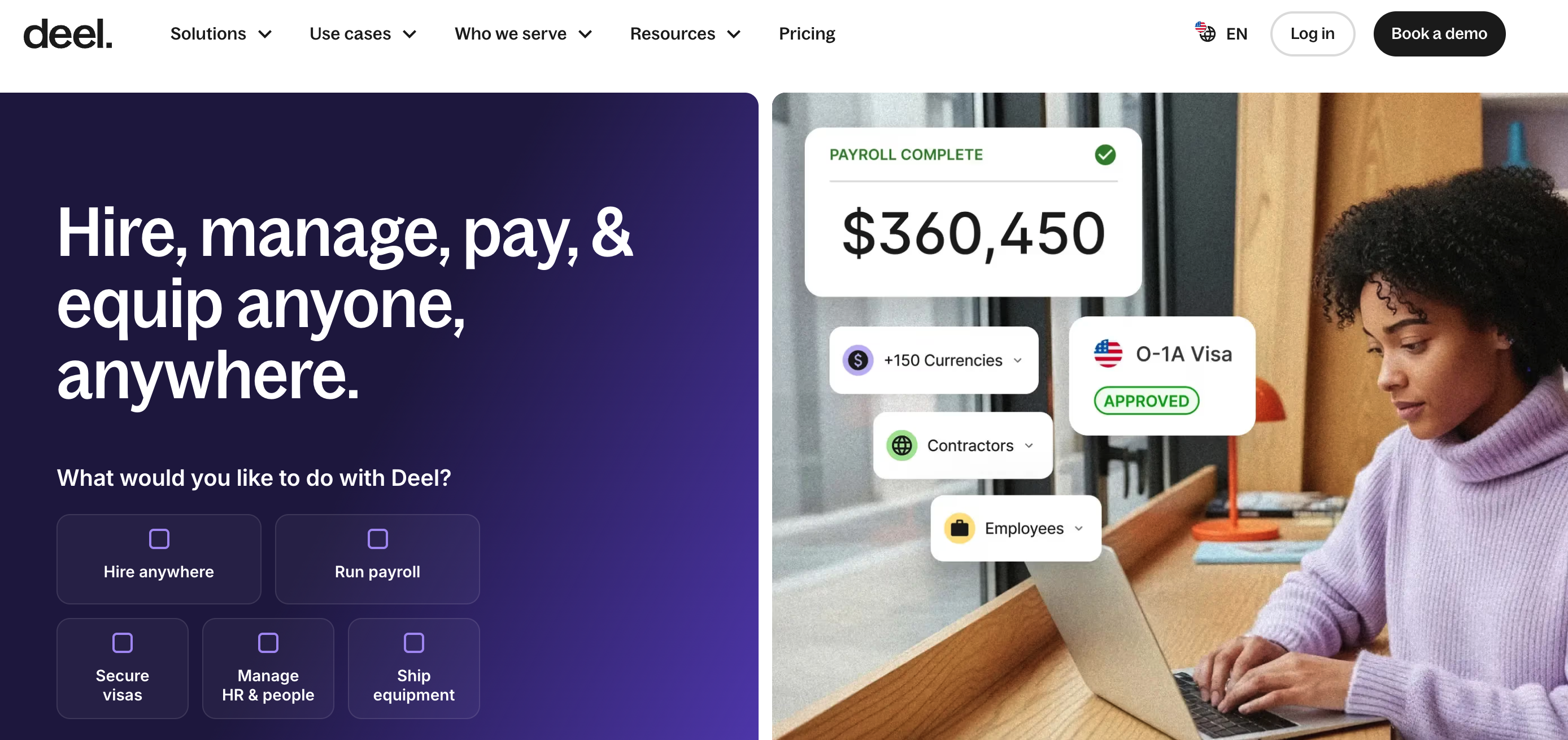
Deel operates in China through 14 wholly owned entities covering Shanghai, Beijing, Shenzhen, and Chengdu. Because Deel holds legal employer status directly, compliance liability sits with Deel rather than with a local intermediary. This structure gives clients direct accountability on statutory obligations.
Deel administers all six statutory social insurance components required under Chinese law, including pension, medical, unemployment, work-related injury, and maternity insurance, along with the housing provident fund. Contribution rates are calculated at the city level and vary by up to five percentage points between cities such as Shanghai and Chengdu. Deel also supports Personal Information Protection Law (PIPL) data-localisation requirements through in-country servers and Standard Contractual Clause (SCC) templates.
Deel's starting price for China EOR is from $604 per employee per month. This price point is among the higher figures across the providers reviewed in this guide. Buyers should confirm which services are included at that rate and which carry additional fees before budgeting.
Strengths:
-
Owns 14 China entities across Shanghai, Beijing, Shenzhen, and Chengdu, providing direct compliance control without reliance on a local third-party partner.
-
Rated 4.8 out of 5 on G2 across more than 3,000 reviews, with reviewers frequently citing China payroll stability as a positive factor.
-
Handles city-level social insurance rate variation and supports PIPL data-localisation with in-country servers and SCC templates.
Limitations:
-
Starting price of $604 per employee per month is among the higher price points reviewed in this guide. Buyers should verify which services are included versus priced as add-ons before committing.
Best for:
Deel suits companies that need direct entity-backed employment across multiple Chinese cities and want a single platform covering multi-country payroll alongside China-specific compliance.
G-P
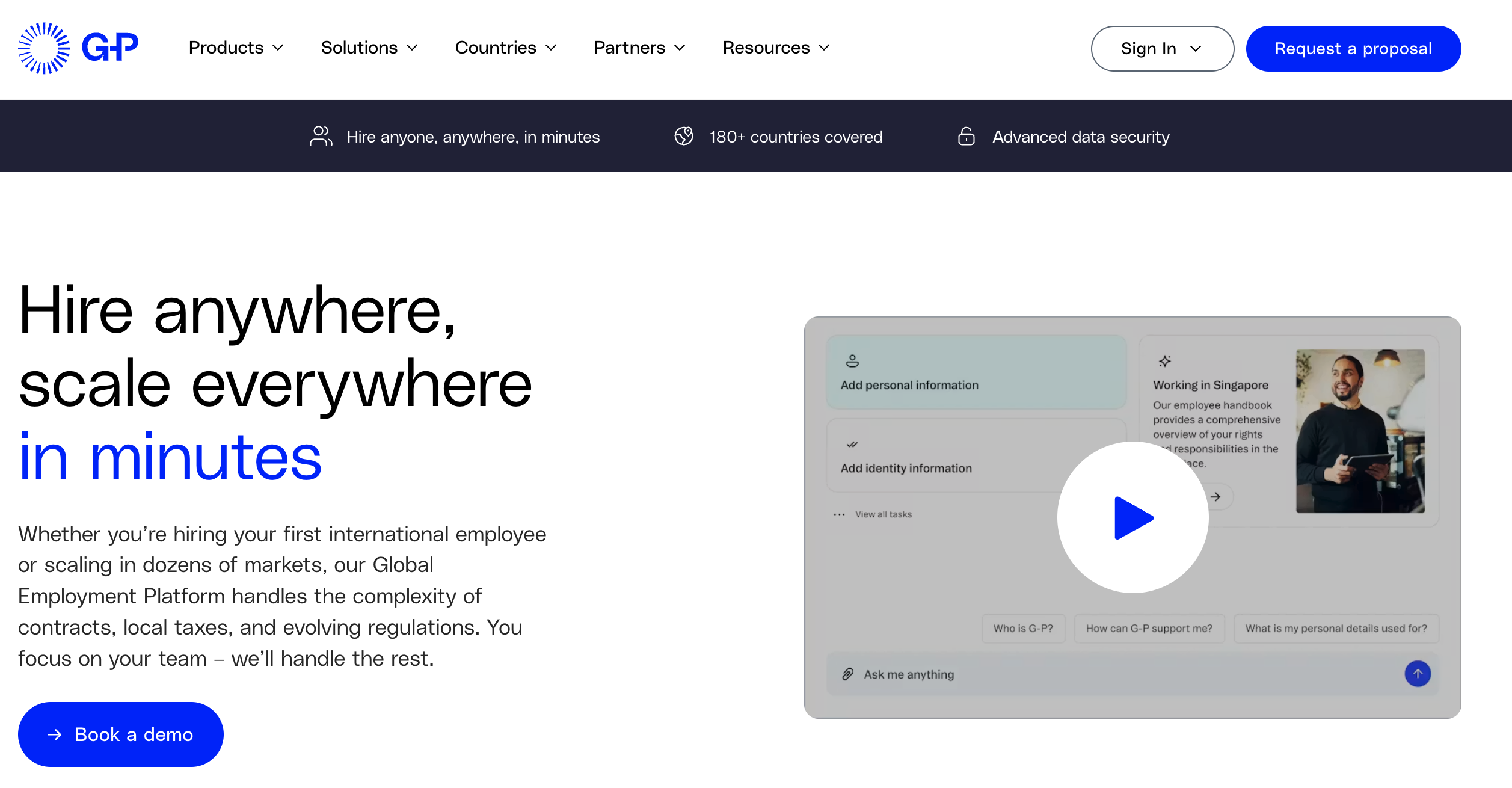
G-P, formerly Globalization Partners, supports hiring in 180 or more countries through its global EOR platform, with China listed as a supported country within its Asia-Pacific coverage. The company employs workers through its own Chinese entity, which means compliance liability sits with G-P directly rather than with a local partner.
G-P's platform is called G-P Meridian. It covers hiring, onboarding, payroll, benefits, and compliance across multiple countries from a single interface. The platform includes G-P Gia, an AI-powered compliance intelligence tool that provides guidance on local employment law requirements. Clients also receive support from a dedicated Customer Success Manager, giving teams a consistent point of contact for their China employment questions.
G-P does not publish pricing publicly. The starting price for China employment is approximately $599 per employee per month or a custom quote, depending on headcount and service scope. Buyers should request a direct quote to confirm inclusions versus add-ons before budgeting. Onboarding timelines published in country comparisons indicate a range of two to seven days, though this is country-dependent.
Strengths:
-
Covers 180 or more countries including China through its own entity, with G-P Meridian providing a unified interface for hiring, payroll, benefits, and compliance across all markets.
-
G-P Gia delivers AI-powered compliance intelligence, giving HR and legal teams access to jurisdiction-specific guidance within the platform.
-
Each client is assigned a dedicated Customer Success Manager, providing consistent, named support rather than a general helpdesk model.
Limitations:
-
Pricing is not publicly listed. Enterprise-oriented custom quotes may not suit smaller businesses that need cost certainty before engaging a provider.
Best for:
G-P suits mid-market to enterprise teams that need locally compliant China employment managed through a global platform with dedicated account support and AI-assisted compliance tools.
Multiplier
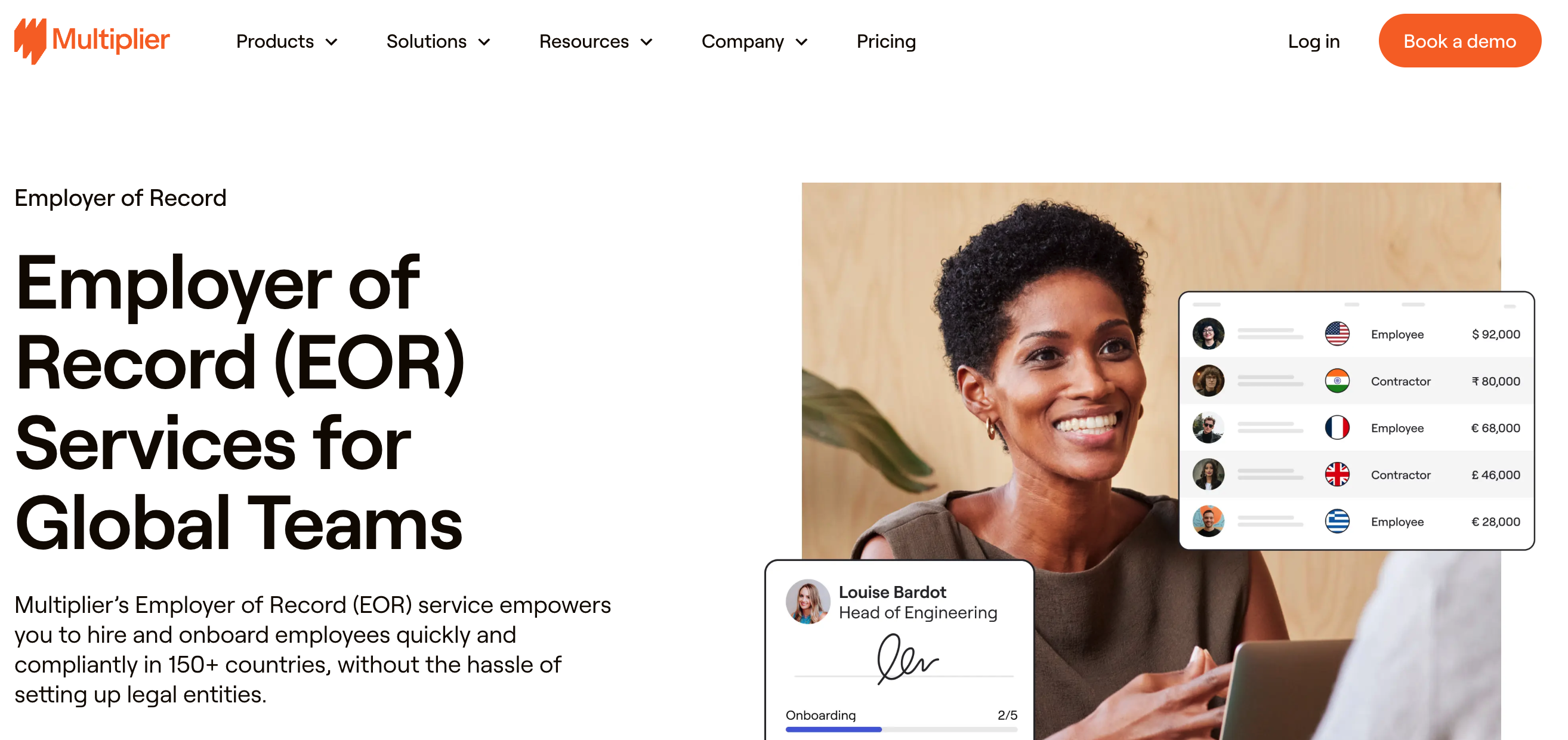
Multiplier is an EOR provider that operates through its own Chinese entity, covering 150+ countries with a strong APAC presence. Starting price for China EOR is $505 per employee per month. The platform supports employment, payroll, benefits, and compliance management across its coverage footprint.
Multiplier administers statutory benefits required under Chinese labour law. This includes the social insurance scheme covering pension, medical, unemployment, work-related injury, and maternity insurance, along with the housing provident fund. Multiplier's FAQ states most customers have their first employee onboarded within 48–72 hours, depending on country requirements. G2 lists Multiplier Employer of Record at 4.7/5 with 1,384 reviews.
Customer support is described as human-first with local expertise. Specific details on response times, dedicated account management tiers, or support escalation paths are not publicly listed in researched sources. The $505 per month starting price covers China EOR; whether all statutory filings are included or whether some services carry additional fees is not publicly confirmed in reviewed sources.
Strengths:
-
Operates through its own Chinese entity, keeping compliance liability with Multiplier rather than a local intermediary the client cannot audit directly.
-
Strong APAC presence across 150+ countries, making it a practical option for companies managing hiring across Europe and Asia-Pacific from a single platform.
Limitations:
-
Public sources reviewed did not confirm whether bilingual contract support and PIPL compliance documentation are included in the standard China plan, which limits pre-purchase cost and scope verification.
Best for:
Multiplier suits mid-size companies that need quick employee onboarding and manage hiring across Europe and Asia-Pacific from a single EOR platform.
Remote
Remote is a global EOR that employs workers through its own Chinese entity, covering 90+ EOR countries. The platform offers standardised global contracts and is noted for competitive benefits packages for China hires. China-specific pricing is not publicly listed in researched sources and requires a direct quote. $699 per employee per month Remote’s average onboarding time is 2.3 days. G2 rating 4.5/5 from 6,156 reviews.
Remote administers China's statutory social-insurance contributions and housing fund, including pension, medical, unemployment, and work-injury insurance; its public materials do not explicitly document a sixth social-insurance component. Bilingual Mandarin and English contract support satisfies the language-of-record requirement for statutory documents in China. Remote's support article notes that if a contract is not available in multiple languages, the English version is used; translations into another language are available for an additional fee via an external provider. Individual income tax filing administration and PIPL compliance support are not confirmed in publicly reviewed sources. Remote remits payroll taxes but does not file employees' personal income tax returns. Remote publishes a China PIPL privacy notice that outlines data subject rights and processing by Remote (Shanghai) Global Employment Services Co., Ltd.
Customer support is provided by in-house local experts with dedicated specialist support. Specific response time commitments and account management tier details are not publicly listed in researched sources. The platform covers payroll, benefits, compliance, IP protection, and workforce management through an owned-entity structure.
Strengths:
-
Employs workers through its own Chinese entity, so compliance liability sits with Remote directly rather than with a local partner the client cannot instruct.
-
Standardised global contracts and competitive benefits packages are cited as differentiators for China hires, supporting consistent employment terms across countries.
Limitations:
-
China-specific pricing is not publicly listed, which makes pre-purchase budget planning difficult without requesting a direct quote. Country coverage for EOR is 90+ countries, which is narrower than several other providers reviewed in this guide.
Best for:
Remote suits companies that prioritise owned-entity employment in China and want standardised global contracts with competitive statutory benefits coverage.
Rippling

Rippling is a software-first EOR platform that unifies HR, IT, payroll, and compliance in a single system. It covers 80 countries for EOR services. China-specific entity ownership status is not publicly documented in reviewed sources.
Rippling's platform model is designed for mid-enterprise businesses that want workforce management and IT administration handled together. Pricing for China EOR is custom and requires a direct quote. Onboarding timelines for China are not publicly listed in reviewed sources.
Strengths:
-
Rippling ranked first out of 29 EOR providers in one published comparison, scoring 4.82 out of 5, the highest score in that review.
-
The platform consolidates HR, IT, payroll, and compliance into one interface, reducing the number of separate tools a company needs to manage an international workforce.
Limitations:
-
Rippling covers 80 EOR countries, which is a narrower footprint than several other providers reviewed in this guide. Teams with hiring needs outside that network should verify China coverage directly before committing.
-
Entity ownership status for China is not publicly documented in reviewed sources. Buyers should confirm whether Rippling employs workers through its own Chinese entity or via a local partner before assessing compliance liability.
Best for:
Mid-enterprise businesses that need HR, IT, payroll, and compliance managed in one platform and can confirm China entity coverage directly with Rippling.
RemotePeople
RemotePeople is an employer of record provider with coverage across 150 or more countries, including China. Its starting price is $199 per employee per month, which is among the lowest price points across the providers reviewed in this guide. Whether that price covers all statutory filings, bilingual contracts, visa support, and offboarding, or whether those services carry additional fees, is not publicly documented in reviewed sources.
RemotePeople positions itself as a locally grounded option for foreign businesses hiring in China without registering their own entity. The provider offers onboarding in 2 to 4 days. Entity ownership status for China, meaning whether RemotePeople employs workers through its own Chinese legal entity or via a local partner, is not publicly documented in reviewed sources.
Platform integration details and self-service capabilities are not publicly documented in reviewed sources. The support model, including response times and dedicated account management tiers, is also not publicly listed. Review scores on G2, Capterra, or Trustpilot were not available in reviewed sources.
Strengths:
-
RemotePeople offers bilingual employment contracts in Mandarin and English, satisfying the language-of-record requirement for statutory documents under Chinese labour law.
-
The provider includes visa and work permit support for foreign nationals, a service that some providers price separately or exclude from standard plans.
Limitations:
-
Platform transparency is limited. Integration capabilities, self-service features, and support response times are not publicly documented, making it difficult to assess operational fit before signing.
-
Entity ownership status for China is not publicly confirmed in reviewed sources. Buyers cannot verify from public documentation whether compliance liability sits with RemotePeople directly or with a local partner.
Best for:
Companies that prioritise local China support, require bilingual contracts as a baseline, and want visa assistance included without negotiating it as a separate line item.
RemoFirst
RemoFirst is a global EOR provider suited to startups and SMBs that need affordable international hiring across a wide country footprint. Its published starting price for China EOR is $404 per employee per month, based on the comparison table in researched sources. The platform covers 185+ countries and positions itself as a cost-accessible option for remote team expansion.
RemoFirst operates through a hybrid entity model. Whether it employs workers in China through its own wholly owned entity or through a local partner is not confirmed in public documentation reviewed for this guide. Buyers with strict entity-ownership requirements should request written confirmation before signing. The platform includes payroll, tax, benefits administration, and compliance support within its standard service scope. Specific detail on Individual Income Tax filing administration, PIPL compliance support, and bilingual Mandarin/English contract generation for China is not publicly documented in reviewed sources.
Customer support is described as including a dedicated account manager and in-country experts, with 24/7 availability listed in published comparison sources. Specific support tiers, response time commitments, and escalation paths are not publicly listed in reviewed sources.
Strengths:
-
Wide country coverage of 185+ countries makes RemoFirst a practical option for companies hiring across multiple regions alongside China, without switching providers.
-
Published starting price of $404 per employee per month is among the lower price points for China EOR in this guide, which suits budget-conscious teams adding their first China hire.
Limitations:
-
Entity ownership status for China is not confirmed in public documentation reviewed for this guide. Whether RemoFirst employs workers through its own Chinese entity or a local partner affects where compliance liability sits, and buyers should verify this directly before committing.
Best for:
RemoFirst suits startups and SMBs that prioritise cost-accessible global hiring across a large country footprint and are comfortable confirming China-specific compliance details directly with the provider.
What Are the Key Services of an EOR in China?
An EOR in China takes on the legal employer role and administers every employment obligation the Chinese state requires. That scope is broader than in most markets because China's regulatory framework is layered across national law, provincial rules, and city-level administration.
Six service categories define what a compliant EOR must deliver: statutory social insurance and housing fund administration, employment contract management, Individual Income Tax withholding and filing, payroll processing, Personal Information Protection Law compliance, and ongoing employment governance. Each category carries its own compliance obligations under Chinese law.
City-level variation adds operational complexity to every category. Social insurance contribution bases and rates differ between municipalities. The gap between Shanghai and Chengdu, for example, can reach five percentage points on individual components. A compliant EOR calculates and remits contributions at the correct city-level rate for each employee, not a national average.
Employment Contracts and Local Compliance
Employment contracts in China must be written in Mandarin, which is the language of record for all statutory documents. Bilingual Mandarin and English versions are standard practice and satisfy both local requirements and the practical needs of foreign employers.
Under the PRC Labour Contract Law, three contract types are permitted: fixed-term, open-ended, and project-based. EOR providers generate contracts compliant with the specific requirements of the city and province where the employee is based, since local regulations can vary from national minimums.
Probation period rules are set by statute and tied directly to contract duration. Non-compete clauses require a separate written agreement and must include agreed compensation for the restriction period. EOR providers manage both requirements as part of the contract generation process.
Payroll and Tax Administration
Payroll in China runs on a monthly cycle. Individual income tax must be withheld by the employer and filed with the tax authority by the 15th of the following month.
Since the 2019 individual income tax reform, tax is calculated on a cumulative annual basis rather than month by month. This means the effective withholding rate adjusts each month as the employee's annual income accumulates, which requires accurate year-to-date tracking throughout the payroll cycle.
Social insurance contributions cover five insurances plus the housing fund. Contribution bases are city-specific and reset each July. Employer contribution rates vary by city and by component, and the combined employer burden typically runs well above the employee's gross salary. EOR providers handle individual income tax withholding and all social insurance filings on behalf of the employing entity.
Benefits Administration
China's statutory benefits scheme covers six components: pension, medical, unemployment, work-related injury, maternity insurance, and the housing provident fund. Every employer operating in China must enrol employees in all six.
Contribution rates and bases are not uniform. They vary by city and are updated annually by each municipal authority. The housing provident fund rate is set specifically by local municipal governments, meaning the rate in Shanghai differs from the rate in Chengdu or Beijing.
Beyond the statutory minimum, supplemental benefits are common in China. Private health insurance, meal allowances, and transport subsidies are standard additions in competitive employment packages. Some EOR providers offer these as optional add-ons to their base service.
Employee Onboarding
Onboarding in China requires social insurance registration in the city where the employee is based. There is no single national registration. Each city maintains its own social insurance bureau, and the EOR must register the employee locally before payroll can begin.
Under PRC Labour Contract Law, the employment contract must be signed before the employee's start date. EOR providers collect identity documents, bank account details, and tax registration information during the onboarding process.
For local hires, onboarding typically takes two to seven days. Foreign nationals require additional steps: work permit and residence permit applications extend the timeline beyond that standard window. Companies hiring foreign nationals should plan for a longer lead time and confirm the specific requirements with their EOR provider before extending an offer.
Ongoing HR Support
Ongoing HR support in China extends well beyond initial onboarding. Social insurance contribution bases are updated annually, typically on a July cycle, and EOR providers must apply revised rates across all active employees in each city.
Individual income tax reconciliation filing runs from March through June each year. EOR providers manage this annual filing on behalf of employed workers, ensuring submissions meet the deadlines set by Chinese tax authorities.
Contract renewal management is also part of the ongoing service scope. Under PRC Labour Law, a third fixed-term contract triggers an obligation to offer an open-ended contract, so providers track renewal cycles and flag obligations before they arise.
Providers monitor regulatory changes at both national and municipal levels, since contribution rates and filing requirements vary by city. Employee relations support, including dispute handling and disciplinary processes, must follow PRC Labour Law procedures. Some providers assign dedicated account managers; others route requests through shared support queues. This distinction is a material differentiator when assessing ongoing service quality.
Employee Offboarding
Offboarding an employee in China requires strict compliance with statutory notice periods. For employer-initiated termination, the standard notice period is 30 days. Where the employer opts not to serve notice, one additional month's salary is payable in lieu.
Statutory severance follows a defined formula: one month's salary per completed year of service. This amount is capped at three times the local average monthly wage per year, limiting total exposure for higher-earning employees.
EOR providers manage the full offboarding sequence. This includes severance calculation, final payroll processing, social insurance deregistration, and housing provident fund account closure. Each step must be completed in the correct order to avoid penalties.
Wrongful termination risk is significant under Chinese labour law. Courts and arbitration panels apply a high evidentiary standard, so EOR providers maintain a documented trail covering the grounds for termination, the notice served, and all payments made. This documentation record is the primary protection against a successful wrongful termination claim.
How to Hire Through an EOR in China
Hiring through an EOR in China follows a defined sequence. Each step addresses a specific compliance requirement that differs from most other markets.
-
Decide between EOR and entity. If your company does not hold a Chinese legal entity such as a Wholly Foreign-Owned Enterprise (WFOE), an EOR is the compliant path to employment. Registering a WFOE takes three to six months and requires minimum registered capital. An EOR allows employment to begin without that structure.
-
Select a provider. Assess entity ownership, city coverage, pricing transparency, Personal Information Protection Law (PIPL) compliance support, and visa support availability.
-
Submit employee details. Provide the offer terms, job title, compensation, and the city of employment to the EOR.
-
Contract generation in Mandarin. The EOR produces a bilingual employment contract. Mandarin is the language of record for all statutory documents in China.
-
Social insurance registration by city. The EOR registers the employee with the local social insurance bureau. Contribution rates and bases vary by city. This is a China-specific complexity not present in most other markets.
-
Payroll run and individual income tax filing. The EOR processes monthly payroll and files individual income tax returns by the 15th of the following month.
-
Ongoing compliance monitoring. The EOR tracks regulatory changes, annual social insurance base adjustments, and any city-level policy updates that affect the employment relationship.
Selection and Setup
The first decision is whether to use an EOR or register a Chinese legal entity. If your company does not hold a WFOE or other licensed Chinese entity, an EOR is the compliant path to employment. Registering a WFOE takes months and requires minimum registered capital. An EOR removes that requirement.
When selecting a provider, assess five criteria: entity ownership, city coverage, pricing transparency, PIPL compliance support, and visa support availability. The single most important due diligence question is whether the provider owns its Chinese entity or uses a local partner. A provider that owns its entity holds the compliance liability directly. A provider that routes employment through an unvetted partner creates a gap the client cannot audit or instruct.
Once a provider is selected, the setup process runs in four steps: sign the EOR agreement, provide the employee offer details, confirm the city of employment, and allow the EOR to complete social insurance registration with the relevant municipal bureau.
Onboarding and Compliance
The EOR generates a bilingual employment contract in Mandarin and English for the employee to sign. Mandarin is the language of record for all statutory documents in China.
Before the first payroll run, the EOR completes social insurance registration in the employee's city of employment. Individual income tax registration is also handled by the EOR on behalf of the employee.
For foreign nationals, work permit and residence permit applications must be completed before employment begins. These applications are city-specific and follow a defined sequence set by local authorities.
-
The first payroll run includes pro-rated salary, social insurance deductions, and individual income tax withholding.
-
Ongoing compliance monitoring covers annual social insurance base updates, applied per municipality.
-
Individual income tax annual reconciliation is completed by the EOR on the statutory cycle.
What Are the Benefits of Using an EOR in China?
Using an EOR in China reduces the compliance burden that comes with one of the most regulated employment markets in the world. Foreign companies cannot simply hire a worker in China without a licensed local entity or a compliant employment partner. An EOR removes that barrier.
China's regulatory complexity makes the compliance and speed benefits more pronounced here than in less regulated markets. Contribution rates vary by city, statutory filings follow tight monthly deadlines, and employment contracts must meet Mandarin-language requirements. An EOR manages each of these obligations directly.
The sections below cover six specific benefits: legal employer status, statutory compliance, payroll execution, individual income tax administration, foreign national support, and cost visibility.
Faster Market Entry
Registering a Wholly Foreign-Owned Enterprise (WFOE) in China typically takes three to six months. During that period, a foreign company cannot legally hire local employees or begin operations.
An EOR removes that dependency. The EOR already holds a licensed Chinese entity and can onboard employees in two to seven days. The company begins hiring while entity registration is still months away.
That difference translates directly into competitive advantage. A company can respond to a market opportunity, place a sales hire, or begin a product pilot without waiting for government approval of its own legal structure.
Reduced Compliance Risk
China's Labour Contract Law, social insurance regulations, and Individual Income Tax rules create layered obligations that apply at both national and municipal levels. Contribution rates for pension, medical, and housing fund vary by city and are adjusted annually.
Non-compliance carries real costs: back-payment of social insurance contributions, IIT penalties, and exposure to labour dispute liability. These risks apply regardless of whether the foreign company intended to comply.
EOR providers monitor regulatory changes and update contribution rates, contract templates, and filing procedures on behalf of their clients. Providers that own their Chinese entity directly carry the compliance obligation themselves, which reduces the gap that appears when employment is routed through an unaudited local partner.
Simplified Payroll Administration
China payroll involves three distinct monthly obligations: individual income tax withholding, city-specific social insurance contributions, and housing fund contributions. Each obligation uses a different calculation base and a different rate.
The cumulative annual IIT method adds further complexity. Each monthly payroll run must account for income earned year-to-date, which means the effective withholding rate changes every month for each employee.
EOR providers consolidate all three obligations into a single monthly invoice. The client pays one amount; the provider handles all filings, remittances, and reconciliations behind that figure.
City-level contribution bases reset each July. When that reset occurs, payroll must be recalculated for every employee in the affected city. EOR providers absorb that recalculation work as part of the standard service.
Access to Local Benefits
Statutory benefits in China cover five social insurances plus the housing provident fund. These six components are mandatory, and contribution rates and bases vary by city. Errors in administration carry direct legal liability.
EOR providers maintain established relationships with local social insurance bureaus in major cities. Those relationships support accurate registration, timely remittance, and correct base calculations for each municipality.
Beyond the statutory minimum, Chinese employees commonly expect supplemental benefits: private health cover, meal allowances, and transport subsidies. EOR providers can facilitate these additions within the employment structure they manage.
Access to a locally competitive benefits package matters in a tight talent market. Foreign companies that offer only the statutory minimum often lose candidates to domestic employers that offer more. EOR providers give foreign companies the infrastructure to compete on benefits without registering a local entity.
Lower Entity Setup Costs
Registering a Wholly Foreign-Owned Enterprise (WFOE) in China requires registered capital, legal fees, government filing fees, and ongoing entity maintenance costs including annual audits and local accounting. Total setup costs typically range from $15,000 to $50,000 depending on the business scope and city, with annual maintenance adding further overhead.
An EOR eliminates registered capital requirements entirely. Legal and accounting overhead is reduced to the EOR service fee, which is charged per employee per month rather than as a fixed entity cost.
EOR pricing is predictable and scales with headcount. For companies hiring fewer than 10 to 15 employees in China, EOR is typically more cost-effective than entity registration. Gloroots uses country-specific, flat-fee pricing with full cost visibility before onboarding begins.
More Flexible Workforce Scaling
China's employment market is city-specific. Social insurance contribution rates, housing fund bases, and minimum wage thresholds vary by municipality. Registering a separate legal entity or sub-entity in each city adds cost and administrative complexity that most foreign companies cannot justify for small headcounts.
An EOR with multi-city social insurance registration capability can onboard employees in Shanghai, Beijing, Shenzhen, and other cities under a single client agreement. The EOR handles city-level filings without requiring the client to hold a local entity in each location.
Scaling down is also faster through an EOR. Offboarding an employee through an EOR follows a defined contractual process. Winding down a legal entity in China requires government deregistration, tax clearance, and liquidation procedures that can take months. For companies testing the Chinese market before committing to a permanent entity structure, EOR provides a lower-commitment entry point.

How to Find the Right EOR for China
The right EOR for China depends on your company size, headcount, and compliance requirements. Three buyer profiles map to distinct provider priorities.
-
SMB with 1 to 5 hires: Prioritise pricing transparency and fast onboarding. Look for providers that publish country-specific fees before you sign and can activate employment within a week.
-
Mid-market with 10 or more hires: Prioritise entity ownership and dedicated account management. A provider that owns its Chinese entity carries the compliance obligation directly and can assign a consistent point of contact who understands your workforce structure.
-
Enterprise with expat relocations: Prioritise visa support and Personal Information Protection Law compliance documentation. Confirm that the provider holds in-country servers, offers Standard Contractual Clause templates, and manages work permit applications as part of the standard service.
Before contracting any China EOR, ask the following questions during due diligence.
-
Do you own your Chinese legal entity, or do you use a local partner?
-
Which cities do you cover for social insurance registration and filing?
-
How do you handle annual adjustments to city-level contribution bases?
-
What is included in the quoted monthly fee, and what carries an additional charge?
-
How do you support Personal Information Protection Law obligations, including data localisation?
What is your process for resolving a labour dispute in China?
-
Can you provide bilingual employment contracts in Mandarin and English as a baseline?
-
Do you manage visa and work permit applications, and if so, at what cost?
Local Compliance Expertise
Local compliance expertise in China means understanding both the national Labour Contract Law and the city-level social insurance regulations that sit beneath it.
Contribution rates, bases, and filing deadlines vary by municipality. The gap between cities can reach five percentage points on a single insurance component, and each municipality publishes its own annual adjustment cycle. A provider that applies a single national rate across all cities is not compliant.
The primary signal to check is entity ownership. A provider that owns its Chinese entity carries the legal employer obligation directly. One that routes employment through a local partner introduces a compliance layer the client cannot audit or instruct. Ask any candidate provider whether it holds its own business licence in China before evaluating anything else.
Providers with in-country legal and HR teams are better positioned to respond to regulatory changes and handle disputes than those relying on third-party partners. When a municipality revises its contribution base mid-year, an in-country team can update payroll calculations and notify affected clients within the same cycle. A partner-dependent model adds delay and reduces accountability.
Clear Service Scope
Service scope in China EOR varies significantly between providers. Some include individual income tax filing, bilingual contracts, and visa support in the base price. Others bill these separately, which can make a low headline price misleading.
Before signing, request a written breakdown of what is included and what is excluded. The following services should be confirmed as included in any China EOR engagement:
-
Statutory social insurance filing covering all six components: pension, medical, unemployment, work-related injury, maternity insurance, and the housing provident fund
-
Individual income tax monthly filing, due by the 15th of the following month
-
Bilingual Mandarin and English employment contracts, satisfying the language-of-record requirement under PRC law
Visa and work permit support for foreign nationals
Offboarding and severance administration
The lowest headline price may not be the lowest total cost. If key services are excluded from the base plan, the final cost can exceed that of a provider with a higher starting price that covers everything.
Support Model
Support model matters more in China than in many other markets. Regulatory complexity generates frequent questions: city-level social insurance rates, contract terms, filing deadlines, and PIPL obligations all shift regularly and vary by municipality.
The key distinction is between a dedicated account manager and a shared support queue. A dedicated account manager retains context about your workforce structure and employment history. A shared queue provides no continuity between interactions, which slows resolution when a compliance question requires background knowledge.
In-country support is preferable to remote support for handling disputes and urgent compliance issues. A China-based HR and legal team can act on local timelines and communicate directly with municipal authorities when needed.
Before signing, confirm two things: the provider's committed response time for standard and urgent queries, and the escalation path when a question exceeds the account manager's authority. These commitments should appear in the service agreement, not only in sales materials.
Technology and Reporting
China EOR platforms must support payroll reporting by city, social insurance contribution tracking, individual income tax withholding records, and employee document management. These are not optional features; they reflect the statutory filing obligations that vary across Chinese municipalities.
PIPL compliance requires data localisation. Buyers should confirm whether the provider's platform stores employee data on servers physically located in China before signing a contract. This is a legal requirement, not a platform preference.
Integration with the client's HRIS or finance systems reduces manual reconciliation across payroll cycles. Some providers, including G-P through its Gia tool, offer AI-powered compliance monitoring that flags regulatory changes automatically as they occur.
Scalability for Your Hiring Plans
Scalability in China means the ability to add employees in new cities without renegotiating the EOR agreement. Providers with social insurance registration across multiple Chinese cities can onboard employees faster than those with limited city coverage.
Pricing model affects scalability directly. Flat-fee-per-employee pricing scales predictably as headcount grows. Percentage-of-salary pricing increases cost as salaries rise, which can make expansion into higher-salary cities materially more expensive over time. Gloroots uses predictable, country-specific pricing with no percentage-of-salary model.
Enterprise buyers should confirm whether the provider can support expat relocations and visa applications at scale. These services are sometimes excluded from standard plans or priced separately, which affects total cost at volume.

Why Gloroots Is a Strong EOR Partner in China
Gloroots employs workers in China through its own entity. Compliance liability sits with Gloroots, not with a local intermediary the client cannot audit or instruct directly.
Gloroots supports compliant full-time employment across 150+ countries. It combines Global EOR, Global Payroll, Compliance and Employment Governance, and Benefits and Statutory Coverage into a single employment operating layer.
On China-specific compliance, Gloroots administers social insurance and housing provident fund contributions at the city level. Contribution bases are updated in line with each municipality's annual adjustment cycle. Bilingual employment contracts in Mandarin and English are generated as standard, satisfying the language-of-record requirement for statutory documents in China.
-
Predictable, country-specific pricing with full cost visibility before onboarding begins. Gloroots does not use percentage-of-salary pricing.
-
Centralised workforce visibility and human-led account support with retained business context across the employment lifecycle.
-
The Advanced plan includes dedicated account management, giving clients with complex or multi-city China hiring needs a consistent point of contact.
For teams that need to confirm city-level costs before budgeting, Gloroots provides a direct quote with all included services itemised upfront. Visit Gloroots pricing or the Gloroots EOR services page to request a China-specific quote or book a demo.
FAQs About the Best EOR in China
How does an EOR work in China?
An EOR in China acts as the legal employer on behalf of the foreign company. It handles employment contracts, social insurance registration, individual income tax withholding, and payroll processing under the PRC Labour Contract Law.
The foreign company retains day-to-day management of the employee's work. The EOR holds compliance liability for all employment law obligations, including statutory filings and benefit contributions.
To employ workers legally in China, the EOR must own or be licensed to operate a Chinese legal entity. Foreign companies cannot employ Chinese workers directly without a registered local entity or a licensed EOR partner.
What does an EOR cost in China?
Base EOR fees across reviewed providers range from $199 per month (RemotePeople) to $604 per month (Deel). That fee covers the EOR service itself and does not include employer social insurance contributions.
Employer social insurance contributions add 30 to 50% above gross salary, depending on the city. Total employment cost equals gross salary plus employer social insurance contributions plus the EOR fee.
Some providers charge additional fees for individual income tax filing, bilingual contracts, or visa support. Buyers should confirm exactly what is included before signing. Request itemised quotes from at least two providers before committing to a contract.
When should a company use an EOR in China?
An EOR is the only compliant path to employment in China for foreign companies without a registered local entity. Common use cases include testing the Chinese market before committing to entity registration, hiring between one and ten employees, relocating expat staff, or scaling quickly in response to a business opportunity.
EOR is not suited to every situation. Companies that need full operational control over their Chinese workforce, or that plan to employ more than 50 people long-term, may find that registering a Wholly Foreign-Owned Enterprise becomes more cost-effective over time.
Can an EOR hire both local and foreign employees in China?
EOR providers can employ both Chinese nationals and foreign nationals in China. The employment process for foreign nationals requires additional steps before work begins.
Foreign employees must hold a Work Permit for Foreigners and a residence permit. Eligibility conditions include a minimum age threshold, recognised educational qualifications, and a clean criminal record. Processing typically takes 15 to 30 business days.
Some EOR providers include visa and work permit support in their standard service fee. Others price it as a separate line item. Confirm the scope before signing a contract.
How do I choose the right EOR in China?
Five criteria matter most: local compliance expertise, clear service scope, support model, technology and reporting, and scalability. Weight each against your headcount plans and the cities where you intend to hire.
The single most important due diligence question is whether the provider owns its Chinese legal entity. A provider that employs through a third-party intermediary transfers compliance risk to a party you cannot audit or instruct directly.
Request itemised pricing before signing. Headline fees rarely reflect total cost once city-level social insurance contributions are added. PIPL compliance support and visa assistance are differentiating factors for companies with data-sensitive roles or expat employees. Trial the provider's support responsiveness before committing to a long-term contract.