







- Australia's EOR compliance requirements include Fair Work Act obligations, 12% superannuation contributions from 1 July 2025, Single Touch Payroll (STP) reporting, and the Payday Super reform from 1 July 2026 requiring superannuation to be paid on each payday rather than quarterly.
- EOR platform fees across the eight providers reviewed range from $199 to $699 per employee per month, but statutory costs including superannuation, state-based payroll tax, and workers' compensation insurance are additional and must be requested as a full cost breakdown before signing.
- Entity ownership model matters for compliance accountability: providers operating through directly owned local entities reduce reliance on third-party partners, but entity status for several providers on this list requires editorial verification before a final decision is made.
- Most EOR providers complete Australian employee onboarding within 2 to 5 business days, though timelines depend on right-to-work verification, contract execution, and role complexity.
- Using an EOR removes the need to register a local proprietary limited company, which typically costs between A$15,000 and A$40,000 and takes six to twelve months to complete.
Australia is a high-demand destination for international hiring. The country has a population of approximately 26.5 million, uses the Australian Dollar (AUD), and operates on a standard 38-hour workweek. Payroll runs on a fortnightly cycle. The corporate tax rate is 30%, individual income tax is progressive to 45%, and the superannuation guarantee rate is 12% effective 1 July 2025.
From 1 July 2026, the Payday Super reform requires employers to pay superannuation contributions on the same day as wages, replacing the current quarterly payment cycle.
The eight providers on this list were evaluated across country coverage, entity ownership model, pricing transparency, onboarding speed, platform experience, and compliance depth. See the methodology section for full evaluation criteria.
Our Top 8 Picks: Australia EOR Comparison 2026
The table below compares eight EOR providers on the factors that matter most for hiring in Australia. Pricing figures are indicative platform fees only and exclude statutory costs including superannuation (12% from 1 July 2025), payroll tax, and workers' compensation insurance.
| Provider | Pricing per month | Country coverage | Onboarding speed | Platform experience | Customer support | Scalability |
|---|---|---|---|---|---|---|
| Gloroots | $199/employee/month | 150+ countries | 3–5 working days; country-dependent | Centralized workforce dashboard covering hiring, payroll, compliance, benefits and workforce visibility | 24/7 human support with dedicated account management | SMB to enterprise; built for multi-country programs |
| Atlas HXM | Contact for pricing | 160+ countries through fully owned/direct legal entities | As little as 2 weeks; country-dependent | HXM platform covering EOR, payroll, compliance and workforce management | Dedicated account management and local HR/compliance expertise | Mid-market to enterprise; designed for multi-country employment |
| Deel | $599/employee/month | 130+ EOR countries | Automated onboarding; country-dependent | Unified platform for EOR, payroll, contractors, HR, benefits, compliance and integrations | 24/7 HR, legal and tax expertise | SMB to enterprise; strong fit for fast-scaling distributed teams |
| Rippling | Custom EOR pricing | 80 EOR countries | No universal public EOR onboarding SLA | Unified HR + IT + payroll + finance platform | Customer support through Rippling's platform; support scope varies by product/plan | SMB to enterprise; particularly strong for automation-heavy HR/IT environments |
| Remote | $699/employee/month; $599 when paid annually | 90+ EOR countries | Dedicated onboarding specialist; country-dependent | Owned-entity EOR platform with payroll, benefits, compliance, IP protection and workforce management | In-house local experts and dedicated specialist support | SMB to enterprise; particularly strong for companies prioritizing owned entities/IP |
| Multiplier | $499/monthly; $459 annually for Core; ~11% of supported countries have adjusted pricing | 150+ countries | Country-dependent | Multi-country EOR/payroll platform with employment, payroll, benefits, compliance and workforce management | 24/5 human-first support with local HR and legal expertise | SMB to enterprise; supports companies from first hire to large distributed teams |
| Globalization Partners (G-P) | From $599/employee/month; flat platform fee | 180+ countries | From offer to compliant onboarding in minutes; country-dependent | G-P Global Employment Platform covering hiring, onboarding, payroll, benefits, compliance, reporting and integrations | Ongoing HR/legal support and in-country expertise | Startups to enterprise; particularly strong for global programs |
| Safeguard Global | Contact for pricing | 187+ countries and territories | Country-dependent; no universal public EOR SLA verified | Global workforce platform covering EOR, payroll, HR, compliance and workforce management | Dedicated account management plus regional and in-country specialists | Mid-market to enterprise |

Top 8 Best EOR Platforms in Australia
These eight providers were evaluated across six dimensions: Fair Work Act compliance depth, entity ownership model, Single Touch Payroll (STP) capability, pricing transparency, customer support hours, onboarding speed, and scalability from SMB to enterprise.
Gloroots appears first as the site owner. The remaining seven providers are ordered by composite score across those dimensions, drawing on publicly available evidence and curated research data.
Use the comparison table and individual profiles below to match each provider's strengths to your specific hiring scenario, whether you are making a first Australian hire or scaling a distributed team.
Gloroots
Gloroots supports compliant full-time employment across 150+ countries, including Australia, through its Global Employer of Record service. The platform covers Global Payroll, Compliance and Employment Governance, Benefits and Statutory Coverage, and Workforce Visibility and Reporting under one employment operating layer.
Gloroots uses predictable, country-specific pricing with full cost visibility before onboarding and no percentage-of-salary pricing. Employers see the complete cost of an Australian hire before any contract is signed, which removes the budget uncertainty common with variable-rate models.
A centralized workforce dashboard gives HR, Finance, and Operations teams visibility across hiring, payroll, compliance, and benefits in one place. Human-led account support with retained business context means the same team handles ongoing employment questions without requiring clients to re-explain their workforce structure on each contact. Gloroots operates through a direct Australian entity rather than a local partner network.
Strengths:
-
Predictable, country-specific pricing with full cost visibility before onboarding and no percentage-of-salary fees, supporting accurate budget planning for Australian hires.
-
Centralized workforce dashboard covering hiring, payroll, compliance, and benefits, giving HR and Finance teams a single point of control across headcount.
-
Human-led account support with retained business context, so account teams carry forward knowledge of each client's workforce structure without requiring repeated briefings.
Limitations:
-
Gloroots operates through a direct Australian entity rather than a local partner network, making the company directly accountable for compliance obligations including payroll, superannuation, and Fair Work Act requirements.
Best for:
Companies that require predictable employment costs, centralized workforce governance, and human-led account support when hiring in Australia without establishing a local entity.


Atlas HXM

Atlas HXM operates a direct Employer of Record model through wholly-owned legal entities in 160+ countries, including Australia. EOR pricing starts from $599 per employee per month for the platform fee, with country-specific statutory costs applied separately.
In Australia, Atlas HXM covers Fair Work Act compliance, superannuation contributions at the current 12% rate, and Single Touch Payroll (STP) reporting to the ATO. Onboarding in Australia takes up to two weeks. On the EOR Select index, Atlas HXM scores 61 out of 100 overall, with country coverage rated 79/100 and support rated 79/100 (source: EOR Select, 2026).
The compliance axis on the EOR Select index scores 42/100, the weakest dimension in the assessment. Fee transparency is limited: only the base EOR price is publicly disclosed. FX markup, security deposit, setup fee, offboarding fee, and minimum term are not publicly listed.
Strengths:
-
Direct EOR network with wholly-owned entities in 160+ countries, which reduces reliance on third-party partners and supports faster compliance resolution.
-
Country coverage scored 79/100 and support scored 79/100 on the EOR Select index, with four documented support channels: email, chat, phone, and a knowledge base.
Limitations:
-
Compliance axis scored 42/100 on the EOR Select index, with zero security certifications on file per the scoring dataset.
-
Fee transparency is low: only one of six cost items (the EOR base price) is publicly disclosed. FX markup, security deposit, setup fee, offboarding fee, and minimum term are undisclosed.
Best for:
Companies that need a direct-entity EOR with broad country coverage and established APAC presence, and can accept limited upfront fee transparency.
Deel
Deel is a global employment platform covering EOR, payroll, and contractor management across 130+ countries. The platform is designed for companies scaling distributed teams and supports automated onboarding workflows.
In Australia, Deel covers Fair Work Act compliance, superannuation contributions at 12%, STP reporting, and modern award interpretation. compliant employment agreements that align with applicable Modern Awards are included in Deel’s Australia EOR service Onboarding is supported through automated workflows, though a confirmed timeline for Australia is not publicly listed in researched sources.
Deel offers EOR services in Australia with pricing listed at $599 per employee per month, with country-specific statutory costs additional.
Strengths:
-
Unified platform covering EOR, payroll, contractors, HR, benefits, compliance, and integrations, reducing the need for multiple vendor relationships.
-
Automated onboarding capability supports faster employee setup, with 24/7 access to HR, legal, and tax expertise across time zones.
Limitations:
-
Research status for Deel in this review is discovery-only: no verified entity ownership model, compliance certifications, or Australia-specific service details were confirmed from primary sources at time of writing. All claims require editorial verification before publication.
Best for:
Companies that want a unified platform covering EOR, contractors, and payroll in one system, particularly teams scaling across multiple countries from a single interface.
Rippling
Rippling is a software-first (SaaS) EOR platform that combines HR, IT, payroll, and compliance in one unified system. In Australia, it manages payroll, superannuation, and Fair Work Act compliance on behalf of employers. Its model type is software, which distinguishes it from service-led or hybrid EOR providers.
Rippling scored 4.85 out of 5 across compliance, features, support, pricing, scalability, and customer satisfaction in a review of 30 EOR providers for Australia, placing it at the top of that ranking. Pricing is custom and not publicly listed as a flat rate. Additional modules can increase the total cost, and support is available during business hours rather than around the clock.
Strengths:
-
Scored 4.85 out of 5 across compliance, features, support, pricing, scalability, and customer satisfaction in a review of 30 EOR providers for Australia.
-
Unified platform covering HR, IT, payroll, and compliance in one system, removing the need for multiple vendor relationships for mid-market and enterprise teams.
-
Handles payroll, superannuation, and Fair Work Act compliance in Australia within a single automated workflow.
Limitations:
-
Pricing is custom and not publicly listed; additional modules increase the total cost, making it less cost-effective for smaller teams.
-
Customer support is available during business hours only, with no documented 24/7 coverage for Australian clients.
Best for:
Mid-market and enterprise companies that want HR, IT, payroll, and Fair Work compliance managed inside one software platform.
Remote
Remote is a global EOR platform ranked as a strong option for user-friendly compliance management among EOR providers in Australia. It operates through owned entities with a focus on intellectual property protection for employers hiring distributed teams. Pricing starts from $699 per employee per month on the standard plan.
In Australia, Remote supports Fair Work Award-compliant employment contracts, superannuation contributions at the current statutory rate of 12%, Single Touch Payroll (STP) reporting, and home office provisions for remote workers. Onboarding is supported by a dedicated onboarding specialist, with timeline varying by country.
Strengths:
-
Operates through owned entities with a stated focus on intellectual property protection, which reduces risk for companies employing technical or creative talent in Australia.
-
Supports Fair Work Award-compliant contracts, 12% superannuation, STP reporting, and home office provisions, covering the core statutory requirements for Australian employment.
-
Dedicated onboarding specialist assigned per engagement, providing structured support through the employment setup process.
Limitations:
-
Support hours for Australian clients are not fully documented in reviewed sources; the platform is noted as business hours coverage in available comparison data.
-
Pricing at $699 per employee per month is at the higher end of the market compared to providers starting from $400 to $599 per month.
Best for:
Companies prioritising user-friendly compliance management and intellectual property protection when employing remote workers in Australia.
Multiplier
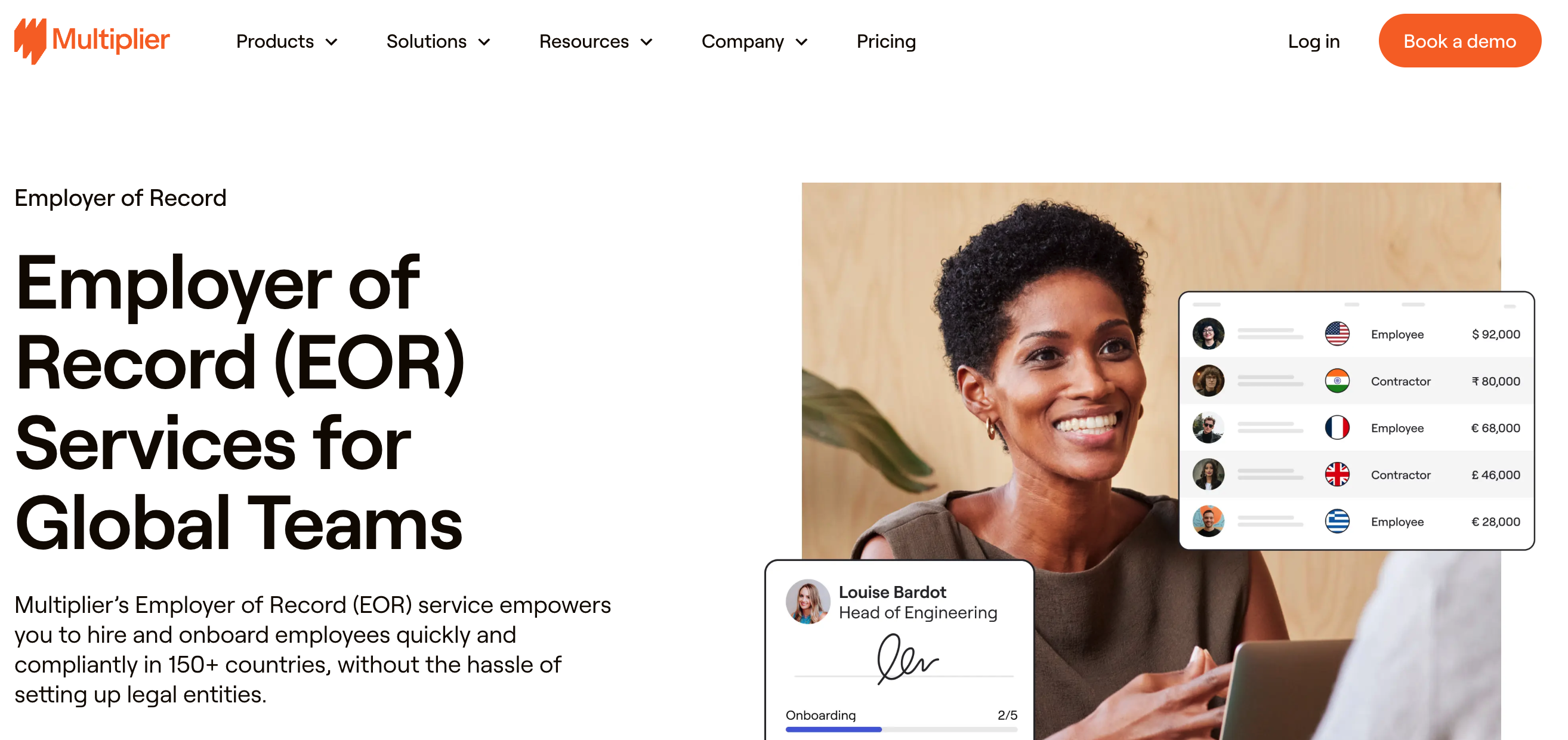
Multiplier is a global employment platform covering 150+ countries, with a strong presence across the Asia-Pacific region including Australia. The platform supports automated payroll, locally compliant contracts, benefits management, multi-currency payroll, contractor onboarding, and compliance checks. Pricing starts from $400 per employee per month.
In Australia, Multiplier manages Fair Work Act compliance, superannuation contributions at the current 12% rate, and Single Touch Payroll (STP) reporting to the ATO. The platform generates locally compliant employment contracts and supports modern award interpretation for Australian hires. Multi-language contract support simplifies onboarding across complex markets in the APAC region.
The platform provides a clean, user-friendly dashboard and mobile app for managing onboarding, expenses, and payroll. Real-time cost estimation gives hiring teams visibility into total employment costs before committing to a hire.
Strengths:
-
Real-time cost estimation and transparent pricing from $400 per employee per month, with a user-friendly dashboard and mobile app covering onboarding, expenses, and payroll management.
-
Strong Asia-Pacific presence with multi-language contract support, automated payroll, and compliance checks suited to Australian Fair Work and superannuation requirements.
Limitations:
-
Users have reported payment delays, support issues, and platform performance problems, based on published third-party reviews.
Best for:
Best for companies prioritising rapid global onboarding across the Asia-Pacific region, particularly those that value transparent pricing and multi-language contract support for Australian hires.
Globalization Partners
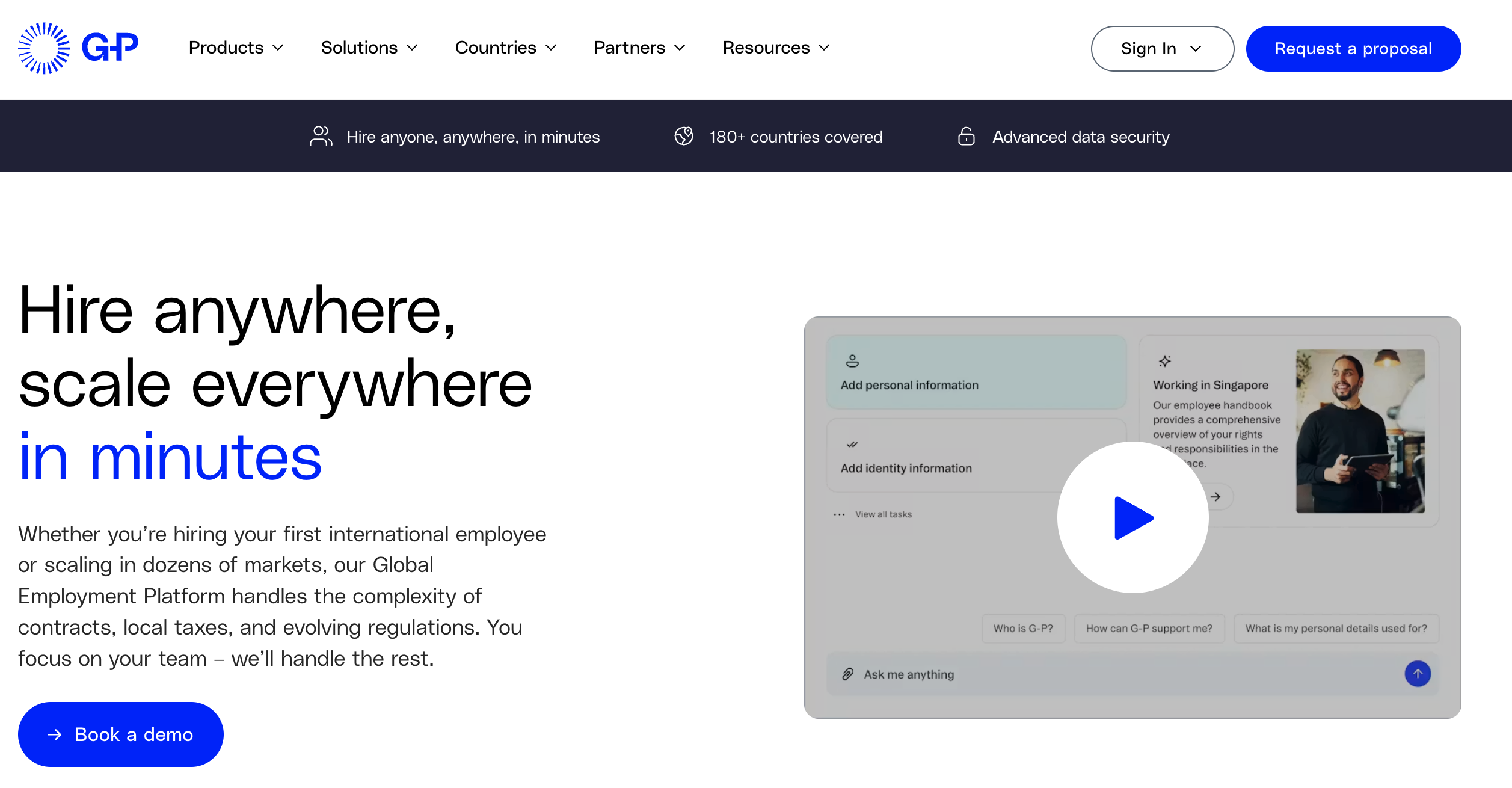
Globalization Partners (G-P) is an enterprise-grade Employer of Record operating across 180+ countries, including Australia. The platform covers EOR, contractor management, and global immigration advisory services. It includes local contracts, payroll with tax compliance, benefits and insurance administration, onboarding and termination support, and 24/7 local HR assistance.
In Australia, G-P manages Fair Work Act compliance, superannuation contributions, and STP reporting. The G-P Meridian platform handles hiring, onboarding, payroll, benefits, and compliance in one system. Onboarding timelines in published country comparisons range from 2 to 7 days, though timelines are country-dependent.
Pricing is custom and not publicly disclosed. Industry sources place G-P pricing at approximately 10 to 20% of salary per employee per month, with one source noting a starting point from $699 per month with a 12-month minimum commitment. This positions G-P as a premium-tier provider suited to organisations with complex, multi-country employment requirements.
Strengths:
-
Deep legal and compliance coverage through G-P's own compliance engine and in-country experts, with dedicated account support for enterprise clients managing complex or multi-country employment programs.
-
Broad service scope across 180+ countries covering EOR, contractor management, payroll, benefits, insurance, onboarding, termination support, and 24/7 local HR assistance.
Limitations:
-
Pricing is not publicly disclosed and is described as premium by industry sources, making cost comparison difficult for teams evaluating flat-fee alternatives.
Best for:
Best for large enterprises with complex, multi-country employment requirements, including organisations managing mergers, acquisitions, or rapid international expansion where compliance depth and dedicated account support are priorities.
Safeguard Global

Safeguard Global is a long-established EOR provider with over 18 years of experience, covering 187 countries and territories. It combines technology with in-country human experts to manage payroll, benefits, HR administration, and end-to-end workforce solutions.
In Australia, Safeguard Global supports Fair Work Act compliance, superannuation contributions at 12% of ordinary time earnings, and Single Touch Payroll (STP) reporting. Onboarding typically takes one to two weeks, depending on the role and location. operates through a directly owned local entity in Australia (Safeguard World Australia Pty Ltd)
The platform covers the full employment lifecycle, from contract generation through to offboarding. Dedicated account management is paired with regional in-country specialists who provide guidance on local labor law and payroll nuances. Safeguard Global was positioned as a market leader in the 2025 NelsonHall EOR Services NEAT Report.
Strengths:
-
In-country experts provide personalized guidance on local labor laws, compliance, payroll nuances, and workforce management throughout the employment lifecycle.
-
Positioned as a market leader in the 2025 NelsonHall EOR Services NEAT Report, with over 18 years of operating as an EOR provider across 187 countries.
Limitations:
-
Public sources reviewed did not document a provider-specific limitation for Safeguard Global beyond premium pricing at $699 per employee per month, which may be a cost consideration for smaller teams.
Best for:
Companies that value personalized, human-led guidance and want a strategic, long-tenured global employment partner with deep in-country compliance expertise.
What Are the Key Services of an EOR in Australia?
An EOR in Australia manages the full employment relationship on behalf of the hiring company. Core services must align with the Fair Work Act and the National Employment Standards (NES), which set minimum conditions for all employees in Australia.
Standard services include payroll processing in AUD, superannuation contributions at 12% of ordinary time earnings, PAYG withholding, and Single Touch Payroll (STP) reporting to the ATO. EOR providers also administer Fair Work Award interpretation, employment contracts, workers' compensation, and multi-state payroll tax obligations.
From 1 July 2026, EOR providers must also manage Payday Super, the new obligation requiring superannuation contributions to be paid on the same day as wages rather than quarterly. This is a distinct compliance requirement that changes payroll processing timelines and cash flow planning for employers.
EOR providers additionally handle casual conversion rights administration, including the obligation to offer casual employees a pathway to permanent employment after 12 months of regular work, as required under the Fair Work Act. Managing these conversion assessments and notifications is part of ongoing employment governance in Australia.
Employment Contracts and Local Compliance
Employment contracts in Australia must specify the applicable modern award or enterprise agreement covering the employee's role. Australia has more than 120 modern awards, each setting minimum pay rates, penalty rates, and conditions for specific industries and classifications.
All contracts must meet the National Employment Standards (NES) minimum entitlements regardless of which award applies. NES entitlements cannot be contracted out of, even where an enterprise agreement provides alternative arrangements.
EOR providers must also manage casual conversion rights. Eligible casual employees who have worked regularly for 12 months have the right to request conversion to permanent employment. The EOR is responsible for tracking eligibility and managing that process on the employer's behalf.
Payroll and Tax Administration
The superannuation guarantee rate is 12% of ordinary time earnings, effective 1 July 2025. EOR payroll calculations must apply this rate to all eligible employees.
From 1 July 2026, the Payday Super reform requires superannuation to be paid on each payday rather than quarterly. This changes EOR payroll cycles materially: contributions must be calculated, remitted, and reconciled with every pay run rather than on a quarterly schedule.
State-level payroll tax adds further complexity. Rates and thresholds differ across each state and territory, and liability is assessed on total Australian wages paid by the employer. Workers' compensation premiums also form part of the employer cost stack and vary by state and industry classification.
Benefits Administration
Superannuation is a statutory benefit in Australia, not an optional perk. From 1 July 2025, the Superannuation Guarantee rate is 12% of ordinary time earnings, paid by the employer on top of base salary.
For an employee on an $71,958 (A$100,000) base salary, the employer superannuation contribution is $8,635 (A$12,000) per year, bringing total employment cost to A$112,000 before other statutory obligations.
Beyond superannuation, EOR providers in Australia can facilitate common supplementary benefits including salary packaging and novated leasing arrangements. Private health insurance is a widely used voluntary benefit that EOR providers can also support, giving employees access to coverage outside the public Medicare system.
Employee Onboarding
Most EOR providers complete employee onboarding in Australia within 2 to 5 business days, subject to right-to-work verification and contract execution.
Right-to-work verification is a mandatory onboarding step. The EOR must confirm each employee holds valid work rights in Australia, whether through citizenship, permanent residency, or a current visa with work entitlements.
Two statutory documents must be issued at the start of employment. All new employees must receive the Fair Work Information Statement (FWIS). Casual employees must also receive the Casual Employment Information Statement (CEIS). Both are legal requirements under the Fair Work Act.
On the first pay event, the EOR must report the commencement of employment to the Australian Taxation Office through Single Touch Payroll (STP). This STP commencement report is a payroll obligation, not an optional filing.
Ongoing HR Support
An EOR in Australia manages the full employment relationship after onboarding, including workplace documentation, leave tracking, and Fair Work Award compliance monitoring throughout the engagement.
When a Fair Work Commission dispute arises, such as an unfair dismissal or general protections claim, the EOR typically holds legal employer liability. Buyers should confirm in their EOR contract which party bears representation costs and indemnification obligations before signing.
The Fair Work Ombudsman conducts audits of employer payroll records and award compliance. A qualified EOR maintains continuous compliance monitoring to reduce audit exposure. Contracts should also specify how the EOR handles casual conversion obligations, which require employers to offer casual employees a pathway to permanent employment after 12 months of regular work.
Employee Offboarding
Terminating an employee in Australia requires strict compliance with the Fair Work Act and the National Employment Standards. Notice periods under the NES range from one week to five weeks depending on length of service, with an additional week for employees over 45 with at least two years of service.
Employees with six or more months of continuous service (or 12 months for small business employers) can lodge unfair dismissal claims with the Fair Work Commission. Redundancy pay entitlements apply after one year of service. Final pay must include all accrued annual leave and, where applicable, long service leave.
The EOR must submit a Single Touch Payroll finalisation event to the ATO at the end of employment. When switching EOR providers, buyers should review contract notice periods, confirm employee record transfer procedures, and verify superannuation fund continuity to avoid contribution gaps.
How to Hire Through an EOR in Australia
Hiring through an EOR in Australia does not require establishing a proprietary limited company. The EOR becomes the legal employer of record for Fair Work Act purposes, taking on statutory obligations that would otherwise fall to the client company.
The EOR manages payroll, superannuation contributions, PAYG withholding, and Single Touch Payroll (STP) reporting on the client's behalf. Companies should also account for the Payday Super reform, which will require superannuation contributions to be paid on each payday rather than quarterly, making payroll cycle setup a material compliance consideration.
The client retains day-to-day direction of the worker's tasks and outputs. Employment risk, Fair Work compliance, and statutory filings sit with the EOR.
Selection and Setup
When evaluating EOR providers for Australia, assess each against criteria specific to the local regulatory environment: depth of Fair Work Act compliance, whether the provider operates through owned entities or third-party partners, Single Touch Payroll (STP) capability, readiness for the Payday Super reform, and whether support hours cover AEST and AEDT business hours.
Before signing, review the EOR master services agreement carefully. Pay particular attention to the indemnification scope and how the provider handles Fair Work Commission disputes on the client's behalf. These terms vary significantly between providers and carry real employment liability implications.
-
Request a full cost breakdown before committing. This should include the EOR platform fee, superannuation contributions, state-based payroll tax, workers' compensation insurance, and any additional charges for onboarding or offboarding.
-
Most providers activate Australian employment within 2 to 5 business days, though timelines depend on the complexity of the role and the worker's location.
Providers with transparent, country-specific pricing reduce the risk of unexpected costs after contracts are signed. Gloroots uses predictable, country-specific pricing with full cost visibility before onboarding and no percentage-of-salary pricing, which supports accurate budget planning for Australian hires. See pricing for details.
Onboarding and Compliance
Every new hire in Australia requires a Fair Work Information Statement (FWIS) before or on the first day of employment. Casual employees must also receive a Casual Employment Information Statement (CEIS). Both documents are mandatory under the Fair Work Act.
Right-to-work verification is a required step before employment begins. Employers must sight and record evidence of a worker's entitlement to work in Australia.
Onboarding documentation also includes a Standard Choice Form, which gives employees the opportunity to nominate their preferred superannuation fund. The EOR must submit a Single Touch Payroll (STP) commencement report on the first pay event.
-
From 1 July 2026, Payday Super requires superannuation to be remitted on each payday rather than quarterly. EOR payroll systems must be configured to meet this obligation.
-
Fair Work Act unfair dismissal protections do not apply during the minimum employment period: six months for most employers, twelve months for small businesses.
What Are the Benefits of Using an EOR in Australia?
Using an EOR in Australia removes the need to register a proprietary limited company before hiring. Entity setup typically costs between $10,794 (A$15,000) and $28,783 (A$40,000) and takes six to twelve months. An EOR reduces that to days.
The table below compares the two approaches across the factors that matter most to finance and operations teams.
| Factor | Proprietary Limited Company | EOR |
|---|---|---|
| Setup speed | 6-12 months | 2-5 days |
| Initial cost | $10,794 (A$15,000)-$28,783 (A$40,000) | No entity setup cost |
| Ongoing costs | ASIC fees, local accounting, legal counsel | Monthly EOR service fee |
| Compliance responsibility | Employer bears full liability | Shared with or transferred to EOR |
| Scalability | Fixed structure; changes require ASIC filings | Adjust headcount without entity changes |
| Local knowledge | Must hire or retain in-country expertise | Included in service |
| Risk allocation | Employer holds Fair Work and tax exposure | EOR assumes employer-of-record liability |
For a concrete cost picture: a base salary of $71,958 (A$100,000) carries a superannuation obligation of approximately $8,635 (A$12,000) at the current 12% rate, plus state payroll tax, workers' compensation premiums, and an EOR service fee typically in the range of $576 (A$800) to $1,007 (A$1,400) per month. Total employment cost will exceed the base salary figure by a material margin. See our employer of record cost guide for a full breakdown.
Faster Market Entry
Setting up a proprietary limited company in Australia typically takes 6 to 12 months and costs between $10,794 (A$15,000) and $28,783 (A$40,000), covering ASIC registration, legal counsel, accounting infrastructure, and ongoing compliance obligations.
An EOR removes that timeline entirely. A company can have its first Australian employee onboarded within one week. The EOR handles ABN and TFN registration, enrolls the employer in Single Touch Payroll (STP), and sets up a compliant superannuation fund on the employer's behalf.
This means a business can execute its Australian hiring plan immediately, without waiting for entity approval or building local administrative capacity from scratch.
Reduced Compliance Risk
Australian employment law creates several specific compliance exposures for foreign employers. Underpayment of award wages, incorrect superannuation calculations, and Single Touch Payroll reporting errors each carry financial penalties. Payroll tax obligations also vary by state, adding another layer of complexity for companies without local expertise.
The Fair Work Ombudsman actively audits employers across industries. A finding of underpayment or record-keeping failure can result in significant back-pay orders and civil penalties.
From 1 July 2026, the Payday Super reform requires superannuation to be paid on each payday rather than quarterly. Non-compliance will attract penalties. An EOR manages this obligation directly, removing the risk from the employer's books. Casual conversion compliance, which requires employers to offer casual employees a pathway to permanent employment after 12 months, is another area the EOR monitors and administers on the employer's behalf.
Simplified Payroll Administration
Australian payroll carries obligations that multiply quickly: multi-state payroll tax lodgments, STP Phase 2 reporting to the ATO, PAYG withholding variation management, and Payday Super remittance requirements arriving 1 July 2026.
An EOR consolidates every obligation into a single monthly invoice. The employer pays one amount; the EOR handles ATO remittances, super fund payments, and state payroll tax lodgments on the employer's behalf.
This removes the need to track separate deadlines across the ATO, state revenue offices, and superannuation funds, reducing both administrative load and the risk of late-payment penalties.
Access to Local Benefits
An EOR in Australia administers the full set of statutory entitlements: superannuation at 12% of ordinary time earnings, four weeks of annual leave, ten days of personal and carer's leave, up to 18 weeks of government-funded parental leave plus any employer top-up, and state-specific long service leave.
Beyond statutory minimums, an EOR can facilitate voluntary benefits including private health insurance, salary packaging arrangements, and novated leasing. These additions matter in Australia's tight labor market, where about 72% of employers globally report difficulty filling open roles, and competitive benefits directly affect talent attraction and retention.
Lower Entity Setup Costs
Establishing a proprietary limited company in Australia typically costs between $10,794 (A$15,000) and $28,783 (A$40,000) in legal, registration, and advisory fees. Ongoing obligations add further expense: ASIC annual review fees, local accounting and audit requirements, and Australian legal counsel retainers.
An EOR replaces those fixed costs with a predictable monthly fee of approximately $576 (A$800) to $1,007 (A$1,400) per employee. For companies hiring fewer than 10 to 15 employees in Australia, EOR is almost always the more cost-effective path. Beyond that threshold, the cumulative EOR fee begins to approach entity setup costs, and a break-even analysis is worth running before committing to either structure. Learn more about employer of record cost factors to inform that calculation.
More Flexible Workforce Scaling
Most EOR providers impose no minimum headcount requirement, so companies can engage a single employee in Australia without committing to a full subsidiary structure. This makes EOR a practical way to test the Australian market before deciding whether entity setup is warranted.
Scaling down is equally straightforward. When headcount is reduced, the EOR manages redundancy pay and notice obligations under the National Employment Standards, keeping the hiring company at arm's length from direct Fair Work liability.
From 1 July 2026, the Payday Super reform requires superannuation contributions to be remitted on each pay cycle rather than quarterly. EOR providers absorb the operational complexity of that change, including system updates, payment scheduling, and ATO reporting alignment, so the hiring company does not need to reconfigure its own payroll infrastructure. For companies evaluating this model, EOR for startups and EOR for small business pages outline how entity-free employment supports early-stage and growing teams.

How to Find the Right EOR for Australia
The right criteria depend on where your company sits. A startup hiring its first Australian employee weights speed and price differently than a mid-market team scaling an APAC operation or an enterprise consolidating HR and IT systems across regions. Identify your segment before comparing providers.
One structural question cuts across all segments: does the EOR operate through a directly owned Australian entity or a partner network? That distinction determines who holds accountability for PAYG withholding and Single Touch Payroll (STP) filing with the ATO. A partner-network model can introduce gaps in that accountability chain.
Beyond entity ownership, evaluate each provider against these criteria: Fair Work Award interpretation, superannuation administration, STP Phase 2 compliance, casual conversion rights management, Fair Work Ombudsman audit preparedness, and Payday Super readiness ahead of the mandatory 1 July 2026 start date. For a broader view of how providers compare globally, see the best employer of record guide.
Local Compliance Expertise
Australian employment law is specific and frequently updated. Verify that any EOR you consider can demonstrate active compliance across the following areas before you commit.
-
Entity ownership model: A directly owned Australian entity means the EOR holds full accountability for PAYG withholding and STP filing. A partner-network arrangement can split or obscure that accountability, increasing your exposure.
-
STP Phase 2 compliance: The ATO's expanded Single Touch Payroll reporting requirements are now in effect. Confirm the provider files disaggregated income types and tax treatment codes correctly.
-
Payday Super readiness: From 1 July 2026, superannuation contributions must be paid on each payday rather than quarterly. Ask providers for their implementation plan and whether their payroll engine already supports this cadence.
-
Casual conversion rights management: The Fair Work Act requires employers to assess and offer conversion to permanent employment for eligible casual employees. The EOR must track eligibility and manage that process on your behalf.
-
Fair Work Ombudsman audit preparedness: The EOR should maintain records sufficient to respond to an FWO audit, including time and wages records, pay slips, and award classification documentation.
Clear Service Scope
Service scope defines what the EOR legally owns versus what it refers elsewhere. Before signing, ask whether the provider handles multi-state payroll tax lodgment across all Australian states and territories, manages casual conversion administration under the Fair Work Act, and provides Fair Work Commission dispute support or only advisory guidance.
Visa sponsorship scope also varies. Some EOR providers manage TSS and ENS sponsorship directly; others refer clients to immigration partners, adding cost and coordination risk.
Confirm indemnification terms: what liability does the EOR accept for compliance failures? Finally, verify offboarding scope. A complete service covers redundancy calculations and NES final pay obligations, not just contract termination.
Support Model
Support quality matters most when a compliance deadline cannot wait. At minimum, an EOR covering Australia should provide AEST/AEDT business hours coverage. For global teams operating across multiple time zones, 24/7 support is the more reliable standard.
Fair Work Award interpretation queries require specific expertise, not a shared support queue. Dedicated account management ensures the person handling your query retains context on your workforce and award classifications.
Ask for response time SLAs on compliance-critical issues such as Fair Work Commission dispute notifications, where delays carry legal risk. Enterprise buyers should require a named account manager. SMBs may accept a shared support model, provided response time commitments are documented in the service agreement.
Technology and Reporting
A capable EOR platform must support Single Touch Payroll Phase 2 (STP Phase 2), Australia's mandatory real-time payroll reporting standard. STP Phase 2 requires disaggregated income reporting to the ATO and is non-negotiable for any provider operating in Australia.
From 1 July 2026, Payday Super requires employers to pay superannuation contributions on each payday rather than quarterly. Confirm that your EOR's payroll configuration supports this change before signing a contract.
Beyond compliance, look for real-time payroll visibility and superannuation tracking within the platform dashboard. Integration with common Australian accounting software such as Xero and MYOB reduces manual reconciliation. If your organisation requires Australian data residency for employee records, verify this capability directly with each provider before committing.
Scalability for Your Hiring Plans
For companies hiring one to three employees in Australia, flat-fee providers with lower per-seat costs are generally more cost-effective. Providers targeting larger programmes often offer volume pricing for ten or more employees; verify discount terms directly, as these are rarely published.
Some enterprise-focused providers set minimum headcount requirements. Confirm this before shortlisting. If you plan to expand beyond Australia, check each provider's APAC coverage, since regional depth varies significantly across the best employer of record options and across EOR for enterprises and EOR for startups programmes.
Finally, confirm that your EOR supports a structured transition to a company-owned entity. Once headcount grows past the point where EOR fees exceed entity running costs, a managed transition path protects continuity and avoids disruption.

Why Gloroots Is a Strong EOR Partner in Australia
Gloroots runs compliant full-time employment across 150+ countries through a single platform covering Global Employer of Record, Global Payroll, Compliance and Employment Governance, and Benefits and Statutory Coverage.
Pricing is predictable and country-specific. Gloroots publishes the full cost before onboarding begins and does not charge a percentage of salary. Companies know exactly what they will pay per employee in Australia before a contract is signed. See Gloroots pricing for current rates.
In Australia, Gloroots manages Fair Work Award compliance, interprets modern awards across 120+ industry classifications, and handles TSS and ENS visa sponsorship end to end. Superannuation is administered at the current 12% rate with automated payroll and STP Phase 2 reporting to the ATO.
-
Fair Work Award-compliant contracts with correct penalty rates and leave loading
-
Superannuation at 12% with quarterly payment compliance and ATO reporting
STP Phase 2 real-time payroll reporting
TSS and ENS visa sponsorship managed in full
Workforce visibility is centralized. A single dashboard covers hiring, payroll, compliance, benefits, and headcount across every active country. Account support is human-led, with dedicated managers who retain context across the employment lifecycle.
For companies expanding beyond Australia, Gloroots supports employment in 150+ countries under the same governance model. Support runs 24/7 with dedicated account management. To employ workers in Australia without entity setup, contact Gloroots through Gloroots EOR services.
FAQs About the Best EOR in Australia
How does an EOR work in Australia?
An EOR becomes the legal employer of your Australian workers for Fair Work Act purposes. Your company retains full day-to-day management and direction of those employees.
The EOR handles PAYG withholding, superannuation contributions (currently 12% of ordinary time earnings), Single Touch Payroll (STP) reporting to the ATO, and compliance with applicable Fair Work Awards. From 1 July 2026, the Payday Super reform requires the EOR to remit superannuation on each payday rather than quarterly.
In Australia, the EOR model is the standard structure for foreign companies hiring without a local entity. The PEO model, common in some other markets, is less widely used here. To understand the mechanics in more detail, see how does an EOR work.
What does an EOR cost in Australia?
Most providers on this list charge between $576 (A$800) and $1,007 (A$1,400) per employee per month as the EOR platform fee. That figure excludes statutory costs, which are mandatory and employer-borne.
For a worker on a $71,958 (A$100,000) base salary, the total employer cost typically includes: $8,635 (A$12,000) in superannuation (12% of ordinary time earnings), approximately A$5,000 to A$7,000 in state payroll tax (rate and threshold vary by state), a workers' compensation insurance premium, and the EOR fee of $576 (A$800) to $1,007 (A$1,400) per month.
Some providers charge a percentage of salary, which makes costs harder to forecast as headcount grows. Gloroots uses predictable, country-specific pricing with full cost visibility before onboarding and no percentage-of-salary pricing. For a full breakdown of what drives EOR fees, see employer of record cost.
When should a company use an EOR in Australia?
An EOR suits companies that need to hire in Australia quickly without committing to entity setup. Common scenarios include testing the Australian market with one to five employees, needing to place staff within days rather than months, and lacking local HR or legal expertise to manage Fair Work obligations.
Registering an Australian proprietary limited company with ASIC takes time and carries ongoing compliance costs. An EOR is typically more cost-effective than a local entity for fewer than 10 to 15 employees. Companies planning to hire from mid-2026 onward should also confirm their EOR is ready for Payday Super, which requires superannuation contributions to be paid on each payday rather than quarterly. EOR for small businesses entering Australia can reduce setup risk while maintaining full statutory compliance.
Can an EOR hire both local and foreign employees in Australia?
Yes. An EOR can employ Australian citizens, permanent residents, and foreign nationals who hold valid Australian work rights. Before employment begins, the EOR must verify each worker's right to work through the Visa Entitlement Verification Online (VEVO) system or an equivalent check.
For skilled foreign workers, an EOR can sponsor Temporary Skill Shortage (TSS) visas and support Employer Nomination Scheme (ENS) applications. Sponsorship is only available for roles that meet the TSS skill level and salary thresholds set by the Department of Home Affairs. Roles that fall below those thresholds are not eligible for TSS sponsorship, regardless of employer preference. Buyers should confirm directly with each provider on this list whether visa sponsorship is offered as part of their Australia service.
How do I choose the right EOR in Australia?
Start with five criteria: compliance depth with Fair Work and modern awards, pricing transparency, onboarding speed, support hours in AEST/AEDT, and country coverage if you plan to hire beyond Australia.
Also check the entity ownership model. Providers operating wholly-owned entities in Australia carry employment liability directly; those using third-party partners add a layer of risk. From 1 July 2026, confirm your provider is ready for Payday Super, which requires superannuation contributions to be paid on each payday rather than quarterly.
Before signing, review contract notice periods and the employee record transfer process in case you need to switch providers later. See the full selection criteria section above for detailed guidance.