







- Argentina's labor framework requires payroll with inflation-indexed adjustments, mandatory 13th-month salary paid in two annual installments, workers' compensation insurance enrollment, and monthly tax filings with AFIP, making provider compliance depth more consequential here than in most markets.
- The 2026 Labor Modernization Law introduced extended workday provisions and an hours bank overtime model that must be reflected in employment contracts; buyers should confirm whether their chosen provider has updated Argentina contracts before signing.
- At least one provider in this comparison classifies Argentina as a partial-rate taxable country, meaning VAT or indirect local costs are added on top of the stated monthly fee; confirm the full cost structure with each provider before contracting.
- Dismissal without just cause triggers severance of one month's salary per year of service plus notice pay, making offboarding one of the highest-cost employment events in the region; model this cost before hiring, not after.
- Provider pricing for Argentina EOR ranges from $199 to $699 per employee per month across the eight platforms reviewed, with differences in entity ownership model, compliance update status, and support structure that affect total cost and risk beyond the headline fee.
Argentina offers a deep technology talent pool, favorable time zone overlap with North American teams, and competitive salary levels. Peso volatility and inflation-indexed salary obligations make provider selection more consequential here than in most markets.
Argentina's labor framework is detailed and actively enforced. The 2026 Labor Modernization Law introduced changes to several employment provisions. Buyers should verify how their chosen provider handles those updates before signing a contract.
This page covers eight EOR providers evaluated on Argentina-specific compliance depth, pricing transparency, onboarding speed, platform experience, and third-party review scores. It also covers when an EOR makes more sense than forming a local entity, how to read the total employer cost model including severance methodology, and what criteria matter most before contracting. If you are new to the model, see how does EOR work before comparing providers.
Our Top 8 Picks: Argentina EOR Comparison 2026
The eight providers below were selected based on Argentina-specific compliance capability, pricing transparency, onboarding speed, platform experience, and available third-party review data. Each row reflects publicly available or directly sourced evidence. For a broader ranking of global EOR options, see best employer of record.
| Provider | Pricing per month | Country coverage | Onboarding speed | Platform experience | Customer support | Scalability |
|---|---|---|---|---|---|---|
| Gloroots | $199/employee/month | 150+ countries | 3-5 working days | Centralized workforce dashboard covering hiring, payroll, compliance, benefits and workforce visibility | 24/7 human support with dedicated account management | SMB to enterprise; built for multi-country programs |
| Deel | $599/employee/month; country-specific statutory costs are additional | 130+ EOR countries; broader global hiring footprint is larger | Automated onboarding; country-dependent | Unified platform for EOR, payroll, contractors, HR, benefits, compliance and integrations | 24/7 HR, legal and tax expertise | SMB to enterprise; strong fit for fast-scaling distributed teams |
| Multiplier | $499/month or $459/month annually for Core plan; approximately 11% of countries have adjusted pricing | 150+ countries | Country-dependent | Multi-country EOR/payroll platform with employment, payroll, benefits, compliance and workforce management | Human-first support and local expertise | SMB to enterprise; supports companies from first hire to large distributed teams |
| Safeguard Global | From approximately $599/employee/month; premium markets and country complexity can increase cost | 187 countries | 1-2 weeks in most countries; country-dependent | Global workforce platform covering EOR, payroll, HR and compliance | Dedicated account management and regional/in-country specialists | Mid-market to enterprise |
| Mercans | $299-$599/employee/month plus $300 implementation fee; market-specific | 160 countries | 48 hours stated by Mercans; country/process dependent | Proprietary HR Blizz platform for payroll, HR, compliance and reporting | Dedicated account manager and in-country specialists | SMB to enterprise |
| Pebl | From $199/employee/month | 185+ countries | Country-dependent | Global EOR platform covering hiring, onboarding, payroll, benefits and compliance | Dedicated support and in-country expertise | SMB to enterprise |
| Payoneer Workforce Management | From $199/employee/month | 160+ countries | Typically 5-7 business days for EOR onboarding; country-dependent | Global workforce platform covering EOR, payroll, contracts, compliance, benefits and payments | Dedicated account manager, local HR specialist and legal counsel | SMB to enterprise |
| Remote | $699/employee/month standard; annual or contract arrangements may offer different pricing | 90+ EOR countries | Dedicated onboarding specialist; country-dependent | Not publicly listed in researched sources | In-house local experts and dedicated specialist support | SMB to enterprise; particularly strong for companies prioritizing owned entities and IP protection |

Top 8 Best EOR Platforms in Argentina
The eight platforms below cover the full range of Argentina hiring needs, from startups running a single hire to enterprises managing large distributed teams.
Each profile follows a consistent structure: overview, key Argentina-specific services, ART (workers' compensation insurance) coverage confirmation, platform experience, customer support, pricing, and best-fit guidance.
Profiles also flag whether each provider has updated employment contracts for the 2026 Labor Modernization Law extended workday and hours bank provisions, and whether indirect VAT or local country costs apply in Argentina in addition to the stated monthly fee.
Gloroots
Gloroots runs compliant full-time employment across 150+ countries, including Argentina, without requiring companies to establish a local legal entity. The platform combines Global Employer of Record (EOR), Global Payroll, Compliance and Employment Governance, and Benefits and Statutory Coverage into a single employment operating layer.
For Argentina specifically, Gloroots manages payroll with inflation-indexed adjustments, social security filings with AFIP and ANSES, obra social healthcare contributions, aguinaldo (13th-month salary) administration, and collective bargaining agreement compliance. Gloroots includes ART (workers' compensation insurance) enrollment and applicable occupational-risk insurance administration in its Argentina EOR service, with ART premiums billed separately from the EOR service fee. Gloroots tracks Argentine labor-law changes and keeps employment structures updated.
Gloroots uses predictable, country-specific pricing with full cost visibility before onboarding. Pricing starts from $199 per employee per month; confirm Argentina-specific rate directly with the team. No percentage-of-salary pricing applies. Onboarding in Argentina takes 3-5 working days.
Strengths:
-
Supports compliant employment across 150+ countries with predictable, country-specific pricing and full cost visibility before onboarding. No percentage-of-salary pricing applies.
-
Provides centralized workforce visibility and human-led account support with retained business context, so account teams carry forward knowledge of each client's workforce structure across engagements.
-
Combines Global EOR, Global Payroll, Compliance and Employment Governance, and Benefits and Statutory Coverage in one platform, reducing the need for multiple vendors.
Limitations:
-
Public sources reviewed did not document a provider-specific limitation.
Best for:
Companies that require Ley de Contrato de Trabajo compliance, inflation-indexed payroll management, and transparent, predictable pricing when hiring in Argentina without a local entity.


Deel
Deel is a global HR platform offering employer of record services across 150+ countries. EOR pricing starts at $599 per employee per month, with costs for some hires exceeding $1,000 depending on country-specific statutory requirements. The platform is rated 4.7/5 on G2 Retrieved September 8, 2026..
For Argentina, Deel manages employment contracts compliant with the Labor Contract Law, AFIP and ANSES filings, mandatory 13th-month salary (aguinaldo) administration, obra social healthcare contributions, and collective bargaining agreement compliance. ART workplace injury insurance coverage is Deel lists Accident Insurance (ART) among Argentina employer costs, indicating ART coverage is included.. Compliance with the 2026 Labor Modernization Law is Deel notes that Argentina’s Law 27,802 took effect in March 2026, with 82 articles suspended on March 30 and reinstated on April 23, 2026.. Treatment of Argentina indirect VAT and whether local country costs are included or billed separately requires direct confirmation from Deel Clients can add VAT percentages to Deel invoices themselves; Deel states it does not provide VAT advice..
Deel scored 4.5/5 in an independent benchmark of 130+ EOR providers, placing it in the top 5% of the field. Standout scores include global coverage (5.0), payment terms (4.5), customer support (4.5), and platform technology (4.5). The platform supports 40+ native integrations and same-day self-service onboarding.
Strengths:
-
Industry-leading automation across onboarding, payroll, compliance, and equipment management, with 40+ native integrations, same-day self-service onboarding, and owned-entity infrastructure across 150+ countries.
-
Aggregate score of 4.5/5 in an independent benchmark of 130+ EOR providers, with standout scores in global coverage, payment terms, customer support, and platform technology.
-
Unified platform covering EOR, payroll, contractor management, HR, benefits, compliance, and integrations in a single interface.
Limitations:
-
Pricing starts at $599 per employee per month and can exceed $1,000 for some Argentina hires, placing Deel at the higher end of the market for smaller hiring volumes.
-
Support can feel transactional for small teams that prefer a human-led account experience with retained business context.
Best for:
SMB and scaleup teams that need automation, scalability, and a unified global HR stack across multiple countries.
Multiplier
Multiplier is a global Employer of Record platform covering 150+ countries. Core pricing is $499 per employee per month, or $459 per month when billed annually. Multiplier has a 4.7/5 rating on G2 from 2,192 reviews, retrieved September 8, 2026. Its platform provides a centralized dashboard for onboarding, contracts, payroll, expenses, leave, compliance, and workforce management. The platform also provides country-specific compliance prompts during onboarding and instant contract generation. Multiplier assigns every customer a named Customer Success Manager, with 24/5 support from local HR and legal experts for EOR and 24/7 support for Global Payroll.
For Argentina, Multiplier provides EOR employment and compliance support, including locally compliant contracts, payroll, benefits, and country-specific compliance requirements. Multiplier's public Argentina materials discuss the 2026 Labor Modernization Law, including the extended probation period and other employment changes, indicating that the provider is actively monitoring the reform. However, public sources do not provide sufficient detail to independently confirm each specific Argentina service item such as AFIP/ANSES filings, ART, obra social, and CBA administration as separate included features.
Multiplier's Argentina EOR allows companies to hire without establishing a local entity. Multiplier states that it operates through owned entities and provides compliance support through its local HR and legal teams.
Strengths:
-
150+ country coverage with a centralized EOR platform, instant contract generation, payroll, benefits, and compliance management.
-
Dedicated Customer Success Manager for every customer, supported by local HR and legal experts.
-
Multiplier has published an Argentina-specific analysis of the 2026 Labor Modernization Law, showing active monitoring of the country's regulatory changes.
Limitations:
-
Multiplier does not publicly disclose a clear Argentina-specific VAT billing treatment.
-
Public Argentina materials do not provide enough detail to independently verify the full scope of AFIP/ANSES, ART, obra social, and CBA administration.
Best for:
Companies that need fast, entity-free hiring in Argentina with centralized global payroll, compliance management, and dedicated customer support.
Safeguard Global
Safeguard Global provides Employer of Record services in Argentina, allowing companies to hire, onboard, pay, and support employees without establishing their own local entity. Safeguard Global covers 187 countries and combines its workforce platform with local HR and compliance expertise.
Safeguard Global does not publicly disclose a standard Argentina-specific EOR price. Its public materials state that EOR pricing can consist of a provider fee plus the actual employer costs applicable in each country, so a specific Argentina quote should be obtained directly from Safeguard Global.
For Argentina, Safeguard Global confirms EOR support covering compliant hiring, onboarding, payroll, HR support, and local regulatory compliance. Its public Argentina materials do not provide enough detail to independently confirm specific handling of LCT-compliant contracts, AFIP/ANSES filings, aguinaldo, obra social, CBA administration, or ART as separately documented service components.
Safeguard Global has also published an Argentina 2026 labor-reform update discussing Law 27.802 and its implications for employers. However, this does not by itself confirm that every EOR process has already been updated for the new requirements.
Safeguard Global's platform provides country-specific onboarding forms, contract previews, onboarding tracking, time and expense management, payroll visibility, workforce analytics, and centralized workforce data. Its EOR onboarding process is described as taking a couple of days generally, but an Argentina-specific onboarding SLA is not publicly stated.
Safeguard Global has a 4.3/5 rating from 131 G2 reviews, retrieved September 8, 2026.
Strengths:
-
187-country coverage with EOR, payroll, HR, benefits, and workforce-management capabilities.
-
Argentina-specific EOR support allows companies to hire without establishing their own local entity.
-
Combines a centralized workforce platform with local HR and compliance expertise.
Limitations:
Argentina-specific EOR pricing is not publicly disclosed.
-
Public sources do not provide detailed confirmation of ART coverage, Argentina-specific VAT treatment, or the complete scope of AFIP/ANSES, aguinaldo, obra social, and CBA administration.
Argentina-specific onboarding timing is not publicly stated.
Best for:
Mid-market and enterprise companies that need broad global EOR coverage combined with local compliance expertise, workforce management, and payroll support in Argentina.
Mercans
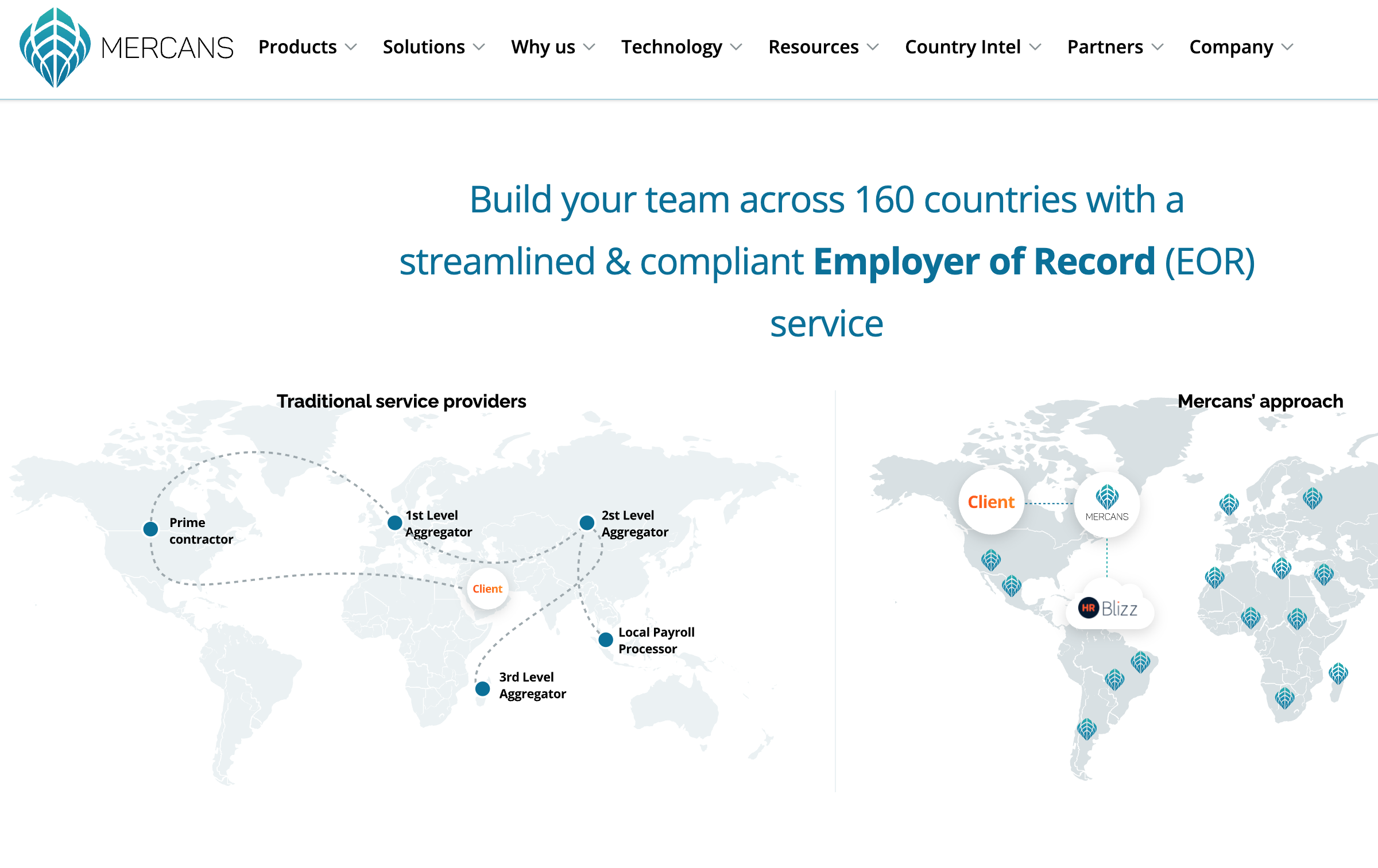
Mercans is ranked second among the ten best EOR service providers for Argentina in 2026 by People Managing People. The company operates in 160+ countries with full-time in-country teams and a proprietary AI-powered payroll platform covering EOR, payroll, contractor solutions, and global mobility support.
The platform runs on two proprietary engines: HR Blizz, a SaaS-based HR and payroll system, and G2N, an API-first payroll calculation engine. Mercans holds SOC1/2 and ISO 27017/27018 certifications along with Binding Corporate Rules approval for global data privacy compliance.
Pricing ranges from $299 to $599 per employee per month with a $300 implementation fee, though market-specific rates apply. Mercans details Argentina payroll services including LCT-based payroll rules, monthly F.931 social security filings covering health insurance (obra social), and mandatory SAC/aguinaldo payments, with processes aligned to evolving labor law. Mercans notes employers in Argentina must budget for ART workers' compensation insurance as part of employment costs. Mercans states its Argentina EOR service ensures compliance "through a period of significant labor law reform," including the 2026 reform. Mercans' Argentina guide lists the standard VAT rate as 21%. Mercans is rated 4.8/5 on G2 based on 47 reviews.
Strengths:
-
Named a Leader in the Avasant Payroll Business Process Transformation 2025 to 2026 RadarView and recognized in the Gartner Payroll Market Guide 2026 and ISG Provider Lens for three consecutive years.
-
Holds SOC1/2 and ISO 27017/27018 certifications along with Binding Corporate Rules approval, providing top-tier global data privacy compliance for companies with cross-border workforce obligations.
-
Offers AI-powered payroll with real-time anomaly detection, compliance automation, and actionable reporting insights via its proprietary HR Blizz platform.
Limitations:
-
Public sources reviewed did not document a provider-specific limitation for Mercans beyond the $300 implementation fee, which adds to initial onboarding cost.
Best for:
Companies that require integrated payroll and EOR services in Argentina, particularly those that prioritize AI-powered payroll accuracy, strong compliance certifications, and in-country specialist support.
Pebl
Pebl supports EOR hiring in Argentina without requiring companies to establish a local entity. Its Argentina service covers employment contracts, payroll, tax and social-security contributions, statutory benefits, aguinaldo, healthcare, leave, benefits administration, and compliant terminations.
Pebl’s EOR pricing starts at $399 per employee per month. It supports EOR hiring across 185+ countries through a global employment platform.
Pebl’s Argentina documentation covers CBA requirements and confirms ART worker-risk insurance as an employer cost. However, Pebl does not publicly identify the specific ART provider or disclose a separate Argentina-specific EOR price.
Pebl has a 4.6/5 G2 rating from 602 reviews. Its public materials do not confirm a specific 2026 Labor Modernization Law update or detailed Argentina-specific VAT treatment.
Strengths:
-
Comprehensive Argentina payroll, benefits, tax, social-security, ART, and compliance support.
-
185+ country coverage with a centralized global employment platform.
Strong independent G2 rating.
Limitations:
Argentina-specific EOR pricing is not publicly disclosed.
-
Specific ART provider, 2026 labor-law implementation, and Argentina VAT treatment are not publicly detailed.
Best for:
Companies hiring in Argentina that need comprehensive EOR payroll, benefits, statutory compliance, and local labor-law support without establishing a local entity.
Payoneer
Payoneer Workforce Management, formerly known as Skuad, offers employer of record services in Argentina with transparent pricing starting at $249 per employee per month (volume-discounted) or $399 per employee per month at the standard rate. The platform covers 160+ countries and provides a unified hiring and payments interface.
Services include instant onboarding of new hires, global payroll processing, local employment law compliance, benefits administration, work permit management, and timesheet tracking. Argentina-specific services cover LCT-compliant employment contracts, AFIP and ANSES filings, aguinaldo administration, obra social contributions, and collective bargaining agreement compliance.
Customer support operates on a 24x5 basis with a dedicated support manager and localized assistance.
Strengths:
-
Offers one of the lower published starting prices for Argentina EOR at $249 per employee per month (volume-discounted), making it accessible for cost-conscious hiring programs.
-
Provides a unified platform covering contracts, onboarding, payroll, compliance, benefits, and payments across 160+ countries with 24x5 dedicated support.
Limitations:
-
The discounted rate of $249 per employee per month depends on hiring volume; the standard rate is $399 per employee per month, which increases costs for lower-volume hiring.
Best for:
Startups and mid-market companies seeking a cost-effective Argentina EOR entry with a unified hiring and payments platform.
Remote
Remote operates as a global Employer of Record platform with owned legal entities in every country where it operates, including Argentina. The company covers 190+ countries and positions itself around transparent pricing and data security. Published pricing starts at $699 per employee per month, covering payroll processing, tax compliance, benefits management, and contract generation.
Remote owns its Argentine legal entity directly, which means employment contracts and statutory filings are handled without a local aggregator. The platform targets technology companies building distributed teams and supports multi-currency payroll arrangements where Argentine regulations permit. Argentina-specific services include payroll in Argentine pesos, 13th-month salary (aguinaldo) administration, mandatory health insurance (obra social) enrollment, tax withholding automation, monthly AFIP declarations, and collective bargaining agreement compliance across applicable sectors.
Argentina classifies as a partial rate taxable country under Remote's own support documentation, meaning local indirect costs such as VAT are added on top of the standard monthly fee. Buyers should confirm the full cost structure directly with Remote before contracting. ART workplace injury insurance coverage status for Argentina has not been confirmed in available sources and should be verified with Remote directly. Remote's compliance update status in relation to Argentina's 2026 Labor Modernization Law is also an open item that buyers should raise before signing.
Strengths:
-
Owns legal entities in every country of operation, including Argentina, removing aggregator risk and providing a single accountable party for statutory filings and employment contracts.
-
Transparent published pricing starting at $699 per employee per month with coverage across 190+ countries, supported by ISO/IEC 27001 certification and SOC 2 Type II attestation.
-
G2 rating of 4.5 out of 5 based on 3,887 reviews, reflecting broad user adoption across technology companies building distributed teams.
Limitations:
-
The platform interface complexity increases the learning curve for new administrators, and some public reviews note occasional response delays from the support team.
-
Argentina is classified as a partial rate taxable country, meaning VAT and other local indirect costs are added on top of the standard $699 monthly fee, which affects total cost planning.
Best for:
Technology companies hiring Argentine talent that prioritize a direct entity model, transparent published pricing, and broad global coverage across 190+ countries.
What Are the Key Services of an EOR in Argentina?
An EOR in Argentina acts as the legal employer on behalf of a foreign company, taking on the obligations that Argentine labor law assigns to the employing entity. Argentina's regulatory environment makes the scope of these services particularly consequential. AFIP tax filings, collective bargaining agreement obligations, ART workplace injury insurance, obra social healthcare contributions, and the compliance changes introduced by the 2026 Labor Modernization Law all require accurate, ongoing execution.
The subsections below cover each core service area: what the obligation entails under Argentine law and what a compliant EOR should handle on the client's behalf. Reviewing each area helps buyers assess whether a provider's stated coverage matches the actual compliance requirements of hiring in Argentina.
Employment Contracts and Local Compliance
Argentine employment contracts must comply with the Employment Contract Law (Ley de Contrato de Trabajo, or LCT), which governs the baseline rights and obligations of all employment relationships in the country.
Contracts must specify salary in Argentine pesos and include inflation adjustment mechanisms. Collective bargaining agreement (CBA) provisions apply by industry sector and override LCT minimums where they are more favorable to the employee.
The 2026 Labor Modernization Law introduced extended workday provisions of up to 12 hours and an hours bank overtime model. Both changes must be reflected in employment contracts. Termination clauses must include a severance calculation methodology: one month's salary per year of service applies to dismissal without just cause.
Payroll and Tax Administration
Argentine payroll runs on a monthly cycle. Employers must also pay the annual complementary salary (aguinaldo, or SAC), equivalent to one month's salary, in two installments: one in June and one in December.
Employer contributions to the Federal Administration of Public Revenue (AFIP) total between 24% and 26.4% of gross salary, depending on company size and sector. Employee contributions include pension at 11%, mandatory health insurance (obra social) at 3%, and other statutory deductions.
AFIP Form 931 declarations must be filed monthly. Salary adjustments are frequent due to inflation and may be mandated by government decree or CBA negotiation. At least one major EOR provider classifies Argentina as a partial-rate taxable country, meaning VAT or indirect costs may be added to EOR service fees.
Benefits Administration
Argentina mandates several employer-funded benefits that an EOR must administer correctly on behalf of the hiring company.
Health insurance, known as obra social, requires the employer to contribute 6% of gross salary and the employee to contribute 3%. Enrollment and monthly contribution management are part of the EOR's statutory obligations.
Workers' compensation insurance (ART, Accidentes de Trabajo) is a mandatory employer obligation. The EOR must handle enrollment and manage ongoing contributions throughout the employment relationship.
-
The 13th-month salary payment, known as aguinaldo, is a statutory benefit paid in two installments each year, in June and December. It is not discretionary.
-
Annual leave entitlement ranges from 14 to 35 days depending on the employee's length of service.
-
Applicable collective bargaining agreements may require supplementary benefits such as meal vouchers or transportation allowances.
Employee Onboarding
EOR onboarding in Argentina covers employment contract execution in Spanish, registration with AFIP and ANSES, obra social enrollment, ART insurance enrollment, and bank account setup for payroll disbursement.
Onboarding timelines typically range from one to two weeks, depending on the provider and the readiness of employee documentation.
Background check timing requires attention. Conducting checks after an offer is extended may create discrimination exposure under Argentine anti-discrimination rules. Checks should be completed before the offer is made.
Bilingual documentation in Spanish and English is standard practice for multinational employers operating in Argentina. It supports internal audit requirements and reduces the risk of contract interpretation disputes across jurisdictions.
Ongoing HR Support
Argentina's labor environment requires continuous monitoring, not periodic check-ins. Salary adjustments tied to inflation indices can occur multiple times per year, triggered by government decree or collective bargaining agreement renegotiation cycles.
A qualified EOR tracks AFIP filing updates, monitors collective bargaining agreement compliance across applicable industry sectors, and applies regulatory changes as they take effect. The 2026 Labor Modernization Law adds a further layer of complexity, as implementation guidance continues to develop and requires active tracking.
Union relations and collective bargaining agreement renegotiation cycles demand proactive management rather than reactive responses. A strong EOR provides dedicated account support with retained knowledge of each client's workforce structure, rather than generic ticket-based handling that loses context between interactions.
Employee Offboarding
Offboarding in Argentina carries significant statutory costs. Dismissal without just cause triggers severance pay of one month's salary per year of service, plus notice pay of 15 to 30 days depending on length of service.
The EOR manages severance calculation, final payroll processing, AFIP deregistration, health insurance termination, and workplace accident insurance closure. Each step must be completed in the correct sequence to avoid additional liability.
Argentina's severance obligations make offboarding one of the highest-cost employment events in the region. Buyers should model this cost before making a hiring decision, not after. An employee with three years of service would receive approximately three months' salary in severance plus applicable notice pay.
How to Hire Through an EOR in Argentina
Hiring through an EOR in Argentina follows two main phases: selection and setup, then onboarding and compliance. Each phase has distinct tasks, and the right provider handles most of the regulatory coordination on your behalf.
Argentina's regulatory complexity means the setup phase requires more provider-side coordination than in simpler markets. AFIP registration, collective bargaining agreement identification, and workers' compensation insurance (ART) enrollment all require local expertise and active management before the first payroll runs.
Buyers should also confirm whether the provider's Argentina contract templates have been updated for the 2026 Labor Modernization Law, which may affect contract structure and workday configuration during setup. For a full explanation of how the EOR model works before comparing providers, see how does EOR work.
Selection and Setup
Selection begins with confirming that the provider operates through an owned or verified partner entity in Argentina, not an aggregator chain. A direct or verified entity reduces handoff risk and gives you a single accountable party for compliance.
Before signing, confirm that workers' compensation insurance (ART) is included in the provider's scope for Argentina. Also ask whether the provider's Argentina employment contracts have been updated for the 2026 Labor Modernization Law, which may affect contract templates and workday configuration.
Setup involves sharing employee details, agreeing on salary and benefits, identifying the applicable collective bargaining agreement, and executing the employment contract. Argentina setup timelines typically run one to two weeks from contract execution to first payroll.
Finally, confirm whether Argentina indirect VAT or other local country costs will appear as separate line items on invoices. Some providers bundle these into a single fee; others invoice them separately.
Onboarding and Compliance
Onboarding an employee in Argentina through an EOR covers employment contract execution in Spanish, registration with AFIP and ANSES, obra social (mandatory health insurance) enrollment, ART workplace injury insurance enrollment, and payroll configuration including inflation adjustment parameters.
Background checks should be completed before the offer is extended. Running checks after an offer creates discrimination exposure under Argentine law. The EOR provides bilingual documentation and manages all statutory registrations on the employer's behalf.
The first payroll run includes verification of all statutory deductions and employer contributions. Ongoing compliance begins immediately: AFIP F931 declarations are due monthly from the first payroll period, so the EOR must be fully configured before the first pay date.
What Are the Benefits of Using an EOR in Argentina?
Using an EOR in Argentina removes the requirement to register a local legal entity before hiring. Companies can employ workers compliantly from the first hire without the cost or time of entity formation.
Argentina's combination of complex labor law under the Employment Contract Law, frequent salary adjustment mandates, collective bargaining agreement obligations, and the 2026 Labor Modernization Law makes the compliance burden particularly high for companies without local HR expertise. Errors in any of these areas carry significant legal and financial exposure.
The subsections below cover the six primary benefits buyers cite when choosing an EOR over local entity formation in Argentina. Each benefit addresses a specific operational or legal risk that foreign employers face when hiring in the country.
Faster Market Entry
An EOR allows companies to hire in Argentina within one to two weeks. Establishing a local entity through the IGJ or DPJ, activating a CUIT, and completing full registration typically takes three to six months. Even an expedited path rarely falls below four to eight weeks.
The EOR absorbs the entity registration burden entirely. The provider's existing Argentine legal entity becomes the employer of record, so the hiring company can extend an offer and begin onboarding without waiting for government approvals.
Speed matters most in Argentina's technology sector. Argentine software engineers and data professionals frequently hold multiple offers at once. A company that can move from offer to signed contract in days rather than months retains a real competitive advantage in that market.
Reduced Compliance Risk
Argentina's labor law changes frequently. The 2026 Labor Modernization Law is the most recent significant update, and companies without local expertise often learn about changes after a filing deadline has passed. An EOR's compliance team monitors regulatory updates and implements them on the client's behalf.
Misclassification is a specific and costly risk. Treating employees as independent contractors carries significant penalties under Argentine law. An EOR eliminates that risk by employing workers directly under compliant employment contracts.
Two additional liability sources affect companies operating without local support: collective bargaining agreement non-compliance and AFIP filing errors. Failure to enroll workers in mandatory workplace injury insurance, known as ART, is a further compliance gap that an EOR manages as part of standard employment administration.
Simplified Payroll Administration
Argentine payroll runs on a monthly cycle with two mandatory aguinaldo payments in June and December. Employer contributions range from 24% to 26.4% of gross salary, and inflation-indexed salary adjustments can occur multiple times per year.
AFIP F931 declarations must be filed each month, requiring accurate contribution data across social security, health insurance, and other statutory charges. Managing this without local payroll software, an Argentine accountant, and AFIP filing expertise creates significant administrative exposure for foreign companies.
An EOR handles all of this as a single managed service. Payroll processing, contribution calculations, F931 filings, and inflation adjustment tracking are covered under one engagement. Multi-currency payroll, with Argentine peso payroll and USD billing to the client, is a standard EOR capability that simplifies foreign exchange management for international companies.
Access to Local Benefits
Argentine employees are entitled to a defined set of mandatory benefits. These include obra social health insurance, ART workers' compensation insurance, aguinaldo, statutory vacation ranging from 14 to 35 days based on seniority, 90 days of maternity leave, and 2 days of paternity leave.
Collective bargaining agreements add supplementary entitlements on top of statutory minimums in many industry sectors. Candidates in Argentina compare offers against both statutory floors and applicable CBA entitlements, making compliant benefits a direct factor in hiring competitiveness.
An EOR manages enrollment, contribution, and administration for all mandatory benefits. Companies do not need to establish local benefit relationships or track contribution deadlines independently. Every statutory obligation is covered within the EOR engagement.
Lower Entity Setup Costs
Establishing a local entity in Argentina requires IGJ or DPJ registration, CUIT activation, notary fees, legal counsel, and mandatory capital deposits. Estimated setup costs run between $10,000 and $25,000 USD equivalent, before any ongoing AFIP filing obligations are factored in.
An EOR eliminates these upfront costs entirely. The service fee covers all employment infrastructure, including payroll processing, statutory filings, and compliance management, within a single monthly charge.
The break-even point, where entity costs become more economical than EOR fees, is typically reached at 8 to 12 employees in Argentina, given the setup cost range and ongoing AFIP filing complexity. For companies hiring fewer than 8 to 12 employees, an EOR is almost always the lower-cost option. See our employer of record cost guide for a fuller breakdown of how EOR fees compare to entity overhead.
More Flexible Workforce Scaling
An EOR allows companies to scale headcount in Argentina up or down without the fixed overhead of a local entity, local HR staff, or ongoing AFIP compliance infrastructure.
Scaling down through an EOR involves managed offboarding with severance calculation and statutory deregistration handled by the provider. Scaling up is limited only by the provider's capacity and the company's hiring pipeline, not by entity registration timelines.
Workforce flexibility carries particular value in Argentina given the country's economic volatility and the potential need to adjust headcount quickly. Companies using an EOR retain that flexibility without committing to the fixed costs of a permanent local structure. This model suits EOR for startups and growth-stage teams that need to respond to market conditions without restructuring their legal footprint.

How to Find the Right EOR for Argentina
Choosing an EOR for Argentina requires more than a standard vendor checklist. Argentina's labor framework adds layers that generic evaluation criteria do not cover.
Argentina-specific factors should carry significant weight in any assessment: inclusion of mandatory workplace injury insurance (ART), demonstrated compliance with the 2026 Labor Modernization Law, collective bargaining agreement (CBA) identification and management capability, and the ability to apply inflation-indexed salary adjustments on the required schedule.
The five criteria below cover the areas where Argentina hiring most often creates compliance exposure. Review each one before shortlisting providers.
Local Compliance Expertise
Local compliance expertise in Argentina means demonstrated capability across a specific set of obligations: Employment Contract Law contract drafting, Federal Administration of Public Revenue (AFIP) F931 filings, National Social Security Administration (ANSES) contributions, healthcare fund (obra social) enrollment, workplace injury insurance (ART) management, collective bargaining agreement identification and compliance, 13th-month salary (aguinaldo) administration, and inflation-indexed salary adjustment.
Ask each provider directly whether their Argentina employment contracts have been updated for the 2026 Labor Modernization Law. This is a concrete, verifiable question that separates providers with active local counsel from those relying on outdated templates.
The owned-entity versus aggregator model affects compliance accountability. When a provider operates through its own Argentine legal entity, one party is responsible for every filing and obligation. An aggregator model introduces a local partner, which can create gaps in accountability when issues arise.
Request evidence of an Argentina-specific compliance team or named local counsel before signing. A provider that cannot supply this information has not demonstrated the in-country depth that Argentine labor law requires.
Clear Service Scope
Clear service scope means the provider explicitly confirms what is and is not included in the monthly fee for Argentina. Buyers should not assume coverage; they should verify it in writing before signing.
Confirm that the following are included in the stated fee: ART insurance enrollment and management, aguinaldo administration, collective bargaining agreement compliance monitoring, inflation adjustment processing, and AFIP filing. Each of these carries a compliance obligation under Argentine labor law and should be treated as a core deliverable, not an add-on.
Some providers bill Argentina indirect VAT or local statutory costs separately. Confirm the billing treatment for these items before contracting. Severance calculation and offboarding management should also be explicitly included in scope, given the complexity of termination obligations under the Employment Contract Law.
Support Model
The support model matters in Argentina because regulatory changes and inflation-driven salary adjustments require proactive communication. The 2026 Labor Modernization Law is one example of a development that demands advance notice, not a reactive ticket response after the fact.
Buyers should ask whether they will have a dedicated account manager with retained knowledge of their workforce or access to a shared support pool. A dedicated manager who carries forward context on your team structure reduces the time spent re-explaining your situation on every interaction.
Spanish-language support capability is relevant for Argentine employees who may need to interact with the EOR directly. Providers that offer support only in English create a friction point for local staff. Additionally, 24/7 availability is valuable given Argentina's time zone (ART, UTC-3) and the need to meet payroll deadlines without delays caused by time zone gaps.
Technology and Reporting
Argentina's payroll environment requires more than basic reporting. Providers must deliver real-time payroll visibility, AFIP and ANSES filing confirmation tracking, inflation adjustment monitoring, collective bargaining agreement compliance alerts, and audit-ready documentation.
Bilingual reporting in Spanish and English is standard practice for multinational employers. Confirm this capability before signing, as some platforms default to Spanish-only outputs that require manual translation for finance and legal teams based outside Argentina.
Integration with existing HRIS or finance systems reduces manual reconciliation. Evaluate whether the provider's API or native connectors support your current stack. Platform complexity varies significantly across providers, and teams with limited internal HR capacity should assess the learning curve before committing to a tool built for enterprise administrators.
Scalability for Your Hiring Plans
Scalability in Argentina covers both directions. Providers must support rapid headcount additions and managed offboarding with compliant severance calculations under Argentine labor law.
The break-even point for transitioning from an EOR to a locally registered entity is typically 8 to 12 employees in Argentina. Buyers with growth plans beyond that threshold should ask providers directly about entity transition support before signing a contract. Companies hiring across Latin America should also confirm whether the provider can run multi-country programs from a single platform.
Pricing structure affects scalability economics as Argentine salaries rise with inflation. Flat-fee-per-employee pricing keeps costs predictable at scale, while percentage-of-salary models increase costs automatically as wages adjust upward. For enterprise hiring programs, see EOR for enterprises for guidance on structuring scalable global employment.

Why Gloroots Is a Strong EOR Partner in Argentina
Gloroots runs compliant full-time employment across 150+ countries, including Argentina, without requiring companies to establish a local legal entity. The platform combines Global Employer of Record (EOR), Global Payroll, Compliance and Employment Governance, and Benefits and Statutory Coverage into a single employment operating layer.
For Argentina specifically, Gloroots manages payroll with inflation-indexed adjustments, social security filings with AFIP and ANSES, obra social healthcare contributions, aguinaldo (13th-month salary) administration, and collective bargaining agreement compliance. Companies get entity-free employment backed by local execution and centralized governance.
Gloroots uses predictable, country-specific pricing with full cost visibility before onboarding. No percentage-of-salary pricing applies. Global pricing starts from $199 per employee per month; Argentina-specific rates are available on request. For current Argentina pricing, visit Gloroots pricing or contact the team directly.
-
Onboarding in Argentina typically completes within 3 to 5 working days, subject to document readiness and local verification requirements.
-
Gloroots provides centralized workforce visibility and human-led account support with retained business context across engagements.
-
Gloroots states its compliance team reviews Argentine labor law updates quarterly.
-
Gloroots states that Argentina's 21% IVA may apply to EOR service fees and advises clients to confirm whether quoted fees are inclusive or exclusive of IVA. Its public documentation does not confirm that IVA is included in the stated $199/month EOR fee; salary, social-security contributions, and ART are billed separately.
To discuss Argentina-specific hiring requirements or receive a confirmed quote, contact the Gloroots team or book a demo through the EOR services page.
FAQs About the Best EOR in Argentina
How does an EOR work in Argentina?
An EOR in Argentina acts as the legal employer of record for the client's workers. It issues employment contracts under the Employment Contract Law (Ley de Contrato de Trabajo), registers workers with AFIP and ANSES, enrolls them in mandatory health insurance (obra social) and workplace injury insurance (ART), and processes payroll with inflation-indexed adjustments.
The EOR also administers the mandatory 13th-month salary (aguinaldo) and manages collective bargaining agreement obligations. The client company retains day-to-day direction of the worker's tasks. The EOR absorbs compliance risk and liability for all statutory filings.
What does an EOR cost in Argentina?
EOR fees in Argentina typically range from $199 to $699 per employee per month, based on publicly listed starting rates across providers. That fee covers the EOR service itself, not the full employer cost.
Employer statutory contributions add approximately 24 to 26.4 percent of gross salary, and the mandatory 13th-month salary accrual adds roughly 8.33 percent per month. Together, these add approximately 30 to 35 percent on top of gross salary. At least one provider bills Argentina indirect taxes or local country costs separately, so buyers should confirm billing treatment with each provider. Actual costs vary by headcount, benefits configuration, and salary level. For a detailed cost breakdown, see the employer of record cost guide.
When should a company use an EOR in Argentina?
An EOR is the right model when a company wants to hire in Argentina without registering a local legal entity. It fits best when headcount is below the 8 to 12 employee threshold at which entity formation typically becomes cost-competitive.
Speed matters too. When a company needs to place a hire quickly and lacks local HR or legal expertise, an EOR removes the setup delay. Companies testing the Argentine market before committing to a permanent entity also benefit from the model, since it carries no long-term entity obligation.
Companies with 8 to 12 or more employees and long-term Argentina plans should evaluate whether a local entity becomes more cost-effective over time. For smaller or earlier-stage teams, EOR for small business provides a practical starting point.
Can an EOR hire both local and foreign employees in Argentina?
An EOR can employ both Argentine nationals and foreign nationals working in Argentina. The employment relationship is governed by the same legal framework in both cases.
Foreign nationals must hold valid work authorization before employment begins. An EOR can support work permit and visa sponsorship processes, but the employee must have the legal right to work in Argentina before the engagement starts.
Pre-hire compliance obligations, including background checks, apply equally to local and foreign hires. Salary and benefits must meet the minimums set by the Employment Contract Law and any applicable collective bargaining agreement, regardless of the employee's nationality.
How do I choose the right EOR in Argentina?
Five criteria separate a reliable Argentina EOR from a generic one. First, confirm local compliance expertise: the provider must handle collective bargaining agreement obligations, ART workplace injury insurance, and the 2026 Labor Modernization Law. Second, clarify service scope by asking exactly what is included in the monthly fee versus billed separately. Third, assess the support model: dedicated account managers with Spanish-language capability reduce resolution time on Argentine-specific issues. Fourth, review the technology: bilingual reporting and real-time payroll visibility matter in a high-inflation environment. Fifth, check scalability by asking about break-even planning and multi-country support if your hiring program grows.
As Argentina-specific due diligence, ask each provider directly whether ART insurance is included in the quoted fee and whether their contracts and processes already reflect 2026 Labor Modernization Law compliance.